正态分布与密度函数
A fundamental role in probability theory is played by the functions and , defined as follows: for any real number
Because of their close relation to normal probability laws is called the normal density function and , the normal distribution function . These functions are graphed in Figs. 6A and 6B , respectively. The graph of is a symmetric bell-shaped curve. The graph of is an -shaped curve. It suffices to know these functions for positive , in order to know them for all , in view of the relations (see theoretical exercise 6.3 )
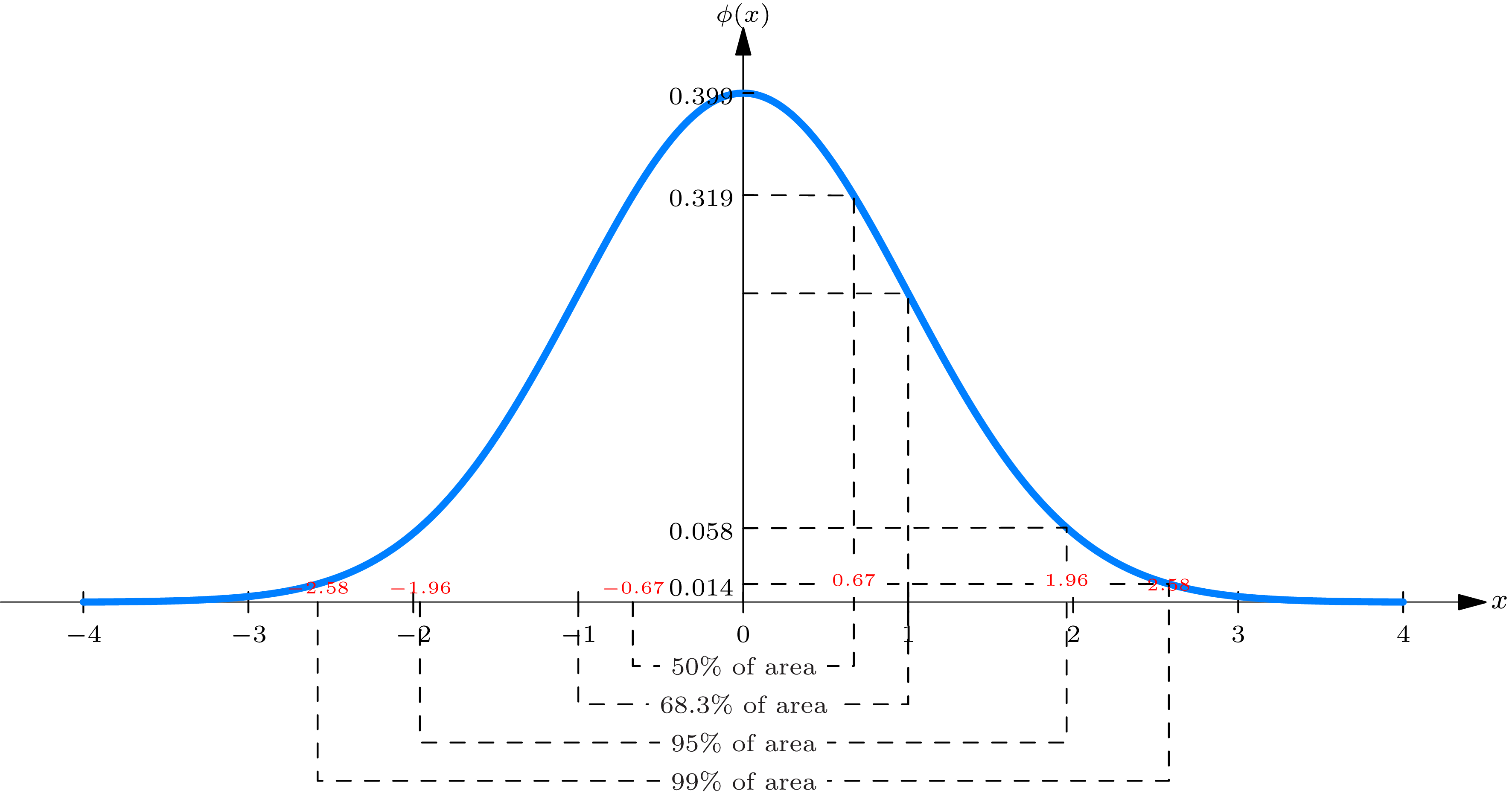
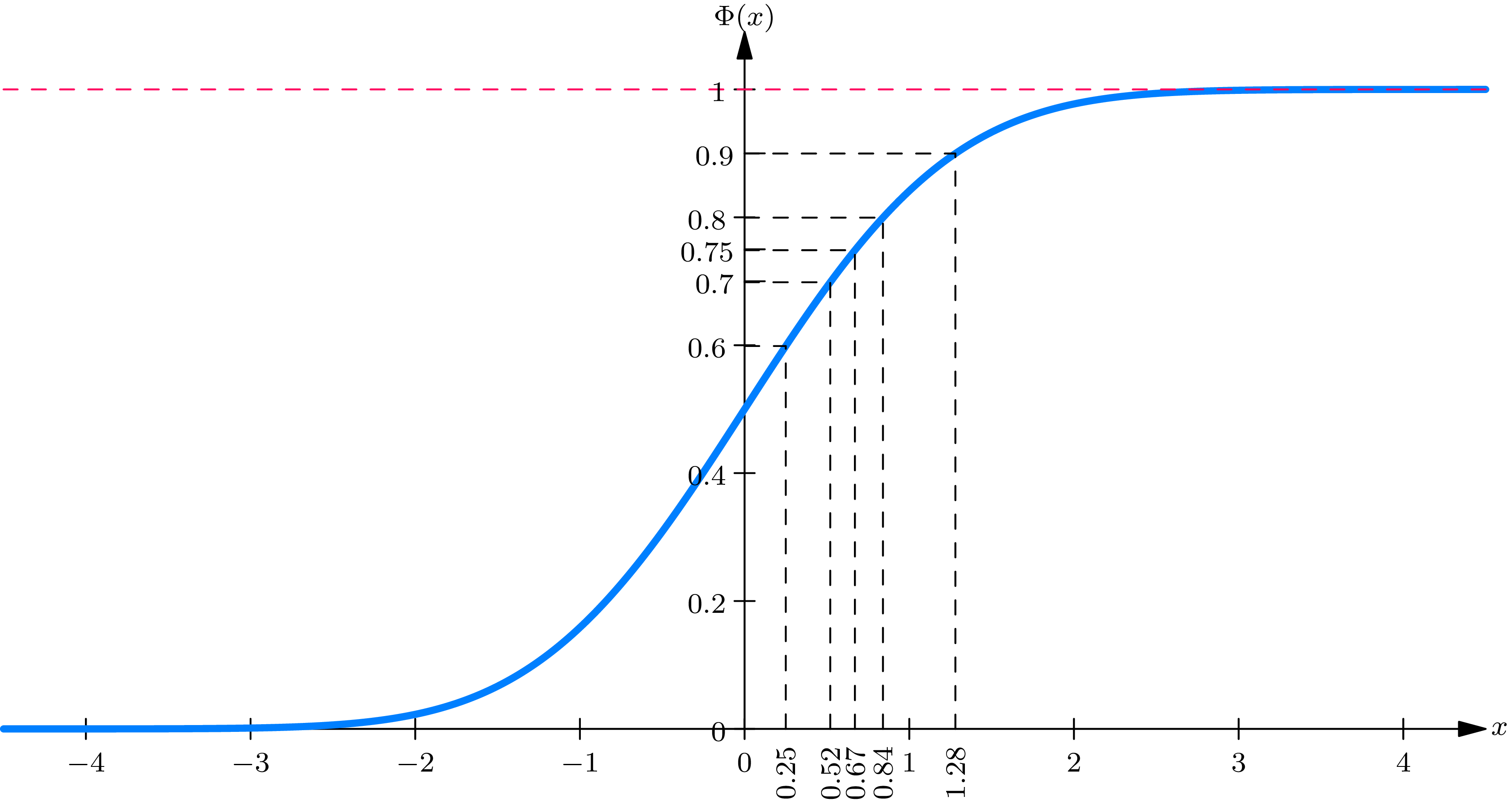
A table of for positive values of is given in Table I .
The function is positive for all . Further, from (2.24)
so that is a probability density function.
The importance of the function arises from the fact that probabilities concerning random phenomena obeying a normal probability law with parameters and are easily computed, since they may be expressed in terms of the tabulated function . More precisely, consider a random
phenomenon whose probability law is specified by the probability density function , given by (4.11) . The corresponding distribution function is given by
Consequently, if is an observed value of a numerical valued random phenomenon obeying a normal probability law with parameters and , then for any real numbers and (finite or infinite, in which ),
Example 6A . “Grading on the curve”. The properties of the normal distribution function provide the basis for the system of “grading on the curve” used in assigning final grades in large courses in American universities. Under this system, the letters are used as passing grades. Of the students with passing grades, receive receive receive , and receive . The system is based on the assumption that the score , which each student obtains on the examinations in the course, is an observed value of a numerical valued random phenomenon obeying a normal probability law with parameters and (which the instructor can estimate, given the scores of many students). From (6.7) it follows that
Therefore, if one assigns the letter to a student whose score is greater than , one would expect 0.1587 (approximately ) of the students to receive a grade . Similarly, 0.3413 (approximately ) of the students receive a grade of if is assigned to a student with a score between and ; approximately receive if is assigned to a student with a score between and ; and approximately receive if is assigned to a student with a score less than .
The following example illustrates the use of (6.7) in solving problems involving random phenomena obeying normal probability laws.
Example 6B . Consider a random phenomenon obeying the normal probability law with parameters and . The probability that an observed value of the random phenomenon will have a value between 0 and 3 is given by
the probability that an observed value of the random phenomenon will have a value between -1 and 1 is given by
The conditional probability that an observed value of the random phenomenon will have a value between -1 and 1, given that it has a value between 0 and 3, is given by
Theoretical Exercises
6.1 . One of the properties of the normal density functions which make them convenient to work with mathematically is the following identity. Verify algebraically that for any real numbers , and (among which and are positive)
where
6.2 . Although it is not possible to obtain an explicit formula for the normal distribution function , in terms of more familiar functions, it is possible to obtain various inequalities on . Show the following inequality, which is particularly useful for large values of : for any
Hint: Use the fact that .
Exercises
6.1 . Let be the observed value of a numerical valued random phenomenon obeying a normal probability law with parameters (i) and , (ii) and . For in define and so that
Find and for .
Answer
| 0.05 | 0.10 | 0.50 | 0.90 | 0.95 | 0.99 | |
| 1.645 | 1.282 | 0.000 | -1.282 | -1.645 | -2.326 | |
| 0.063 | 0.126 | 0.675 | 1.645 | 1.960 | 2.576 | |
| 3.290 | 2.564 | 0.000 | -2.564 | -3.290 | -4.652 | |
| 0.126 | 0.252 | 1.350 | 3.290 | 3.920 | 5.152 |
6.2 . Suppose that the life in hours of a electronic tube manufactured by a certain process is normally distributed with parameters hours and . What is the maximum allowable value for , if the life of a tube is to have probability 0.80 of being between 120 and 200 hours?
6.3 . Assume that the height in centimeters of a man aged 21 is a random phenomenon obeying a normal probability law with parameters and . What is the conditional probability that the height of a man aged 21 will be greater than 170 centimeters, given that it is greater than 160 centimeters?
Answer
.
6.4 . A shirt manufacturer determines by observation that the circumference of the neck of a college man is a random phenomenon approximately obeying a normal probability law with parameters inches and inches. For the purpose of determining how many shirts of a manufacturer’s total production should have various collar sizes, compute for each of the sizes (measured in inches), 14, 14.25, 14.50, 14.75, 15.00, , and 16.00, the probability that a college man will wear a shirt collar of the given size, assuming that his collar size is the smallest size more than of an inch larger than the circumference of his neck.
6.5 . A machine produces bolts in a length (in inches) found to obey a normal probability law with parameters and . The specifications for the bolt call for items with a length (in inches) equal to . A bolt not meeting these specifications is called defective.
(i) What is the probability that a bolt produced by this machine will be defective?
(ii) If the machine were adjusted so that the length of bolts produced by it is normally distributed with parameters and , what is the probability that a bolt produced by the machine will be defective? (iii) If the machine is adjusted so that the lengths of bolts produced by it are normally distributed with parameters and , what is the probability a bolt produced by the machine will be defective?
Answer
(i), (ii) 0.2866; (iii) 0.0456.
6.6 . Let
Tabulate and for . Compare these functions with and , by plotting and on one graph and and on a second graph.
6.7 . Tabulate Give a probabilistic meaning to .
Answer
.