分布函数
To describe completely a numerical-valued random phenomenon, one needs only to state its probability function. The probability function is a function of sets and for this reason is somewhat unwieldy to treat analytically. It would be preferable if there were a function of points (that is, a function of real numbers ), which would suffice to determine completely the probability function. In the case of a probability function, specified by a probability density function or by a probability mass function, the density and mass functions provide a point function that determines the probability function. Now it may be shown that for any numerical valued random phenomenon whatsoever there exists a point function, called the distribution function, which suffices to determine the probability function in the sense that the probability function may be reconstructed from the distribution function. The distribution function (often referred to as the cumulative distribution function or CDF ) thus provides a point function that contains all the information necessary to describe the probability properties of the random phenomenon. Consequently, to study the general properties of numerical valued random phenomena without restricting ourselves to those whose probability functions are specified by either a probability density function or by a probability mass function, it suffices to study the general properties of distribution functions.
The (cumulative) distribution function of a numerical valued random phenomenon is defined as having as its value, at any real number , the probability that an observed value of the random phenomenon will be less than or equal to the number . In symbols, for any real number ,
Before discussing the general properties of distribution functions, let us consider the distribution functions of numerical valued random phenomena, whose probability functions are specified by either a probability mass function or a probability density function. If the probability function is specified by a probability mass function , then the corresponding distribution function for any real number is given by
Equation (3.2) follows immediately from (3.1) and (2.7) . If the probability function is specified by a probability density function , then the corresponding distribution function for any real number is given by
Equation (3.3) follows immediately from (3.1) and (2.1) .
We may classify numerical valued random phenomena by classifying their distribution functions . To begin with, consider a random phenomenon whose probability function is specified by its probability mass function, so that its distribution function is given by (3.2) . The graph then appears as it is shown in (Fig. 3A) ; it consists of a sequence of horizontal line segments, each one higher than its predecessor. The points at which one moves from one line to the next are called the jump points of the distribution function ; they occur at all points at which the probability mass function is positive. We define a discrete distribution function as one that is given by a formula of the form of (3.2) , in terms of a probability mass function , or equivalently as one whose graph (Fig. 3A) consists only of jumps and level stretches. The term “discrete” connotes the fact that the numerical valued random phenomenon corresponding to a discrete distribution function could be assigned, as its sample description space, the set consisting of the (at most countably infinite number of) points at which the graph of the distribution function jumps.
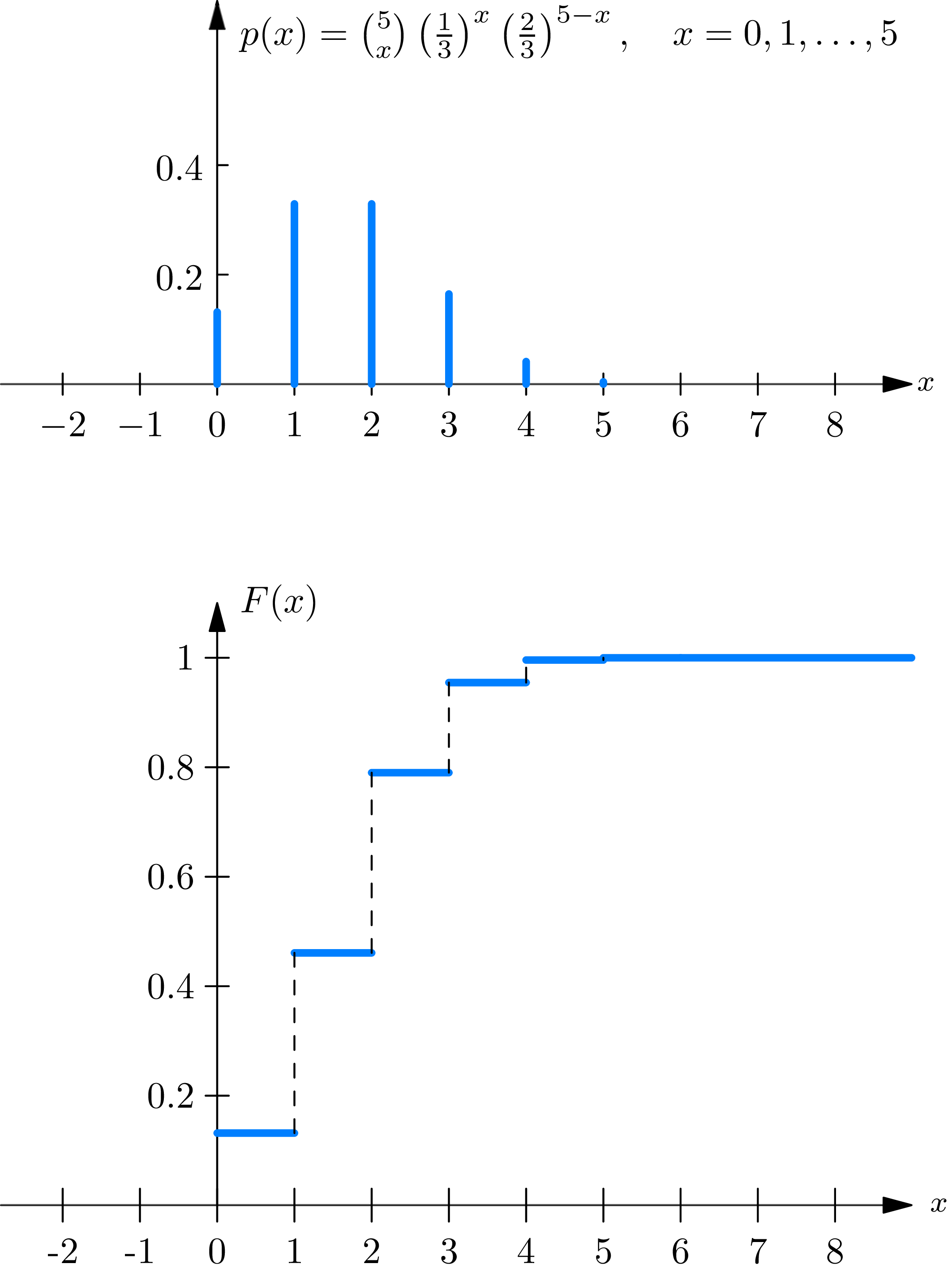
Let us next consider a numerical valued random phenomenon whose probability function is specified by a probability density function, so that its distribution function is given by (3.3) . The graph then appears (Fig. 3B) as an unbroken curve. The function is continuous. However, even more is true; the derivative
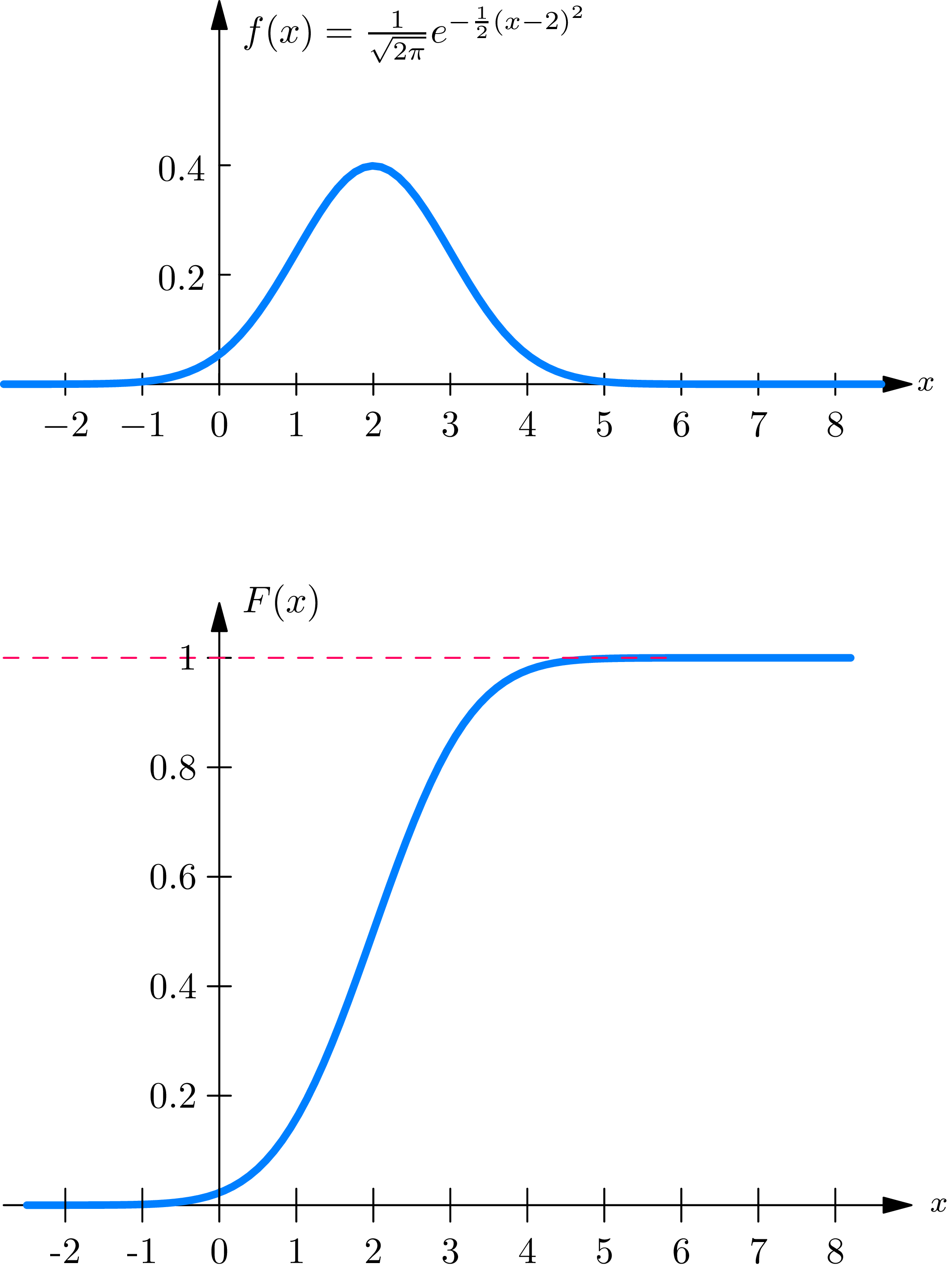
We define a continuous distribution function as one that is given by a formula of the form of (3.3) in terms of a probability density function.
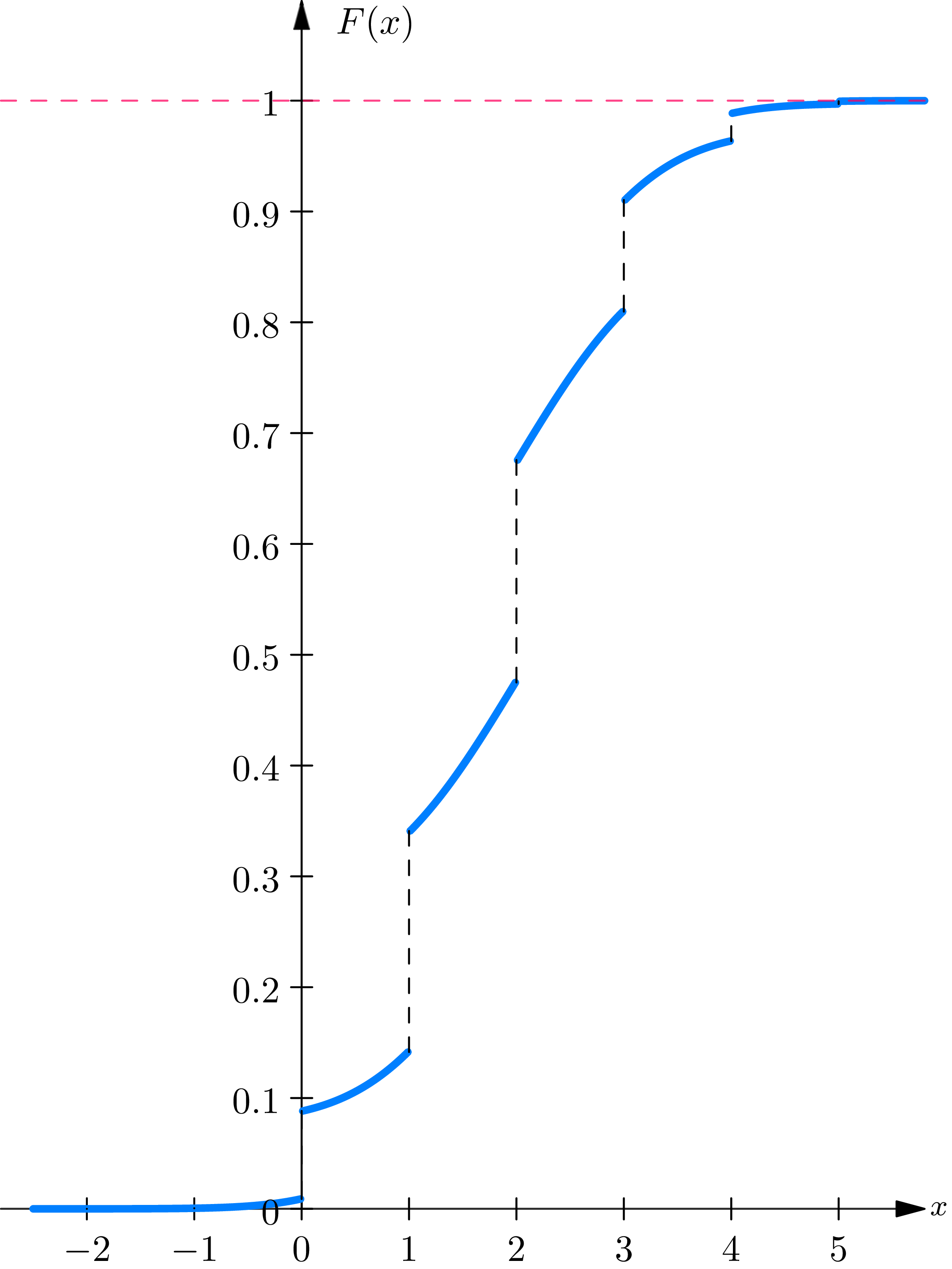
Most of the distribution functions arising in practice are either discrete or continuous. Nevertheless, it is important to realize that there are distribution functions, such as the one whose graph is shown in (Fig. 3C) , that are neither discrete nor continuous. Such distribution functions are called mixed . A distribution function is called mixed if it can be written as a linear combination of two distribution functions, denoted by and , which are discrete and continuous, respectively, in the following way: for any real number
Any numerical valued random phenomenon possesses a probability mass function defined as follows: for any real number
Thus represents the probability that the random phenomenon will have an observed value equal to . In terms of the representation of the probability function as a distribution of a unit mass over the real line, represents the mass (if any) concentrated at the point . It may be shown that represents the size of the jump at in the graph of the distribution function of the numerical valued random phenomenon. Consequently, for all if and only if is continuous.
We now introduce the following notation. Given a numerical valued random phenomenon, we write to denote the observed value of the random phenomenon. For any real numbers and we write to mean the probability that an observed value of the numerical valued random phenomenon lies in the interval to . It is important to keep in mind that represents an informal notation for .
Some writers on probability theory call a number determined by the outcome of a random experiment (as is the observed value of a numerical valued random phenomenon) a random variable. In Chapter 7 we give a rigorous definition of the notion of random variable in terms of the notion of function, and show that the observed value of a numerical valued random phenomenon can be regarded as a random variable. For the present we have the following definition:
quantity is said to be a random variable (or, equivalently, is said to be an observed value of a numerical valued random phenomenon) if for every real number there exists a probability (which we denote by ) that is less than or equal to .
Given an observed value of a numerical valued random phenomenon with distribution function and probability mass function , we have the following formulas for any real numbers and (in which ):
The use of (3.7) in solving probability problems posed in terms of distribution functions is illustrated in example 3A.
Example 3A . Suppose that the duration in minutes of long distance telephone calls made from a certain city is found to be a random phenomenon, with a probability function specified by the distribution function , given by
Solution
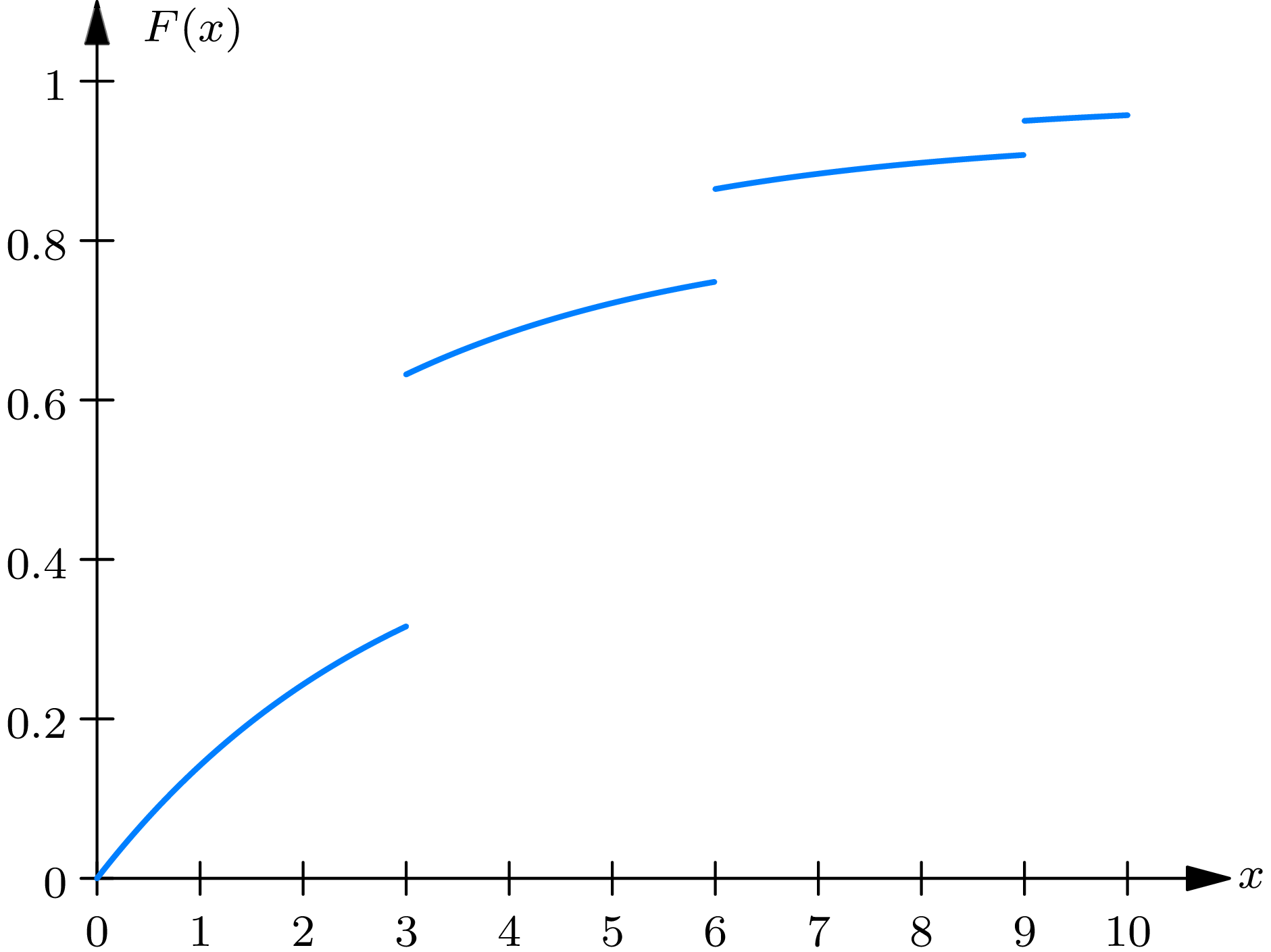
The distribution function given by (3.9) is neither continuous nor discrete but mixed. Its graph is given in (Fig. 3D) . For the sake of brevity, we write for the duration in minutes of a telephone call and as an abbreviation in mathematical symbols of the verbal statement “the probability that a telephone call has a duration strictly greater than six minutes”. The intuitive statement is identified in our model with
观测到的通话时长等于3的概率由下式给出
在第2节中,我们给出了一个函数必须满足的条件,才能成为概率密度函数或概率质量函数。自然会产生一个问题:一个函数必须满足什么条件才能成为分布函数。在概率论的高级研究中表明,一个函数要成为分布函数必须具备以下性质:(i) 必须是非递减的,即对于任意实数和,
(ii) 当趋于正无穷或负无穷时的极限必须存在,并由下式给出
(iii) 在任意点处,右极限(定义为当通过大于的值趋于时的极限)必须等于,
由这些事实可知,一个典型分布函数的图形以直线和为其渐近线。该图形是非递减的。然而,它不需要在每一点都增加,而可以在某些区间上保持水平(平坦)。该图形不需要在所有点都连续[即不需要连续],但至多有可数无穷多个点处图形有间断;在这些点处它向上跳跃,并具有右极限和左极限,满足(3.12)和(3.13)。
上述数值随机现象分布函数的数学性质完全刻画了这类函数。可以证明,对于任何具有所列前三个性质的函数,存在唯一的集函数,定义在实直线的Borel集上,满足第1节的公理以及条件:对于任意有限实数和,其中,
分布函数连续这一事实并不意味着它可以用概率密度函数通过诸如(3.3)这样的公式来表示。如果可以这样表示,则称其为绝对连续。还存在另一种连续分布函数,称为奇异连续,其导数几乎处处为零。这是一个较难想象的概念,例子只能通过相当复杂的分析运算来构造。从实际角度来看,我们可以认为奇异分布函数不存在,因为这类函数的例子在实践中即使有也极少遇到。可以证明,任何分布函数都可以表示为如下形式
理论练习
3.1。证明一个数值随机现象的概率质量函数最多只能在可数无穷多个点处为正。
提示:对于,定义为使得的点的集合。的大小小于,因为如果它大于,则会推出。因此每个集合都是有限大小的。现在,使得的点的集合等于并集 ,因为当且仅当对于某个整数,有。集合作为可数个有限大小集合的并集,因此被证明至多有可数无穷多个成员。
练习
3.1-3.7。对于,练习要求画出练习中给出的每个概率密度函数或概率质量函数所对应的分布函数的草图。
3.8。在“奇数人出局”游戏(描述见第3章第3节)中,如果有5名玩家,则结束游戏所需的试验次数是一个数值随机现象,其概率函数由分布函数指定,给出为
(i) 画出分布函数的草图。
(ii) 该分布函数是离散的吗?如果是,给出其概率质量函数的公式。
(iii) 结束游戏所需的试验次数为(a)大于,(b)小于,(c)等于,(d)介于2和5之间(含)的概率是多少?
(iv) 在给定试验次数大于3次的条件下,结束游戏所需的试验次数(a)大于5次的条件概率是多少?在给定试验次数大于5次的条件下,大于3次的条件概率是多少?
3.9。假设某社会群体中一个人储蓄的金额(以美元计)被发现是一个随机现象,其概率函数由分布函数指定,给出为
注意负的储蓄金额代表债务。
(i) 画出分布函数的草图。
(ii) 该分布函数是连续的吗?如果是,给出其概率密度函数的公式。
(iii) 该群体中一个人拥有的储蓄金额为(a)大于50美元,小于-50美元,介于-50美元和50美元之间,等于50美元的概率是多少?(iv) 在给定储蓄金额大于50美元的条件下,该群体中一个人拥有的储蓄金额(a)小于100美元的条件概率是多少?(b)在给定储蓄金额小于100美元的条件下,大于美元的条件概率是多少?
答案
(ii) ;(iii) (a), (b) 0.184, (c) 0.632, (d) 0;(iv) (a) ,(b) 。
3.10。假设从某个城市打出的长途电话的通话时长(以分钟计)被发现是一个随机现象,其概率函数由分布函数指定,给出为
(i) 画出分布函数的草图。
(ii) 该分布函数是连续的吗?离散的?还是两者都不是?
(iii) 一个长途电话的通话时长(以分钟计)为(a)大于6分钟,小于4分钟,(c)等于3分钟,介于4和7分钟之间的概率是多少?
(iv) 在给定通话已持续超过5分钟的条件下,该长途电话的通话时长(a)小于9分钟的条件概率是多少?在给定通话已持续超过15分钟的条件下,小于9分钟的条件概率是多少?
3.11。假设一名男子在某个地铁站等车的时间(以分钟计)被发现是一个随机现象,其概率函数由分布函数指定,给出为
(i) 画出分布函数的草图。
(ii) 该分布函数是连续的吗?如果是,给出其概率密度函数的公式。
(iii) 该男子等车的时间为(a)大于3分钟,小于3分钟,(c)介于1和3分钟之间的概率是多少?
(iv) 在给定等车时间大于1分钟的条件下,该男子等车的时间(a)大于3分钟的条件概率是多少?(b)在给定等车时间大于1分钟的条件下,小于3分钟的条件概率是多少?
答案
(ii) 对于,;对于,=;其他情况;(iii) (a) ,(b) ,(c) ;(iv) (a) 。
3.12。考虑一个具有如下分布函数的数值随机现象
在给定该随机现象的观测值介于1和6之间(含)的条件下,其介于2和5之间的条件概率是多少?