Table of Contents
37.1 LECTURE
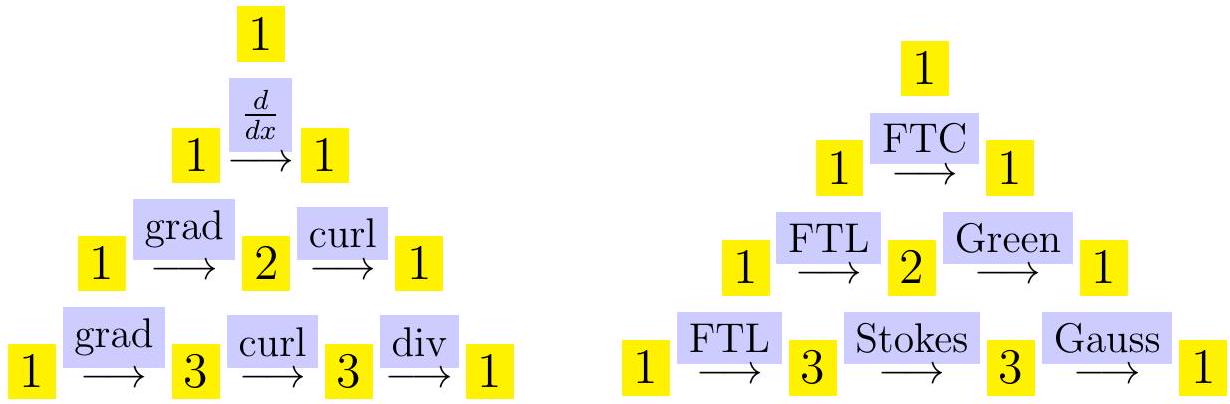
37.1.1 Classifying Integral Theorems by Dimension
The Integral theorems deal with geometries and fields . Integration pairs them in the form of Stokes theorem which involves the boundary of and the exterior derivative of . One can classify the theorems by looking at the dimension of the underlying space and the dimension of the object . In dimension , there are theorems:
37.1.2 Gradient and Line Integrals
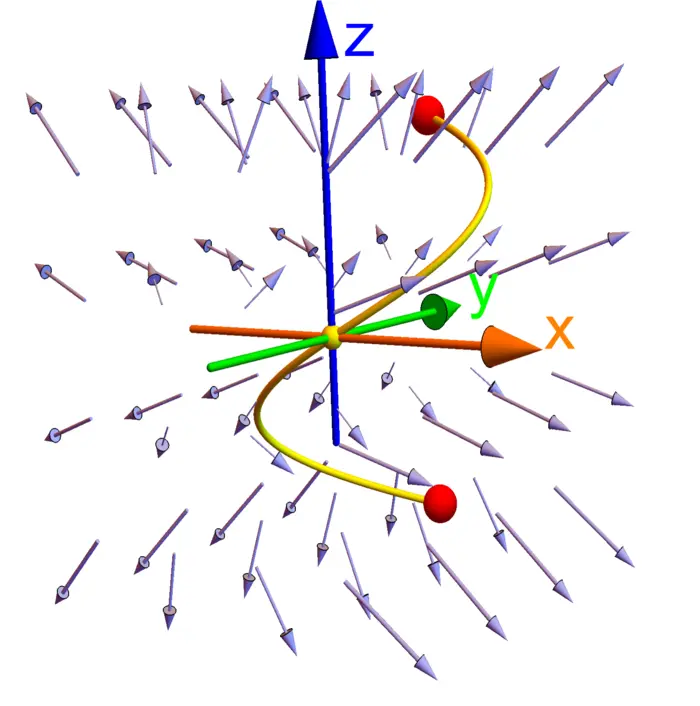
The Fundamental theorem of line integrals is a theorem about the gradient . It tells that if is a curve going from to and is a function (that is a -form), then
Theorem 1. .
In calculus we write the -form as a column vector field . It actually is a -form , a field which attaches a row vector to every point. If the -form is evaluated at r^{\prime}(t) one gets d f(r(t))(r^{\prime}(t)) which is the matrix product. We integrate then the pull back of the -form on the interval . It is the switch from row vectors to column vectors which leads to the dot product \nabla f(r(t)) \cdot r^{\prime}(t). For closed curves, the line integral is zero. It follows also that integration is path independent.
37.1.3 Curls and Line Integrals: Green’s Connection
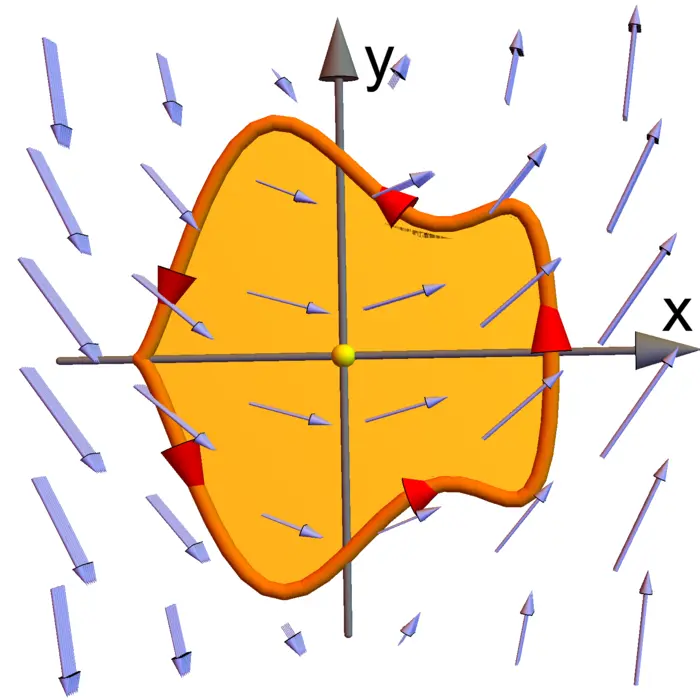
Green’s theorem tells that if is a region bound by a curve having to the left, then
Theorem 2. .
In the language of forms, is a -form and \begin{aligned} d F&=(P_{x} \,d x+P_{y} \,d y) \,d x+(Q_{x} \,d x+Q_{y} \,d y) \,d y\\ &=(Q_{x}-P_{y}) \,d x \,d y \end{aligned} is a -form. We write this -form as and treat it as a scalar function even so this is not the same as a -form, which is a scalar function. If everywhere in then is a gradient field.
37.1.4 Surfaces and Line Integrals
Stokes theorem tells that if is a surface with boundary oriented to have to the left and is a vector field, then
Theorem 3. .
In the general frame work, the field is a -form and the -form \begin{aligned} d F&=(P_{x} \,d x+P_{y} \,d y+P_{z} \,d z) \,d x\\ &\quad +(Q_{x} \,d x+Q_{y} \,d y+Q_{z} \,d z) \,d y\\ &\quad +(R_{x} \,d x+R_{y} \,d y+R_{z} \,d z) \,d z\\ &=(Q_{x}-P_{y}) \,d x \,d y+(R_{y}-Q_{z}) \,d y \,d z+(P_{z}-R_{x}) \,d z \,d x \end{aligned} is written as a column vector field To understand the flux integral, we need to see what a bilinear form like does on the pair of vectors , . In the case we have which is the third component of the cross product with . Integrating over is the same as integrating the dot product of . Stokes theorem implies that the flux of the curl of only depends on the boundary of . In particular, the flux of the curl through a closed surface is zero because the boundary is empty.
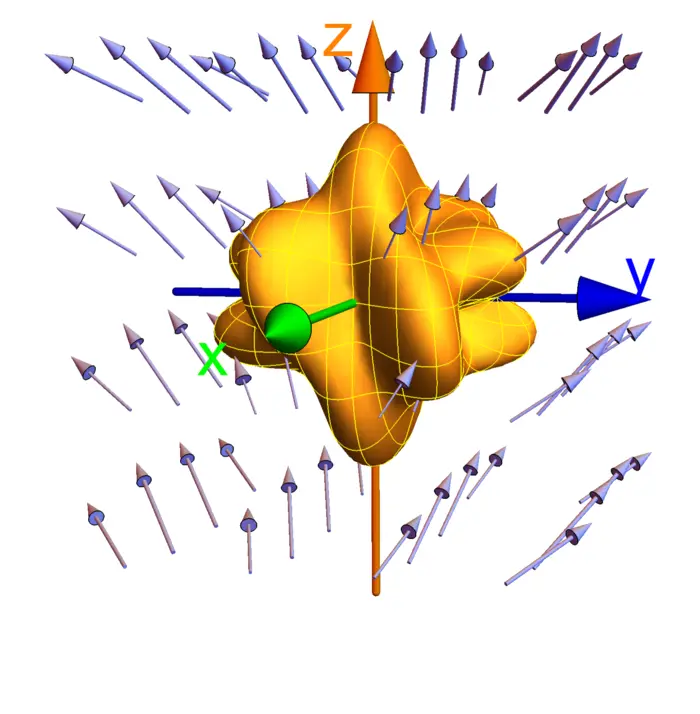
37.1.5 Gauss Theorem: Sources, Sinks, and the Big Picture
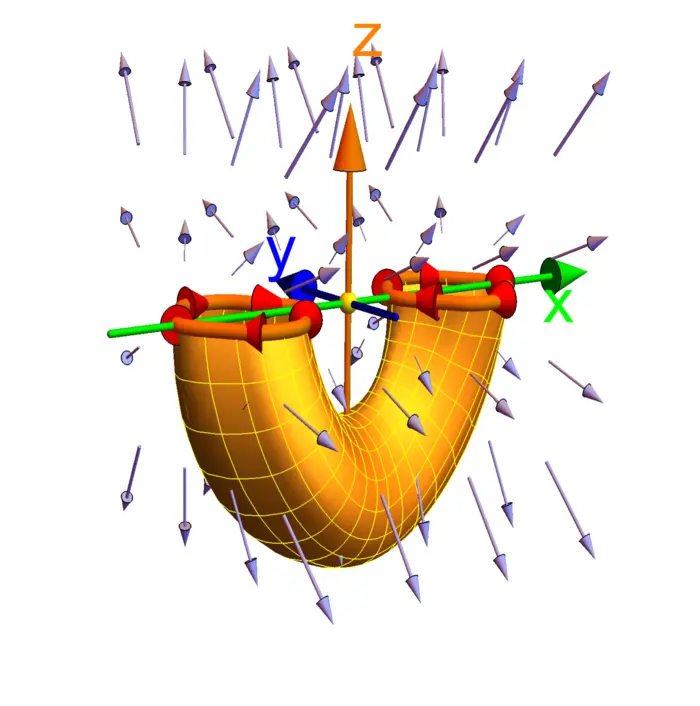
Gauss theorem: if the surface bounds a solid in space, is oriented outwards, and is a vector field, then
Theorem 4. .
Gauss theorem deals with a -form but because a -form has three components, we can write it as a vector field . We have computed \begin{aligned} d F&=(P_{x} \,d x+P_{y} \,d y+Q_{z} \,d z) \,d y \,d z\\ &\quad +(Q_{x} \,d x+Q_{y} \,d y+Q_{z} \,d z) \,d z \,d x\\ &\quad +(R_{x} \,d x+R_{y} \,d y+R_{z} \,d z) \,d x \,d y, \end{aligned} where only the terms survive which we associate again with the scalar function . The integral of a -form over a -solid is the usual triple integral. For a divergence free vector field , the flux through a closed surface is zero. Divergence-free fields are also called incompressible or source free.
37.2 REMARKS
37.2.1 Triplet Trouble: Tensor Types Collide in 3D
We see why the -dimensional case looks confusing at first. We have three theorems which look very different. This type of confusion is common in science: we put things in the same bucket which actually are different: it is only in dimensions that -forms and -forms can be identified. Actually, more is mixed up: not only are -forms and -forms identified, they are also written as vector fields which are tensor fields. From the tensor calculus point of view, we identify the three spaces While we can still always identify vector fields with -forms, this identification in a general non-flat space will depend on the metric. In , the -forms have dimension and can no more be written as a vector. One still does. The electro-magnetic is a -form in which we write as a pair of two time-dependent vector fields, the electric field and the magnetic field .
37.2.2 Hilbert Space Harmonization: Merging Geometries and Fields
Geometries and fields are remarkably similar. On geometries, the boundary operation satisfies . On fields the derivative operation satisfies . "Geometries" as well as "fields" come with an orientation: The operations and look different because calculus deals with smooth things like curves or surfaces leading to generalized functions. In quantum calculus they are thickened up and , defined without limit. Fields and geometries then become indistinguishable elements in a Hilbert space. The exterior derivative has as an adjoint which is the boundary operator. It is a kind of quantum field theory as generates while destroys a "particle". is a "Pauli exclusion".
37.2.3 Dual Forms and Jacobians: A Manifold-Field Marriage
We can spin this further: a -manifold is the image of a parametrization . The Jacobian is a dual -form, the exterior product of the vectors up to (think of column vectors attached to ). If we take a map and look at , we can think of it as a -form (think of row vectors attached to each point in ). The map defines Jacobian , while the Jacobian is the matrix. Cauchy-Binet shows that the flux of through is the integral If , then this is a geometric functional. So: geometries can come from maps from a space to a space , while fields can come from maps from to . The action integral generalizes the Polyakov action a case where and are dual meaning .
37.3 PROTOTYPE EXAMPLES
Example 1. Problem: Compute the line integral of along the path from to .
Solution: The field is a gradient field with . We have \begin{aligned} A=r(0)=(0,0,0), \quad B=r(2 \pi)=(0,0,4), \quad f(A)=1, \quad f(B)=4^{7}. \end{aligned} The fundamental theorem of line integrals gives
Example 2. Problem: Find the line integral of the vector field along the cardioid , where runs from to .
Solution: We use Green’s theorem. Since , the line integral is the double integral We integrate in polar coordinates and get which is . One can short cut by noticing that by symmetry , so that the integral is times the area of the cardioid.
Example 3. Problem: Compute the line integral of along the polygonal path connecting the points , , , .
Solution: The path bounds a surface parameterized on By Stokes theorem, the line integral is equal to the flux of through . The normal vector of is so that \begin{aligned} \iint_{S} \operatorname{curl}(F) \cdot d S&=\int_{0}^{2} \int_{0}^{1}[0,0,-u] \cdot[0,0,1] \,d v \,d u\\ &=\int_{0}^{2} \int_{0}^{1}-u \,d v \,d u\\ &=-2. \end{aligned}
Example 4. Problem: Compute the flux of the vector field through the boundary of the rectangular box Solution: By the Gauss theorem, the flux is equal to the triple integral of over the box:
