
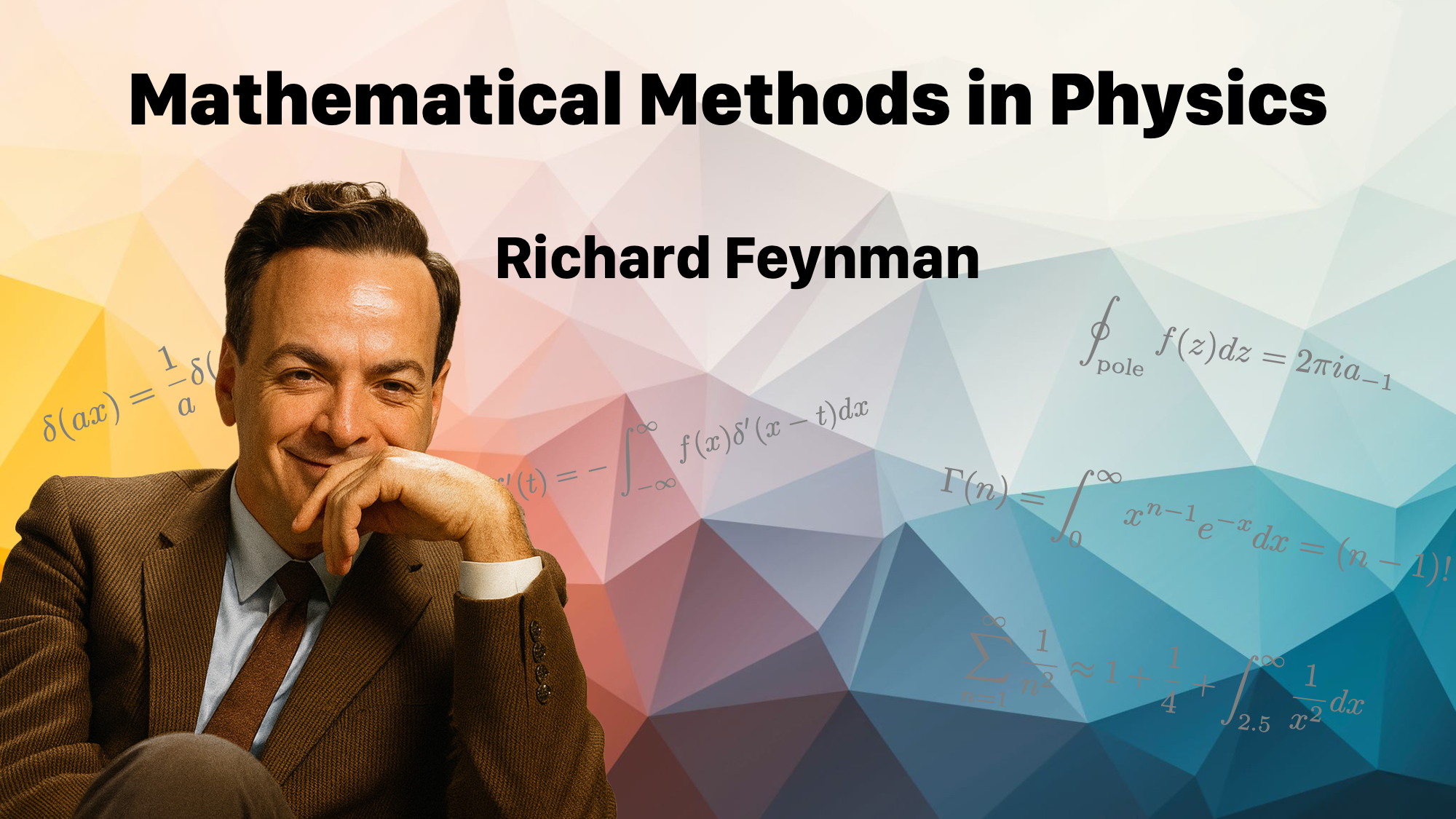
About this book
This collection of notes outlines a fast-paced, practical, and problem-oriented course on the mathematical methods essential for a physicist. True to Feynman's style, the focus is on intuitive understanding and application rather than rigorous proof. The course serves as a "physicist's toolkit" for solving a wide range of real-world problems.
The key topics covered include:
- Solving Equations: The course begins with practical, numerical methods for solving complex equations, including trial-and-error (interpolation), fixed-point iteration, and Newton's method. This immediately sets a tone of hands-on problem-solving.
- Series and Summation: Feynman covers the manipulation of power series, including methods for finding their sum by differentiation and integration. He also introduces clever approximation techniques, like replacing the "tail" of a slowly converging series with an integral (Integral Approximation).
- Advanced Integration Techniques: A significant portion of the course is dedicated to advanced methods for solving definite integrals, a common task in physics. Key techniques include:
- Differentiation under the integral sign (the "Feynman trick").
- Using complex numbers and contour integration to solve real integrals, including the calculation of residues at poles and handling branch points.
- Numerical Integration methods like the Trapezoidal Rule and Simpson's Rule, which were essential in the pre-computer era.
- Essential Functions and Concepts for Physics:
- The Dirac Delta Function: Introduced as a practical tool for representing point sources or impulses, with the classic Feynman justification: "The only justification we give for this is that it gives the correct answer."
- Special Functions: The course is a tour of the "greatest hits" of special functions, explaining where they come from and how to use them:
- Gamma and Beta Functions: Including the Stirling approximation for factorials.
- Bessel Functions: Presented as solutions to problems with cylindrical symmetry (e.g., vibrating drum heads, wave guides).
- Legendre Polynomials: Presented as solutions to problems with spherical symmetry (e.g., potential theory, cavity resonators).
- Elliptic, Error, and Sine/Cosine Integrals: Introduced as tabulated functions that appear in the solutions to specific physical problems (like diffraction).
- Transform Methods: The final part of the course focuses on the powerful techniques of Fourier and Laplace transforms for solving linear differential equations and analyzing the response of linear systems (like electronic circuits or amplifiers). This section connects the abstract mathematics directly to concepts like impulse response, frequency response, and convolution.
In essence, these notes are a masterclass in how to think about and use mathematics to solve physical problems, emphasizing intuition, a wide variety of techniques, and the practical needs of a working scientist.

Learn Most Efficiently
Through Adaptive Books
Social Media
Copyright © 2026 Avidemia. All right reserved.