Units and Dimensions
1. Why Physical Quantities Need Units
A number by itself almost never describes a physical quantity. If a drawing tells you that a length is 2, you cannot build anything from it. Two meters, two feet, and two hand spans are three different lengths, and only one of them is what the designer meant. The number answers how many, and the unit answers how many of what. Both are part of the answer, and dropping either one makes the statement meaningless.1
The Cost of an Implicit Unit: The Mars Climate Orbiter
In 1999 the Mars Climate Orbiter was lost because one team supplied thrust impulse data in pound-force seconds while the receiving software expected newton seconds. The numbers were right. The units were not communicated, and a $125 million spacecraft entered the Martian atmosphere at the wrong altitude.
2. Standardizing the Units
It is not enough for everyone to use units. Everyone must use the same units, defined the same way. When an engineer in Boston specifies a shaft of mass 4.5 kg, a supplier in Osaka must understand exactly the same mass.2
The push for a single worldwide system led to the Metre Convention of 1875 and eventually, in 1960, to the International System of Units, abbreviated SI from the French Système International d'Unités.
Evolution of defined units from physical objects to definition based on nature's constants
The first standards were physical objects. A platinum-iridium bar held near Paris was the meter, and a platinum-iridium cylinder kept beside it was the kilogram. Every national laboratory received a certified copy, and every instrument in every factory was traceable, through a chain of comparisons, back to those two artifacts.

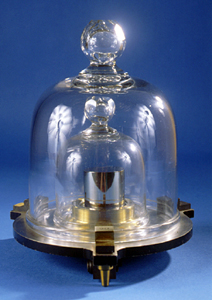
Artifacts have an unavoidable flaw. They change. Metal expands with temperature, absorbs contaminants from the air, and loses a little material every time it is handled or cleaned. Over a century the international prototype kilogram and its official copies drifted apart from one another by several tens of micrograms. Worse, there was no way to tell which one had drifted, because the prototype defined the kilogram and so was, by construction, always exactly right.
The solution was to stop defining units by objects and start defining them by constants of nature, which do not age. The transition happened one unit at a time:
- 1960: the meter was redefined in terms of the wavelength of a krypton-86 emission line, retiring the platinum-iridium bar.
- 1967: the second was redefined by the hyperfine transition frequency of the cesium-133 atom.
- 1983: the meter was redefined again, this time by fixing the speed of light at exactly . One meter is therefore the distance light travels in vacuum in of a second.
- 2019: the kilogram, the last unit still tied to a physical artifact, was redefined by fixing the Planck constant at exactly . The ampere, kelvin, and mole were redefined in the same revision.
Since May 20, 2019, every SI unit is defined by a fixed numerical value of a physical constant. The practical consequence for you is that the definitions no longer change, and a measurement made in any properly equipped laboratory in the world is comparable to any other.
3. The Seven Base Quantities
There are thousands of physical quantities, and defining a separate independent standard for each one would be impossible to maintain and impossible to keep mutually consistent. Scientists recognized long ago that this is unnecessary. Every physical and chemical quantity can be expressed in terms of just seven base quantities, with all remaining quantities following from physical laws that relate them.
| Base quantity | Quantity symbol | Dimension symbol | SI base unit | Unit symbol |
|---|---|---|---|---|
| Length | meter | m | ||
| Mass | kilogram | kg | ||
| Time | second | s | ||
| Thermodynamic temperature | kelvin | K | ||
| Electric current | ampere | A | ||
| Amount of substance | mole | mol | ||
| Luminous intensity | candela | cd |
In mechanics we work almost entirely with length, mass, and time, and we add temperature when thermal effects enter. The last three rows belong to electrical engineering, chemistry, and photometry.
A note on typography
Following the international standard ISO 80000-1, dimension symbols are set in upright sans-serif capitals, , , , , , , , while symbols for physical quantities are set in italic. The distinction is not decoration. In a single chapter may denote a period, a temperature, a torque, or a kinetic energy, whereas always means the dimension of time. Likewise is the dimension of electric current, while is usually the second moment of area. Train your eye on the difference now and a great deal of later confusion disappears.
You will find older textbooks, especially in structural and mechanical engineering, that treat force rather than mass as a base dimension and write dimensions in an , , system. That choice is not wrong, and it was once convenient because engineers measure force with a scale far more often than they measure mass directly. It is no longer standard, and it interacts badly with the pound, as Section 9 explains. This book uses the , , , system throughout.
SI Prefixes
Rather than inventing new unit names for very large and very small values, SI attaches a prefix to an existing unit. The prefix multiplies the unit by a power of ten. The ones you will actually use are:
| Prefix | Symbol | Factor | Prefix | Symbol | Factor |
|---|---|---|---|---|---|
| tera | T | centi | c | ||
| giga | G | milli | m | ||
| mega | M | micro | |||
| kilo | k | nano | n | ||
| pico | p |
Three prefixes dominate engineering practice. Stresses (force divided by area) are quoted in MPa or GPa, dimensions on drawings in mm, and structural loads in kN. The complete list runs from quetta () to quecto (), the four outermost prefixes having been added by the General Conference on Weights and Measures in November 2022. See the NIST table of SI prefixes for the full set.
Two rules are worth memorizing now.
- First, prefixes do not stack: write nanometer, never millimicrometer.
- Second, the kilogram is the only base unit whose name already contains a prefix, so additional prefixes attach to the gram, not the kilogram. One millionth of a kilogram is a milligram (mg), not a microkilogram.
4. Dimension Versus Unit
The dimension of a quantity records which base quantities it is built from, and in what powers. Writing for "the dimension of ," every mechanical quantity has the form
\bbox[8px, #E6F0FA, border: 3px solid #0066CC]{\dim Q = \mathsf{M}^{a}\,\mathsf{L}^{b}\,\mathsf{T}^{c}\,\mathsf{\Theta}^{d}}where the exponents are fixed rational numbers, determined by the physics.
Some books write in place of ; the two notations mean the same thing, and we use here.
Do not confuse dimension with unit. Dimension is what kind of quantity it is; unit is the particular standard used to measure it. A length has dimension whether you report it in meters, feet, or light-years. The dimension is a property of the quantity itself. The unit is a human choice.
Once the dimension of a quantity is known, its SI unit follows immediately by replacing each base dimension with its base unit.
Area. Area is a length times a length, so and the unit is .
Volume. Volume is a length times a length times a length, so and the unit is .
Velocity. From ,
Acceleration. From ,
Force. From Newton's second law ,
This combination occurs so often that it is given a name, the newton, and a symbol, N. So
which is the force that accelerates one kilogram at one meter per second squared.
Work. From for a constant force along the direction of motion,
This unit is named the joule, symbol J.
Kinetic energy. From , and noting that the factor is a pure number with no dimension,
Energy and work come out with the same dimension, as they must, since work is a transfer of energy. This is a useful check on the whole framework: quantities that are physically interchangeable must be dimensionally identical.
Power. Power is work per unit time, , so
Table of Common Derived Quantities
| Quantity | Defining relation | Dimension | SI unit | Special name |
|---|---|---|---|---|
| Area | ||||
| Volume | ||||
| Velocity | ||||
| Acceleration | ||||
| Angular velocity | ||||
| Frequency | hertz (Hz) | |||
| Density | ||||
| Momentum | ||||
| Force | newton (N) | |||
| Moment, torque | ||||
| Pressure, stress | pascal (Pa) | |||
| Work, energy | joule (J) | |||
| Power | watt (W) | |||
| Dynamic viscosity | ( is shear stress and is velocity) |
Units of Moment and Energy:
Notice that torque and energy share the dimension , yet they are completely different physical quantities: one is a vector-like turning effect, the other a scalar. Because of this, SI convention reserves the name joule for energy and always writes torque as . Equal dimensions do not imply equal physics. The converse, however, does hold, and that is the content of Section 6.
The full list of SI derived units with special names is given in the BIPM SI Brochure and, in a more compact form, on the NIST SI units page.
5. Units Outside SI That Survive in Practice
SI is the reference system, but a number of non-SI units remain in daily use because they are convenient, entrenched, or both. You should be able to recognize and convert them.
| Quantity | Unit | Equivalent |
|---|---|---|
| Temperature | degree Celsius (C) | ; a difference of C equals K |
| Energy | electronvolt (eV) | J |
| Energy | calorie (cal) | J |
| Energy | British thermal unit (Btu) | J |
| Power | horsepower (hp) | W |
| Pressure | bar | Pa |
| Pressure | atmosphere (atm) | Pa |
| Volume | liter (L) | |
| Time | hour (h) | s |
| Mass | tonne (t) | kg |
The Celsius scale deserves particular care. Celsius and kelvin degrees are the same size, so temperature differences convert one-to-one, but the two scales have different zeros. In any formula containing an absolute temperature, such as the ideal gas law , you must use kelvin. Substituting Celsius there is a common and expensive error.
6. The Principle of Dimensional Homogeneity
Principle of dimensional homogeneity. Every term in a physically valid equation must have the same dimension.
The reasoning is simple. You cannot add a length to a mass any more than you can add three apples to four Tuesdays. If an equation says , then , , and must all be the same kind of quantity, so
Two corollaries follow, and both are used constantly:
- Arguments of transcendental functions must be dimensionless. In , , , and , the argument carries no dimension, and neither does the result. You can see why from the series : for those terms to be addable, must be a pure number. So in , the constant must have dimension .
- Both sides of an equation must have the same dimension. This gives you a free error check on every result you derive.
Checking a kinematic formula. Verify the dimensional consistency of .
Solution
All three terms have dimension , so the equation is homogeneous. Note that the dimensionless factor 2 plays no role.
Catching an Error Using Dimensional Homogeneity
A student writes the steady, incompressible Bernoulli equation along a streamline as:
where:
- is static pressure (force per unit area)
- is fluid mass density (mass per unit volume)
- is flow speed (length per unit time)
- is acceleration due to gravity (length per unit time squared)
- is elevation above a reference plane (length)
- is a constant along the streamline
Use dimensional analysis to verify whether this equation is physically plausible. If an error exists, identify the inconsistent term and determine its correct dependence on elevation .
Solution
By the principle of dimensional homogeneity, every additive term in a physically meaningful equation must possess identical dimensions.
First, determine the fundamental dimensions of the individual physical quantities in terms of mass (), length (), and time ():
Pressure ():
Density ():
Velocity ():
Gravitational acceleration ():
Elevation ():
Next, evaluate the dimension of each additive term in the proposed equation:
Static pressure term:
Dynamic pressure term:
(The dimensionless factor carries no units and does not affect the dimension.)
Hydrostatic/potential term:
Comparing the three terms shows that the third term fails dimensional homogeneity:
To reconcile the dimension of the hydrostatic term with pressure (), the power of length contributed by elevation must be reduced by one order. Replacing with :
The corrected Bernoulli equation is:
Dimensional homogeneity pinpoints the algebraic error directly without requiring the derivation of the governing Navier–Stokes or Euler equations.
Example: Deducing the Period of a Simple Pendulum via Dimensional Analysis
Problem
Assume that the period of oscillation of a simple pendulum depends only on the length of the cord , the mass of the bob , and the acceleration due to gravity .
Express this relationship as a power law of the form:
where is an undetermined dimensionless constant. Using dimensional analysis, determine the exponents , , and , and deduce the functional form of the period.
Solution
State the fundamental dimensions of each variable in the mass-length-time (––) system:
- Period:
- Length:
- Mass:
- Gravitational acceleration:
Substitute these dimensions into the proposed relationship (noting that ):
Equating the exponents of fundamental dimensions on both sides yields three algebraic equations:
- Mass ():
- Time ():
- Length ():
Substituting , , and back into the assumed power law yields:
While dimensional analysis cannot determine the numerical constant (which small-angle dynamics establishes as ), it reveals two key physical insights without solving the governing differential equation:
- The period is directly proportional to .
- The period is completely independent of the bob mass ().
This is a preview of a much more powerful method. Homogeneity is a checking tool, used after the fact to catch errors. The same principle can be turned around and used as a predictive tool, one that extracts the form of an unknown physical relationship, reduces the number of experiments needed to characterize a system, and tells an engineer how to scale results from a small model to a full-size structure.
Working Rules for Writing Units
Units carry meaning, so they follow a grammar:
- Leave a space between the number and the unit: , not . The exception is the degree symbol for angles, as in .
- Unit symbols are never pluralized and take no period: , not or
- Unit symbols derived from a person's name are capitalized (N, Pa, J, W, K, A), but the spelled-out name is not (newton, pascal, joule, watt, kelvin, ampere).
- Write K, not K. The degree sign was dropped from the kelvin in 1967.
- Use at most one solidus in a compound unit, or none at all: or , never .
- Carry units through the entire calculation rather than restoring them at the end. Treating units as algebraic factors that cancel is the surest way to catch a mistake early.
7. The US Customary System
The US Customary System (USCS) is the system of feet, pounds, and seconds still in everyday use in the United States. Its units descend from the English units of the colonial period.
US Customary System vs Imperial System
It is often called "the imperial system," and that name is not quite right. The British Imperial system was defined by an Act of Parliament in 1824, after the United States had already standardized on the older English units. The two systems therefore diverged, and they still differ for some quantities. A US gallon is 3.785 L; an imperial gallon is 4.546 L. A US fluid ounce and an imperial fluid ounce are also different. For length, mass, and force the two agree, because of an international treaty described below, but it is safer to call the American system US customary and reserve imperial for the British one.
USCS units are defined in terms of SI units
One point often surprises students: since the International Yard and Pound Agreement of 1959, USCS units are themselves defined in terms of SI units. By international agreement,
So there is no competing physical standard for the foot or the pound. There is one system of standards, SI, and USCS is a set of conversion factors on top of it.
Metrication
Metrication: Why the US and Other Nations Use Mixed Unit Systems
Through the twentieth century most countries converted to SI. Many were moving from the older cgs system (centimeter, gram, second) or from national metric variants, so the change was a rescaling rather than a conceptual break.
The United Kingdom and Canada converted only partially. Both use SI officially, yet British road signs give distances in miles and speeds in miles per hour, beer is sold in pints, and body weight is commonly quoted in stones. Canadian road signs are metric while lumber, plumbing fittings, and much construction practice remain in inches and feet, largely because of trade with the United States.
In the United States, SI has been legal since 1866 and preferred for federal agencies since 1988, but it never displaced USCS in daily life. The outcome is a split along industry lines. Scientific research, pharmaceuticals, medicine, the military, and the automotive and aerospace industries have largely moved to SI. Construction, consumer products, and the trades have not. The reason is practical rather than ideological: an entire supply chain is built around the existing sizes. A carpenter asks for a "two by four," a plumber specifies inch pipe, and every tool, fitting, fastener, and building code in the chain is dimensioned to match. Converting one link of that chain in isolation gains nothing and breaks everything.
As an engineer working in the United States you should expect to move between the two systems and should be fluent in both. Carrying units explicitly through every calculation is what makes that safe.
8. Base Units of the USCS
The USCS in engineering is usually set up as a force-length-time system:
| Base quantity | Unit | Symbol |
|---|---|---|
| Force | pound-force | lbf |
| Length | foot | ft |
| Time | second | s |
Mass is then a derived quantity. This is the reverse of SI, where mass is a base quantity and force is derived, and it is exactly the historical situation mentioned in Section 3.
9. Pound-Force, Pound-Mass, and the Slug
This section addresses the single most common source of numerical errors in American engineering practice. Read it slowly.
Where the Trouble Starts
Historically the pound was a unit of mass. It was also used as a unit of weight, meaning the gravitational force on that mass, because a merchant weighing goods on a balance does not care about the distinction. Both usages survive, so the word "pound" now denotes two different quantities:
- pound-mass (lbm): a mass, exactly kg.
- pound-force (lbf): a force, defined as the weight of one pound-mass at standard gravity . Numerically, N.
The definition was chosen so that one pound-mass weighs one pound-force at the Earth's surface. That is convenient at the grocery store and disastrous in Newton's second law. Substituting directly,
The left and right sides are numerically unequal. The set {lbf, lbm, ft, s} is not a consistent set of units, because the unit of force is not equal to (unit of mass) (unit of acceleration). SI has no such problem: the newton was defined as , so holds with no extra factor.
Three Ways Out
Engineers solve this in one of three ways.
Option 1: Introduce a conversion constant . Keep both lbm and lbf and write Newton's second law as
\bbox[8px, #E6F0FA, border: 3px solid #0066CC]{F = \frac{ma}{g_{c}}, \qquad g_{c} = 32.174\ \frac{\mathrm{lbm\cdot ft}}{\mathrm{lbf\cdot s^{2}}}}The constant is a pure unit conversion, dimensionally equivalent to 1 in the same way that is, not a physical quantity, and in particular it is not the local gravitational acceleration even though it shares the number 32.174. You will see this form in thermodynamics and heat transfer texts, where mass flow rates are naturally expressed in lbm/s.
Option 2: Define a consistent mass unit, the slug. Take lbf, ft, and s as the base units and define the mass unit so that works unchanged:
\bbox[8px, #E6F0FA, border: 3px solid #0066CC]{1\ \mathrm{slug} = 1\ \frac{\mathrm{lbf\cdot s^{2}}}{\mathrm{ft}}, \qquad 1\ \mathrm{slug} = 32.174\ \mathrm{lbm} = 14.594\ \mathrm{kg}}A one-slug mass accelerates at under . This is the standard choice in statics, dynamics, and fluid mechanics, and it is the convention this book follows when USCS units are used.
Option 3: Define a consistent force unit, the poundal. Take lbm, ft, and s as base and define N. The poundal is rarely used today and appears mainly in older British texts.
The general rule: {lbf, slug, ft, s} is consistent, and {lbf, lbm, ft, s} is not. In a consistent set you may use directly. In an inconsistent set you must carry .
Weight
For an object of mass at a location where the gravitational acceleration is , the weight is
\bbox[8px, #E6F0FA, border: 3px solid #0066CC]{W = mg \quad \text{(SI and slug-based USCS)}, \qquad W = \frac{mg}{g_{c}} \quad \text{(lbm-based USCS)}}Weight depends on location; mass does not. On the Moon, where , a 70 kg astronaut still has a mass of 70 kg but weighs only 113 N instead of 687 N.
A crate has a mass of 160 lbm. Find
(a) its mass in slugs and in kilograms, and
(b) its weight in lbf at standard gravity and on the Moon, where .
Solution
(a) Converting mass:
(b) On Earth, using the slug value so that applies directly:
The numerical equality of 160 lbm and 160 lbf is exactly what the definition of the pound-force was built to produce, and it is why the two are so easily confused. On the Moon the equality disappears:
The mass is unchanged at 160 lbm. Only the weight has changed.
A 10-kg block.
A steel block has a mass of 10 kg. Find
(a) its weight in newtons,
(b) its mass in pound-mass,
(c) its mass in slugs, and
(d) its weight in pounds-force.
Solution
(a) Weight in newtons. Weight is mass times gravitational acceleration:
(b) Mass in pound-mass. Use the exact definition 1 lbm = 0.45359237 kg:
(c) Mass in slugs. Use 1 slug = 14.594 kg:
Check: 0.6852 slug × 32.174 lbm/slug = 22.05 lbm, which agrees with (b).
(d) Weight in pounds-force. There are two equally good routes.
Route 1, convert the newtons:
Route 2, use in USCS with the mass in slugs:
The two routes agree to rounding. Notice also that the weight in lbf (22.05) is numerically equal to the mass in lbm (22.05), as expected on Earth. That equality is not a law of physics; it is a consequence of how the pound-force was defined.
Summary for the 10-kg block:
| Quantity | SI | USCS |
|---|---|---|
| Mass | 10 kg | 0.685 slug = 22.05 lbm |
| Weight (on Earth) | 98.1 N | 22.05 lbf |
Useful Conversions
| Quantity | Conversion |
|---|---|
| Length | mm (exact); m (exact); km |
| Mass | kg (exact); kg |
| Force | N; kN |
| Pressure | kPa; MPa |
| Energy | J; J |
| Power | W |
| Temperature | ; |
The absolute temperature scale paired with Fahrenheit is the Rankine scale, . Use it wherever an absolute temperature is required in USCS work, just as you would use kelvin in SI.
9. Best Practices for Converting Units
Every conversion in this chapter follows one mechanical rule. Take an equality between units, such as , and rewrite it as a fraction equal to 1:
Multiplying a quantity by 1 does not change it, so you may multiply by either fraction freely. Choose the one that places the old unit in the opposite position from where it sits in the quantity: if the old unit is in the numerator, put it in the denominator of the fraction, and vice versa. The old unit then cancels and the new one remains. Squared or cubed units need the fraction squared or cubed as well.
Speed limit. A highway sign reads 65 mi/h. Express this speed in m/s.
Solution
The mile sits in the numerator, so it goes in the denominator of the first fraction. The hour sits in the denominator, so it goes in the numerator of the last fraction:
Each fraction equals 1, so the physical speed is unchanged. Only its numerical value and unit have been rewritten. The intermediate result, , is the same speed as it would appear on a Canadian sign.
Hydraulic pressure. The gauge on a hydraulic press reads 20 MPa. Express this pressure in ksi.
Solution
The quickest route uses the Useful Conversions table directly:
It is worth seeing where that factor comes from. Write and convert the newton and the meter separately. The meter appears squared in the denominator, so the length fraction must be squared and placed with meters in the numerator:
Both routes agree, as they must.
Tire pressure. A tire gauge reads 32 psi. Express this pressure in pascals.
Solution
Here the old units are lbf in the numerator and in in the denominator, so the force fraction carries lbf below and the squared length fraction carries inches above:
Compare with the table: , the same result to rounding. Notice that this is a gauge reading, so it is the pressure above atmospheric, about 2.2 bar.
Summary
- A physical quantity is a number together with a unit. Only dimensionless quantities such as strain, friction coefficients, and the Reynolds number are exceptions.
- SI defines all units through fixed values of physical constants. Since the 2019 redefinition of the kilogram, no SI unit depends on a physical artifact.
- Seven base quantities (length, mass, time, temperature, electric current, amount of substance, luminous intensity) generate every other quantity through physical laws.
- The dimension of a quantity, written , states what kind of quantity it is. A unit is the particular standard used to measure it. The two are not the same thing.
- Every term in a valid equation has the same dimension, and arguments of transcendental functions are always dimensionless. Use this to check your work on every problem, and see the next section for how the same principle predicts the form of unknown relationships.
- USCS units are defined in terms of SI units. In USCS, use the consistent set {lbf, slug, ft, s} and apply directly, or keep lbm and carry . Never mix lbf and lbm in without .
References
- Bureau International des Poids et Mesures, The International System of Units (SI), 9th edition, 2019. https://www.bipm.org/en/publications/si-brochure
- NIST, Guide for the Use of the International System of Units (SI), Special Publication 811. https://www.nist.gov/pml/special-publication-811
- NIST, SI Units and Prefixes reference tables. https://physics.nist.gov/cuu/Units/units.html and https://physics.nist.gov/cuu/Units/prefixes.html
- NIST, The International System of Units (SI), Special Publication 330, 2019 edition. https://nvlpubs.nist.gov/nistpubs/SpecialPublications/NIST.SP.330-2019.pdf
Footnotes
-
A small number of quantities are genuinely dimensionless and carry no unit. Ratios of two quantities of the same kind fall in this class: strain (length per length), Poisson's ratio (a material property that quantifies the proportional contraction in width relative to the extension in length), the coefficient of friction ( in relating the static friction force to the normal force, with equality at impending slip), and specific gravity. So do the named groups you will meet in fluid mechanics and heat transfer, such as the Reynolds, Mach, Prandtl, and Nusselt numbers. Plane angle is a special case. The radian is defined as a ratio of arc length to radius, so it is dimensionless, yet we still write "rad" to make clear that an angle, and not some other pure number, is intended. Counts behave the same way: the number of bolts in a flange is 12, not 12 of anything. ↩
-
Be careful with everyday language here. In casual speech people say "my weight is 70 kilograms," but the kilogram is a unit of mass, not weight. Weight is the gravitational force on an object, so its SI unit is the newton. A 70 kg person weighs about 687 N at the Earth's surface. ↩