Chapter Summary (Express)
Since an arc on any curve is made up of a lot of little bits of straight lines joined end to end, we can find the length of the arc by adding the lengths of all these little bits using integration.
Since an arc on any curve is made up of a lot of little bits of straight lines joined end to end, if we could add all these little bits, we would get the length of the arc. But we have seen that to add a lot of little bits together is precisely what is called integration, so that it is likely that, since we know how to integrate, we can find also the length of an arc on any curve, provided that the equation of the curve is such that it lend itself to integration.
If is an arc on any curve, the length of which is required (see Fig. 22.1), if we call “a little bit” of the are , then we see at once that or either
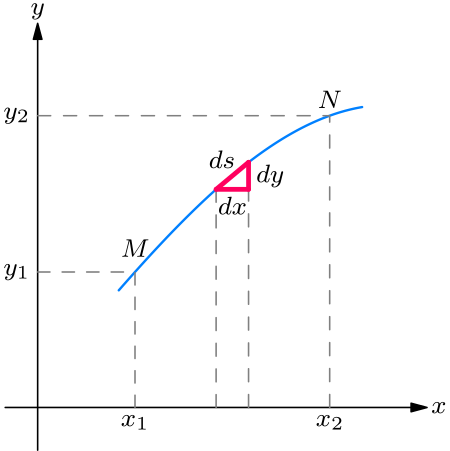
Now the arc is made up of the sum of all the little bits between and , that is, between and , or between and , so that we get either
That is all!
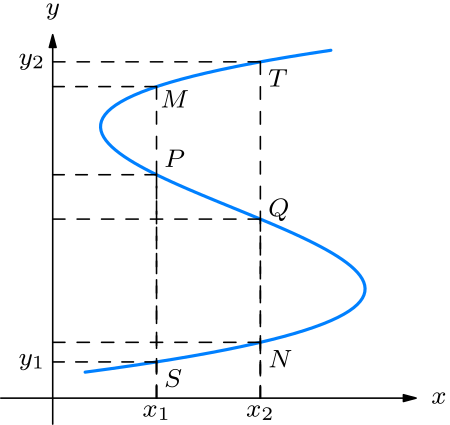
The integral is useful when there are several points of the curve corresponding to the given values of (as in Fig. 22.2). In this case the integral between and leaves a doubt as to the exact portion of the curve, the length of which is required.
The second integral is useful when there are several points of the curve corresponding to the given values of (as in Fig. 22.2). In this case the integral between and leaves a doubt as to the exact portion of the curve, the length of which is required. It may be , instead of , , or , by integrating between and the uncertainty is removed, and in this case one should use the second integral.
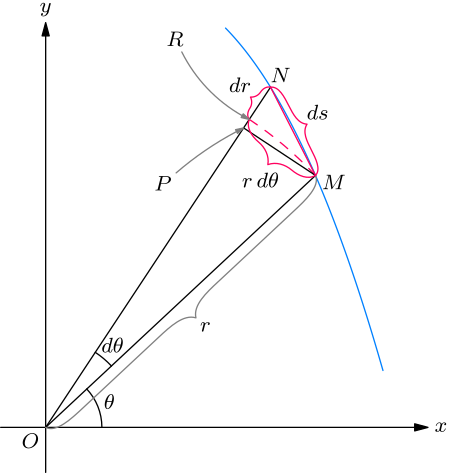
If instead of and coordinates (or Cartesian coordinates), we have and coordinates (or polar coordinates), and if if is a small arc of length on any curve, the length of which is required (see Fig. 22.3), we can write Dividing by we get ; hence hence, since the length is made up of the sum of all the little bits , between values of and we have
If instead of and coordinates,—or Cartesian coordinates, as they are named from the French mathematician Descartes, who invented them—we have and coordinates (or polar coordinates); then, if be a small arc of length on any curve, the length of which is required (see Fig. 22.3), being the pole, then the distance will generally differ from by a small amount . If the small angle is called , then, the polar coordinates of the point being and , those of are and . Let be perpendicular to , and let ; then , and this is very nearly the same as , as long as is a very small angle. Also , and is very nearly equal to , and the arc is very nearly equal to the chord . In fact we can write , and arc chord without appreciable error, so that we have: Dividing by we get ; hence hence, since the length is made up of the sum of all the little bits , between values of and we have
We can proceed at once to work out a few examples.
Example 22.1. The equation of a circle, the centre of which is at the origin—or intersection of the axis of with the axis of —is ; find the length of an arc of one quadrant.
Solution
and so that hence and since ,
The length we want—one quadrant—extends from a point for which to another point for which . We express this by writing
or, more simply, by writing the 0 and to the right of the sign of integration merely meaning that the integration is only to be performed on a portion of the curve, namely that between , as we have seen.
Here is a fresh integral for you! Can you manage it?
Previously, we have differentiated (also denoted by ) and found . If you have tried all sorts of variations of the given examples (as you ought to have done!), you perhaps tried to differentiate something like , which gave that is, just the same expression as the one we have to integrate here.
Hence being a constant.
As the integration is only to be made between and , we write
proceeding then as previously explained, we get or since is and is zero, and the constant disappears, as has been shown.
The length of the quadrant is therefore , and the length of the circumference, being four times this, is .
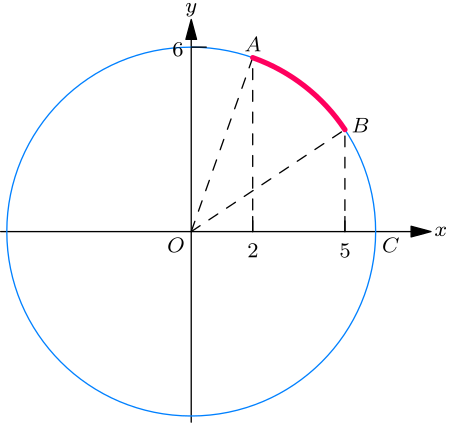
Example 22.2. Find the length of the arc between and , in the circumference (see the following figure).
Solution
Here, proceeding as in previous example,
\[\begin{align} s & =\left[r \arcsin \left(\frac{x}{r}\right)+C\right]_{x_{1}}^{x_{2}}=\left[6 \arcsin \left(\frac{x}{6}\right)+C\right]_{2}^{5} \\ & =6\left[\arcsin \left(\frac{5}{6}\right)-\arcsin \left(\frac{2}{6}\right)\right]\\ &=6(0.985111-0.339837) \\ & =3.87164 \text { units of length (the arcs being expressed in radians). } \end{align}\]/p>
It is always well to check results obtained by a new and yet unfamiliar method. This is easy, for hence and
Therefore, the length of the arc is units of length.
[Recall that the length of a circular arc = arc angle (measured in radians) circle radius.]
A slight discrepancy between the results obtained from the two methods may occur if the result of each calculation is not recorded with sufficient decimal places.
Example 22.3. Find the length of an arc of the curve
between and . (This curve is the catenary.)
Solution
\[\begin{align} y & =\frac{a}{2} e^{\frac{x}{a}}+\frac{a}{2} e^{-\frac{x}{a}}, \quad \frac{d y}{d x}=\frac{1}{2}\left(e^{\frac{x}{a}}-e^{-\frac{x}{a}}\right), \\ s & =\int \sqrt{1+\frac{1}{4}\left(e^{\frac{x}{a}}-e^{-\frac{x}{a}}\right)^{2}} d x \\ & =\frac{1}{2} \int \sqrt{4+e^{\frac{2 x}{a}}+e^{-\frac{2 x}{a}}-2 e^{\frac{x}{a}-\frac{x}{a}}} \, dx . \end{align}\]Now so that we can replace 2 by ; then \[\begin{align} s & =\frac{1}{2} \int \sqrt{e^{\frac{2 x}{a}}+2 e^{\frac{x}{a}-\frac{x}{a}}+e^{-\frac{2 x}{a}}} d x \\ & =\frac{1}{2} \int \sqrt{\left(e^{\frac{x}{a}}+e^{-\frac{x}{a}}\right)^{2}} d x\\ &=\frac{1}{2} \int\left(e^{\frac{x}{a}}+e^{-\frac{x}{a}}\right)\, d x \\ & =\frac{1}{2} \int e^{\frac{x}{a}} d x+\frac{1}{2} \int e^{-\frac{x}{a}} d x=\frac{a}{2}\left[e^{\frac{x}{a}}-e^{-\frac{x}{a}}\right] . \end{align}\]Here , and
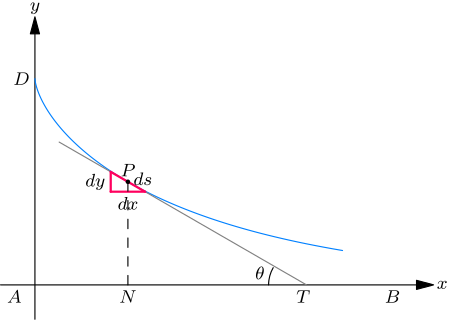
Example 22.4. A curve is such that the length of the tangent at any point (see the following figure) from to the intersection of the tangent with a fixed line is a constant length . Find an expression for an arc of this curve,- which is called the tractrix,-and find the length, when , between the ordinates and .
Solution
We shall take the fixed line for the axis of . The point , with , is a point on the curve, which must be tangent to at . We take as the axis of ; and are what are called axes of symmetry, that is the curve is symmetrical about them; .
If we consider a small portion of the curve, at , then (minus because the curve slopes downwards to the right, see here).
Hence that is When , so that and .
It follows that When , between and is therefore \[\begin{align} s&=3\left[\ln \frac{3}{y}\right]_{1}^{3}=3\left(\ln 1-\ln 3\right) =3 \times(0-1.0986) \\ & =-3.296 \text { or } 3.296, \end{align}\]as the sign refers merely to the direction in which the length was measured, from to , or from to .
Note that this result has been obtained without a knowledge of the equation of the curve. This is sometimes possible. In order to get the length of an arc between two points given by their abscissae (i.e. their -value), however, it is necessary to know the equation of the curve: this is easily obtained as follows: hence
The integration will give us a relation between and , which is the equation of the curve
To integrate let or . Then and the integral becomes \[\begin{align} -\int \frac{\sqrt{a^{2}-y^{2}}\, dy}{y}&=-\int \frac{1}{u y}\left(-\frac{u}{y} du\right)\\ &=\int \frac{u^2}{a^2-u^2}du=-\int\frac{u^2}{u^2-a^2}du\\ &=-\int \frac{(u^2-a^2)+a^2}{u^2-a^2}du\\ &=-\int \left[1+\frac{a^2}{u^2-a^2}\right]du \end{align}\]Since we can rewrite the integral as \[\begin{align} \int \left[-1+\frac{a}{2(u+a)}-\frac{a}{2(u-a)}\right]du&=u+\frac{a}{2}\ln|u+a|-\frac{a}{2}\ln|u-a|+C\\ &=-u+\frac{a}{2}\ln\left|\frac{u+a}{u-a}\right|+C\\ &=-u+\frac{a}{2}\ln\left|\frac{(u+a)(u+a)}{(u-a)(u+a)}\right|+C\\ &=-u+\frac{a}{2}\ln\left|\frac{(u+a)^2}{u^2-a^2}\right|+C\\ &=-u+a\ln\left|\frac{u+a}{\sqrt{u^2-a^2}}\right|+C\\ &=-\sqrt{a^2-y^2}+a\ln\frac{\sqrt{a^2-y^2}+a}{y}+C. && (y>0) \end{align}\]The equation of the tractrix is therefore
If , as before, and if the length of the arc from to is required, it is not an easy matter to calculate the value of corresponding to any given numerical value of . It is, however, easy to find graphically an approximation as near the correct value as we desire, when we are given the value of as follows:
Plot the graph, giving suitable values to , say 3, . From this graph, find what values of correspond to the two given values of determining the arc, the length of which is needed, as accurately is the scale of the graph allows. For of course; suppose that for you find on the graph. This is only approximate. Now plot again, on as large a scale as possible, taking only three values of , , , . On this second graph, which is nearly, but not quite a straight line, you will be probably able to read any value of correct to three places of decimals, and this is sufficient for our purpose. We find from the graph that corresponds to . Then
\[\begin{align} s&=3\left[\ln \frac{3}{y}\right]_{x=0}^{x=1} =3\left[\ln \frac{3}{y}\right]_{3}^{1 \cdot 723} \\ & =3\left(\ln 1.741-0\right)=1.66 . \end{align}\]/p>
If we wanted a more accurate value of we could plot a third graph, taking for values of 1.722, 1.723, this would give us, correct to five places of decimals, the value of corresponding to , and so on, till the required accuracy is reached.
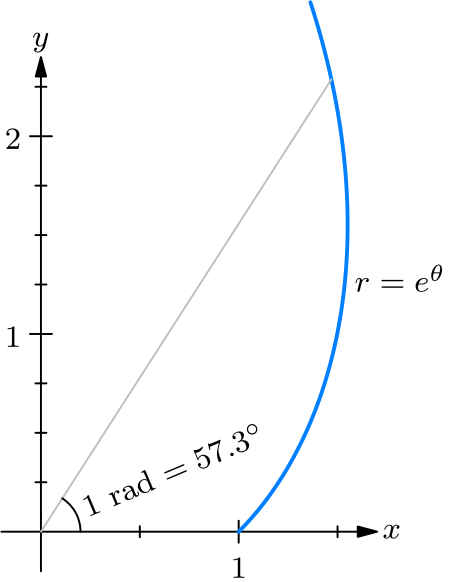
Example 22.5. Find the length of an arc of the logarithmic spiral between and radian (see the following figure).
Solution
Do you remember differentiating It is an easy one to remember, for it remains always the same whatever is done to it: (see here).
Here, since .
If we reverse the process and integrate we get back to , the constant being always introduced by such a process, as we have seen in the chapter on integration.
It follows that
\[\begin{align} s & =\int \sqrt{r^{2}+\left(\frac{d r}{d \theta}\right)^{2}} d \theta=\int \sqrt{r^{2}+r^{2}} d \theta \\ & =\sqrt{2} \int r\, d \theta=\sqrt{2} \int e^{\theta}\, d \theta=\sqrt{2}\left(e^{\theta}+C\right) . \end{align}\]/p>
Integrating between the two given values and , we get
\[\begin{align} s & =\int_{0}^{1} \sqrt{r^{2}+\left(\frac{d r}{d \theta}\right)^{2}} d \theta=\left[\sqrt{2}\left(e^{\theta}+C\right)\right]_{0}^{1} \\ & =\sqrt{2}\, e^{1}-\sqrt{2}\, e^{0}=\sqrt{2}(e-1) \\ & =1.41 \times 1.713=2.42 \text { units of length, } \end{align}\]since when .
Example 22.6. Find the length of an arc of the logarithmic spiral between and .
Solution
As we have just seen,
Example 22.7. As a last example let us work fully a case leading to a typical integration which will be found useful for several of the exercises found at the end of this chapter. Let us find the expression for the length of an arc of the curve .
Solution
Integrate this by parts: let then by the method of differentiation explained previously.
Since (see here), we have \int \sqrt{1+a^{2} x^{2}}\ d x=x \sqrt{1+a^{2} x^{2}}-a^{2} \int \frac{x^{2}\ d x}{\sqrt{1+a^{2} x^{2}}}.\tag{1}
Also, we can write hence \int \sqrt{1+a^{2} x^{2}}\ d x=\int \frac{d x}{\sqrt{1+a^{2} x^{2}}}+a^2 \int \frac{x^{2}\ dx}{\sqrt{1+a^{2} x^{2}}}.\tag{2}
Adding (1) and (2) we get
2 \int \sqrt{1+a^{2} x^{2}} d x=x \sqrt{1+a^{2} x^{2}}+\int \frac{d x}{\sqrt{1+a^{2} x^{2}}}.\tag{3}
Remains to integrate ; for this purpose let 1 then
Differentiating this, to get rid of the constant, we get, that is replacing in we obtain hence
Replacing in (3) and dividing by 2 we get, finally, \[\begin{align} s =\int \sqrt{1+a^{2} x^{2}} d x =\frac{x}{2} \sqrt{1+a^{2} x^{2}}+\frac{1}{2 a} \ln\left(a x+\sqrt{1+a^{2} x^{2}}\right), \end{align}\]which can easily be calculated between any given limits.
You ought now to be able to attempt with success the following exercises. You will find it interesting as well as instructive to plot the curves and verify your results by measurement where possible.
The integration is usually of the kind shown in Example 20.5, Example 20.6, or Example 22.7.
Exercises
Exercise 22.1. Find the length of the line between the two points for which and .
Answer
.
Solution
\[\begin{align} y & =3 x+2 \Rightarrow \frac{d y}{d x}=3 \\ s & =\int_{1}^{4} \sqrt{1+\left(\frac{d y}{d x}\right)^{2}} d x \\ & =\int_{1}^{4} \sqrt{1+3^{2}} d x \\ & =\sqrt{10} \int_{1}^{4} d x \\ & =\sqrt{10}[x]_{1}^{4}=\sqrt{10}(4-1) \\ & =3 \sqrt{10} . \end{align}\]/p>
Checking the answer:
When
When
\[\begin{align} \text { Arc length } & =\sqrt{(14-5)^{2}+(4-1)^{2}}=\sqrt{9^{2}+3^{2}} \\ & =\sqrt{90}=\sqrt{9} \sqrt{10}=3 \sqrt{10} . \end{align}\]/p>
Exercise 22.2. Find the length of the line between the two points for which and .
Answer
Solution
\[\begin{align} s & =\int_{-1}^{a^{2}} \sqrt{1+\left(\frac{d y}{d x}\right)^{2}} d x \\ & =\int_{-1}^{a^{2}} \sqrt{1+a^{2}} d x \\ & =\sqrt{1+a^{2}}\big[x\big]_{x=-1}^{x=a^{2}} \\ & =\sqrt{1+a^{2}}\left(a^{2}+1\right) \\ & =\left(1+a^{2}\right)^{\frac{3}{2}} \end{align}\]/p>
Exercise 22.3. Find the length of the curve between the two points for which and .
Answer
.
Solution
\[\begin{align} s & =\int_{0}^{1} \sqrt{1+\left(\frac{d y}{d x}\right)^{2}} d x \\ & =\int_{0}^{1} \sqrt{1+x} d x \end{align}\]/p>
Let , then
Therefore \[\begin{align} s&=\left[\frac{2}{3}(1+x)^{\frac{3}{2}}\right]_{0}^{1}\\ &=\frac{2}{3}\left(2^{\frac{2}{3}}-1\right)\\ &\approx 1.21895 \end{align}\]/p>
Exercise 22.4. Find the length of the curve between the two points for which and .
Answer
\[\begin{align} \displaystyle s&=\int_{0}^{2} \sqrt{1+4 x^{2}} d x\\ &=\left[\frac{x}{2} \sqrt{1+4 x^{2}}+\frac{1}{4} \ln \left(2 x+\sqrt{1+4 x^2}\right)\right]_{0}^{2}\\ &\approx 4.65 \end{align}\]
Solution
\[\begin{align} s&=\int_{0}^{2} \sqrt{1+\left(\frac{d y}{d x}\right)^{2}}\, dx\\ &=\int_0^2 \sqrt{1+4x^2}\, dx \end{align}\]/p>
In this chapter, we learned that
Here . Therefore
\[\begin{align} s & =\int_{0}^{2} \sqrt{1+4 x^{2}}\, dx \\ & =\left[\frac{x}{2} \sqrt{1+4 x^{2}}+\frac{1}{4} \ln \left(2 x+\sqrt{1+4 x^{2}}\right)\right]_{0}^{2}\\ & =\sqrt{17}+\frac{1}{4} \ln (4+\sqrt{17})-0-\frac{1}{4} \ln 1 \\ & =\sqrt{17}+\frac{1}{4} \ln (4+\sqrt{17}) \\ & \approx 4.64678 \end{align}\]/p>
Exercise 22.5. Find the length of the curve between the two points for which and .
Answer
.
Solution
\[\begin{align} s & =\int_{0}^{\frac{1}{2 m}} \sqrt{1+\left(\frac{d y}{d x}\right)^{2}} d x \\ & =\int_{0}^{\frac{1}{2 m}} \sqrt{1+4 m^{2} x^{2}} d x \end{align}\]/p>
Again, using the formula we get \[\begin{align} s & =\left[\frac{x}{2} \sqrt{1+4 m^{2} x^{2}}+\frac{1}{4 m} \ln \left|2 m x+\sqrt{1+4 m^{2} x^{2}}\right|\right]_{0}^{\frac{1}{2 m}} \\ & =\frac{1}{4 m} \sqrt{1+4 m^{2} \frac{1}{4 m^{2}}}+\frac{1}{4 m} \ln \left(1+\sqrt{1+4 m^{2} \frac{1}{4 m^{2}}}\right)-0 \\ & =\frac{\sqrt{2}}{4 m}+\frac{\ln (1+\sqrt{2})}{4 m} \approx \frac{0.573897}{m} \end{align}\]/p>
Exercise 22.6. Find the length of the curves and between and .
Answer
.
Solution
\[\begin{align} s & =\int_{\theta_{1}}^{\theta_{2}} \sqrt{r^{2}+\left(\frac{d r}{d \theta}\right)^{2}} d \theta \\ & =\int_{\theta_{1}}^{\theta_{2}} \sqrt{a^{2} \cos ^{2} \theta+a^{2} \sin ^{2} \theta} d \theta \\ & =|a| \int_{\theta_{1}}^{\theta_{2}} d \theta \\ & =|a|\left(\theta_{2}-\theta_{1}\right) \end{align}\]/p>
Similarly
\[\begin{align} s & =\int_{\theta_{1}}^{\theta_{2}} \sqrt{r^{2}+\left(\frac{d r}{d \theta}\right)^{2}} d \theta \\ & =\int_{\theta_{1}}^{\theta_{2}} \sqrt{a^{2} \sin ^{2} \theta+a^{2} \cos ^{2} \theta} d \theta \\ & =|a| \int_{\theta_{1}}^{\theta_{2}} d \theta \\ & =|a|\left(\theta_{2}-\theta_{1}\right) \end{align}\]/p>
Exercise 22.7. Find the length of the curve .
Answer
.
Solution
To calculate , we need to differentiate . In one of the exercises of chapter 15, we have differentiated it. However, if you do not recall the result, we can derive it again using the Quotient Rule:
\[\begin{align} \frac{d(\sec \theta)}{d \theta} & =\frac{d}{d \theta}\left(\frac{1}{\cos \theta}\right) \\ & =\frac{0 \times \cos \theta-(-\sin \theta)}{\cos ^{2} \theta} \\ & =\frac{\sin \theta}{\cos ^{2} \theta}=\frac{\sin \theta}{\cos \theta} \frac{1}{\cos \theta} \\ & =\tan \theta \sec \theta \end{align}\]Therefore,
\[\begin{align} & s=\int \sqrt{r^{2}+\left(\frac{d r}{d \theta}\right)^{2}}\ d \theta \\ & =\int \sqrt{a^{2} \sec ^{2} \theta+a^{2} \sec ^{2} \theta \tan ^{2} \theta}\ d \theta \\ & =\int|a \sec \theta| \sqrt{1+\tan ^{2} \theta}\ d \theta \end{align}\]/p>
since
\[\begin{align} s & =\int|a \sec \theta| \sqrt{\sec ^{2} \theta}\,d \theta \\ & =\int a \sec ^{2} \theta\, d\theta \end{align}\]/p>
(suppose )
But , hence
since or
the result may be written as
\[\begin{align} s & =a \sqrt{\sec ^{2} \theta-1} \\ & =\sqrt{a^{2} \sec ^{2} \theta-a^{2}} \\ & =\sqrt{r^{2}-a^{2}} \end{align}\]Here we have assumed .
Remark: Let’s write the equation in polar coordinates. Since , we have Multiplying both sides by (when it is not equal to ) gives But . Therefore, we want to find the length of the vertical line between to . Now we can say that the above formulas make sense.
Exercise 22.8. Find the length of the arc of the curve between and .
Answer
and .
Solution
For this problem, we use the formula
When and when
(We work with the upper branch )
Therefore
Again, since We have
\[\begin{align} s & =\left[\frac{y}{2} \sqrt{1+\frac{y^{2}}{4 a^{2}}}+a \ln \left(\frac{y}{2 a}+\sqrt{1+\frac{y^{2}}{4 a^{2}}}\right)\right]_{0}^{2 a} \\ & =a \sqrt{2}+a \ln (1+\sqrt{2})-a \ln 1 \\ & =a[\sqrt{2}+\ln (1+\sqrt{2})] \approx 2.29559 a \end{align}\]/p>
Exercise 22.9. Find the length of the are of the curve between and .
Answer
and .
Solution
We first differentiate with respect to :
The length of the curve is given by the integral: \[\begin{align} s & =\int_{0}^{4} \sqrt{1+\left(\frac{d y}{d x}\right)^{2}} d x \\ & =\int_{0}^{4} \sqrt{1+(x-1)^{2}} d x \end{align}\]/p>
To evaluate this integral, we make a substitution and apply the following formula:
We substitute and in the above formula:
\[\begin{align} s & =\left[\frac{(x-1)}{2} \sqrt{1+(x-1)^{2}}+\frac{1}{2} \ln \left|(x-1)+\sqrt{1+(x-1)^{2}}\right| \right]_{0}^{4} \\ & =\left[\frac{3}{2} \sqrt{10}+\frac{1}{2} \ln (3+\sqrt{10})\right]-\left[\frac{-1}{2} \sqrt{2}+\frac{1}{2} \ln (-1+\sqrt{2})\right] \\ & \approx 6.80043 \end{align}\]/p>
Exercise 22.10. Find the length of the arc of the curve between and .
(Note. This curve is in rectangular coordinates, and is not the same curve as the logarithmic spiral which is in polar coordinates. The two equations are similar, but the curves are quite different.)
Answer
. Make a substitution to get and .
Solution
Method (a)
\[\begin{align} s & =\int_{0}^{1} \sqrt{1+\left(\frac{d y}{d x}\right)^{2}} d x \\ & =\int_{0}^{1} \sqrt{1+e^{2 x}} d x \end{align}\]/p>
Let or . Then
or
and \[\begin{align} \int \sqrt{1+e^{2 x}} d x & =\int u \frac{u}{e^{2 x}}\ d u \\ & =\int \frac{u^{2}}{u^{2}-1}\ d u \\ & =\int \frac{u^{2}-1+1}{u^{2}-1}\ d u \\ & =\int\left(1+\frac{1}{u^{2}-1}\right)\ du. \end{align}\]/p>
Since We can write
After some manipulations, we get
Hence
\[\begin{align} \int\left(1+\frac{1}{u^{2}-1}\right) d u & =\int\left(1+\frac{1}{2} \frac{1}{u-1}-\frac{1}{2} \frac{1}{u+1}\right) d u \\ & =u+\frac{1}{2} \ln \left|\frac{u-1}{u+1}\right|+C \\ & =\sqrt{1+e^{2 x}}+\frac{1}{2} \ln \frac{\sqrt{1+e^{2 x}}-1}{\sqrt{1+e^{2 x}}+1}+C \end{align}\]and \[\begin{align} s&=\int_{0}^{1} \sqrt{1+e^{2 x}}\ d x\\ &=\left[\sqrt{1+e^{2 x}}+\frac{1}{2} \ln \frac{\sqrt{1+e^{2 x}}-1}{\sqrt{1+e^{2 x}}+1}\right]_{0}^{1} \\ & =\left(\sqrt{1+e^{2}}+\frac{1}{2} \ln \frac{\sqrt{1+e^{2}}-1}{\sqrt{1+e^{2}}+1}\right)-\left(\sqrt{2}+\frac{1}{2} \ln \frac{\sqrt{2}-1}{\sqrt{2}+1}\right) \\ & \approx 2.0035 \end{align}\]/p>
Method (b)
When ,
When , .
Therefore, Make a substitution: then So \[\begin{align} \int \frac{\sqrt{1+y^2}}{y}dy&=\int \frac{u}{y}\frac{u\, du}{y}\\ &=\int \frac{u^2}{y^2} du\\ &=\int \frac{u^2}{u^2-1}du\\ &=\int \frac{u^2-1+1}{u^2-1} du\\ &=\int \left(1+\frac{1}{u^2-1} \right)du \end{align}\]Using partial fractions: Hence \[\begin{align} \int \frac{\sqrt{y^2+1}}{y}dy&=\int \left(1+\frac{1}{u^2-1} \right)du\\ &=\int \left(1+\frac{1}{2(u-1)}-\frac{1}{2(u+1)}\right)du\\ &=u+\frac{1}{2}\ln|u-1|-\frac{1}{2}\ln|u+1|+C\\ &=u+\frac{1}{2}\ln\left|\frac{u-1}{u+1}\right|+C\\ &=\sqrt{1+y^2}+\frac{1}{2}\ln\frac{\sqrt{1+y^2}-1}{\sqrt{1+y^2}+1}+C \end{align}\]/p>
Finally \[\begin{align} s&=\int_1^e \frac{\sqrt{1+y^2}}{y}dy\\ &=\left[\sqrt{1+y^2}+\frac{1}{2}\ln\frac{\sqrt{1+y^2}-1}{\sqrt{1+y^2}+1}\right]_1^e\\ &=\left(\sqrt{1+e^{2}}+\frac{1}{2} \ln \frac{\sqrt{1+e^{2}}-1}{\sqrt{1+e^{2}}+1}\right)-\left(\sqrt{2}+\frac{1}{2} \ln \frac{\sqrt{2}-1}{\sqrt{2}+1}\right) \\ & \approx 2.0035 \end{align}\]as before.
Exercise 22.11. A curve is such that the coordinates of a point on it are and being a certain angle which varies between 0 and . Find the length of the curve. (It is called a cycloid.)
Answer
and .
Solution
We start with
then
and Here \[\begin{align} & x=a(\theta-\sin \theta) \Rightarrow \frac{d x}{d \theta}=a(1-\cos \theta) \\ & y=a(1-\cos \theta) \Rightarrow \frac{d y}{d x}=a \sin \theta \end{align}\]and
\[\begin{align} s & =\int_{0}^{2 \pi} \sqrt{a^{2}(1-\cos \theta)^{2}+a^{2} \sin ^{2} \theta}\ d \theta \\ & =a \int_{0}^{2 \pi} \sqrt{1-2 \cos \theta+\cos ^{2} \theta+\sin ^{2} \theta}\ d \theta \\ & =a \int_{0}^{2 \pi} \sqrt{2} \sqrt{1-\cos \theta} d \theta \end{align}\]/p>
Since , we get
\[\begin{align} s & =a \int_{0}^{2 \pi} \sqrt{2} \sqrt{2 \sin ^{2} \frac{\theta}{2}} d \theta \\ & =2 a \int_{0}^{2 \pi}\left|\sin \frac{\theta}{2}\right| d \theta \end{align}\]/p>
For . Therefore
\[\begin{align} s & =2 a \int_{0}^{2 \pi} \sin \frac{\theta}{2} d \theta \\ & =2 a \int_{0}^{2 \pi} 2 \sin \frac{\theta}{2} d\left(\frac{\theta}{2}\right) \\ & =4 a\left[-\cos \frac{\theta}{2}\right]_{0}^{2 \pi} \\ & =8 a \end{align}\]/p>
Exercise 22.12. Find the length of the curve between the two points for which and .
Answer
.
Solution
\[\begin{align} ds&=\sqrt{(dx)^2+(dy)^2}=\sqrt{\left(\frac{dx}{dy}\right)^2+1}\,dy\\ &=\sqrt{\frac{4}{m^2}y^2+1}\,dy \end{align}\]/p>
When ,
When ,
Hence,
Recall that (see Example 22.7)
Therefore,
and
\[\begin{align} s&=\int_0^\frac{m}{2} \sqrt{\frac{4}{m^2}y^2+1}\,dy\\ &=\left[ \frac{y}{2}\sqrt{1+\frac{4y^2}{m^2}}+\frac{m}{4}\ln\left(\frac{2y}{m}+\sqrt{1+\frac{4y^2}{m^2} }\right)\right]_0^\frac{m}{2}\\ &=\frac{m}{4}\sqrt{2}+\frac{m}{4}\ln\left(1+\sqrt{2}\right) \end{align}\]/p>
Exercise 22.13. Find the expression for the length of an arc of the curve .
Answer
.
Solution
\[\begin{align} s&=\int \sqrt{1+\left(\frac{d y}{d x}\right)^{2}}\ d x &=\int \sqrt{1+\frac{9}{4 a} x}\ d x \end{align}\]/p>
Let . Then or
and \[\begin{align} s & =\int \sqrt{u}\left(\frac{4 a}{9} d u\right)\\ &=\frac{4 a}{9} \int u^{\frac{1}{2}} d u \\ & =\frac{4 a}{9}\cdot \frac{2}{3} u^{\frac{3}{2}} \\ & =\left[\frac{8 a}{27}\left(1+\frac{9}{4 a} x\right)^{3 / 2}\right]_{x_{1}}^{x_{2}} \end{align}\]/p>
Exercise 22.14. Find the length of the curve between the two points for which and .
Answer
.
Solution
In the previous exercise, we showed that the arc length of between and is given by
In this exercise and . Therefore, the arc length is given by
\[\begin{align} & {\left[\frac{8 \times \frac{1}{8}}{27}\left(1+\frac{9}{4 \times \frac{1}{8}} x\right)^{\frac{3}{2}}\right]_{x=1}^{x=2}} \\ & =\frac{1}{27}(1+18 \times 2)^{\frac{3}{2}}-\frac{1}{27}(1+18 \times 1)^{\frac{3}{2}} \\ & \approx 5.26826 \end{align}\]/p>
Exercise 22.15. Find the length of the curve between and .
Answer
.
Solution
and
To find , let . Then
\[\begin{align} \frac{d y}{d x} & =\frac{d y}{d u} \cdot \frac{d u}{d x} \\ & =\left(\frac{3}{2} u^{\frac{1}{2}}\right)\left(-\frac{2}{3} x^{\frac{-1}{3}}\right) \\ & =-\frac{u^{\frac{1}{2}}}{x^{\frac{1}{3}}}=-\frac{\left(a^{\frac{2}{3}}-x^{\frac{2}{3}}\right)^{\frac{1}{2}}}{x^{\frac{1}{3}}} \end{align}\]and \[\begin{align} s&=\int_{0}^{a} \sqrt{1+\left(\frac{d y}{d x}\right)^{2}} d x \\ & =\int_{0}^{a} \sqrt{1+\frac{a^{\frac{2}{3}}-x^{\frac{2}{3}}}{x^{\frac{2}{3}}}} d x \\ & =\int_{0}^{a} \sqrt{\frac{x^{\frac{2}{3}}+a^{\frac{2}{3}}-x^{\frac{2}{3}}}{x^{\frac{2}{3}}}} d x \\ & =\int_{0}^{a} \frac{a^{\frac{1}{3}}}{x^{\frac{1}{3}}} d x \\ & =a^{\frac{1}{3}} \int_{0}^{a} x^{-\frac{1}{3}} d x \\ & =\left[a^{\frac{1}{3}} \times \frac{3}{2} x^{\frac{2}{3}}\right]_{0}^{a} \\ & =\frac{3}{2} a \end{align}\]/p>
Exercise 22.16. Find the length of the curve between and .
Answer
.
Solution
and \[\begin{align} s & =\int_{0}^{\pi} \sqrt{r^{2}+\left(\frac{d r}{d x}\right)^{2}}\ dx \\ & =\int_{0}^{\pi} \sqrt{a^{2}(1-\cos \theta)^{2}+a^{2} \sin ^{2} \theta}\ d\theta \\ & =a \int_{0}^{\pi} \sqrt{1-2 \cos \theta+\cos ^{2} \theta+\sin ^{2} \theta}\ d\theta \end{align}\]/p>
Since , then
Since , we get
\[\begin{align} s & =a \sqrt{2} \int_{0}^{\pi} \sqrt{2 \sin ^{2} \frac{\theta}{2}}\ d\theta \\ & =2 a \int_{0}^{\pi} \sin \frac{\theta}{2}\ d \theta \\ & =2 a \int_{0}^{\pi} 2 \sin \frac{\theta}{2}\ d\left(\frac{\theta}{2}\right) \\ & =4 a\left[-\cos \frac{\theta}{2}\right]_{0}^{\pi} \\ & =4 a \end{align}\]/p>
Full Chapter
Since an arc on any curve is made up of a lot of little bits of straight lines joined end to end, if we could add all these little bits, we would get the length of the arc. But we have seen that to add a lot of little bits together is precisely what is called integration, so that it is likely that, since we know how to integrate, we can find also the length of an arc on any curve, provided that the equation of the curve is such that it lend itself to integration.
If is an arc on any curve, the length of which is required (see the following figure), if we call “a little bit” of the are , then we see at once that or either
Now the arc is made up of the sum of all the little bits between and , that is, between and , or between and , so that we get either
That is all!
The second integral is useful when there are several points of the curve corresponding to the given values of (as in the next figure). In this case the integral between and leaves a doubt as to the exact portion of the curve, the length of which is required. It may be , instead of , , or , by integrating between and the uncertainty is removed, and in this case one should use the second integral.
If instead of and coordinates,—or Cartesian coordinates, as they are named from the French mathematician Descartes, who invented them—we have and coordinates (or polar coordinates); then, if be a small arc of length on any curve, the length of which is required (see the following figure), being the pole, then the distance will generally differ from by a small amount . If the small angle is called , then, the polar coordinates of the point being and , those of are and . Let be perpendicular to , and let ; then , and this is very nearly the same as , as long as is a very small angle. Also , and is very nearly equal to , and the arc is very nearly equal to the chord . In fact we can write , and arc chord without appreciable error, so that we have:
Dividing by we get ; hence hence, since the length is made up of the sum of all the little bits , between values of and we have
We can proceed at once to work out a few examples.
Example 22.1. The equation of a circle, the centre of which is at the origin—or intersection of the axis of with the axis of —is ; find the length of an arc of one quadrant.
Solution.
and so that hence and since ,
The length we want—one quadrant—extends from a point for which to another point for which . We express this by writing
or, more simply, by writing the 0 and to the right of the sign of integration merely meaning that the integration is only to be performed on a portion of the curve, namely that between , as we have seen here.
Here is a fresh integral for you! Can you manage it?
In the chapter on the Derivatives of Trigonometric Functions, we have differentiated (also denoted by ) and found . If you have tried all sorts of variations of the given examples (as you ought to have done!), you perhaps tried to differentiate something like , which gave that is, just the same expression as the one we have to integrate here.
Hence being a constant.
As the integration is only to be made between and , we write
proceeding then as explained in Example [eg:Ch19-1] we get or since is and is zero, and the constant disappears, as has been shown.
The length of the quadrant is therefore , and the length of the circumference, being four times this, is .
Example 22.2. Find the length of the arc between and , in the circumference (see the following figure).
Solution. Here, proceeding as in previous example,
\begin{align} s & =\left[r \arcsin \left(\frac{x}{r}\right)+C\right]_{x_{1}}^{x_{2}}=\left[6 \arcsin \left(\frac{x}{6}\right)+C\right]_{2}^{5} \\ & =6\left[\arcsin \left(\frac{5}{6}\right)-\arcsin \left(\frac{2}{6}\right)\right]\\ &=6(0.985111-0.339837) \\ & =3.87164 \text { units of length (the arcs being expressed in radians). } \end{align}
It is always well to check results obtained by a new and yet unfamiliar method. This is easy, for hence and
Therefore, the length of the arc is units of length.
[Recall that the length of a circular arc = arc angle (measured in radians) circle radius.]
A slight discrepancy between the results obtained from the two methods may occur if the result of each calculation is not recorded with sufficient decimal places.
Example 22.3. Find the length of an arc of the curve
between and . (This curve is the catenary.)
Solution. \begin{align} y & =\frac{a}{2} e^{\frac{x}{a}}+\frac{a}{2} e^{-\frac{x}{a}}, \quad \frac{d y}{d x}=\frac{1}{2}\left(e^{\frac{x}{a}}-e^{-\frac{x}{a}}\right), \\ s & =\int \sqrt{1+\frac{1}{4}\left(e^{\frac{x}{a}}-e^{-\frac{x}{a}}\right)^{2}} d x \\ & =\frac{1}{2} \int \sqrt{4+e^{\frac{2 x}{a}}+e^{-\frac{2 x}{a}}-2 e^{\frac{x}{a}-\frac{x}{a}}} \, dx . \end{align} Now so that we can replace 2 by ; then \begin{align} s & =\frac{1}{2} \int \sqrt{e^{\frac{2 x}{a}}+2 e^{\frac{x}{a}-\frac{x}{a}}+e^{-\frac{2 x}{a}}} d x \\ & =\frac{1}{2} \int \sqrt{\left(e^{\frac{x}{a}}+e^{-\frac{x}{a}}\right)^{2}} d x\\ &=\frac{1}{2} \int\left(e^{\frac{x}{a}}+e^{-\frac{x}{a}}\right)\, d x \\ & =\frac{1}{2} \int e^{\frac{x}{a}} d x+\frac{1}{2} \int e^{-\frac{x}{a}} d x=\frac{a}{2}\left[e^{\frac{x}{a}}-e^{-\frac{x}{a}}\right] . \end{align} Here , and
Example 22.4. A curve is such that the length of the tangent at any point (see the following figure) from to the intersection of the tangent with a fixed line is a constant length . Find an expression for an arc of this curve,- which is called the tractrix,-and find the length, when , between the ordinates and .
Solution. We shall take the fixed line for the axis of . The point , with , is a point on the curve, which must be tangent to at . We take as the axis of ; and are what are called axes of symmetry, that is the curve is symmetrical about them; .
If we consider a small portion of the curve, at , then (minus because the curve slopes downwards to the right, see here).
Hence that is When , so that and .
It follows that When , between and is therefore \begin{align} s&=3\left[\ln \frac{3}{y}\right]_{1}^{3}=3\left(\ln 1-\ln 3\right) =3 \times(0-1.0986) \\ & =-3.296 \text { or } 3.296, \end{align} as the sign refers merely to the direction in which the length was measured, from to , or from to .
Note that this result has been obtained without a knowledge of the equation of the curve. This is sometimes possible. In order to get the length of an arc between two points given by their abscissae (i.e. their -value), however, it is necessary to know the equation of the curve: this is easily obtained as follows: hence
The integration will give us a relation between and , which is the equation of the curve
To integrate let or . Then and the integral becomes \begin{align} -\int \frac{\sqrt{a^{2}-y^{2}}\, dy}{y}&=-\int \frac{1}{u y}\left(-\frac{u}{y} du\right)\\ &=\int \frac{u^2}{a^2-u^2}du=-\int\frac{u^2}{u^2-a^2}du\\ &=-\int \frac{(u^2-a^2)+a^2}{u^2-a^2}du\\ &=-\int \left[1+\frac{a^2}{u^2-a^2}\right]du \end{align} Since we can rewrite the integral as \begin{align} \int \left[-1+\frac{a}{2(u+a)}-\frac{a}{2(u-a)}\right]du&=u+\frac{a}{2}\ln|u+a|-\frac{a}{2}\ln|u-a|+C\\ &=-u+\frac{a}{2}\ln\left|\frac{u+a}{u-a}\right|+C\\ &=-u+\frac{a}{2}\ln\left|\frac{(u+a)(u+a)}{(u-a)(u+a)}\right|+C\\ &=-u+\frac{a}{2}\ln\left|\frac{(u+a)^2}{u^2-a^2}\right|+C\\ &=-u+a\ln\left|\frac{u+a}{\sqrt{u^2-a^2}}\right|+C\\ &=-\sqrt{a^2-y^2}+a\ln\frac{\sqrt{a^2-y^2}+a}{y}+C. && (y>0) \end{align} The equation of the tractrix is therefore
If , as before, and if the length of the arc from to is required, it is not an easy matter to calculate the value of corresponding to any given numerical value of . It is, however, easy to find graphically an approximation as near the correct value as we desire, when we are given the value of as follows:
Plot the graph, giving suitable values to , say 3, . From this graph, find what values of correspond to the two given values of determining the arc, the length of which is needed, as accurately is the scale of the graph allows. For of course; suppose that for you find on the graph. This is only approximate. Now plot again, on as large a scale as possible, taking only three values of , , , . On this second graph, which is nearly, but not quite a straight line, you will be probably able to read any value of correct to three places of decimals, and this is sufficient for our purpose. We find from the graph that corresponds to . Then
\begin{align} s&=3\left[\ln \frac{3}{y}\right]_{x=0}^{x=1} =3\left[\ln \frac{3}{y}\right]_{3}^{1 \cdot 723} \\ & =3\left(\ln 1.741-0\right)=1.66 . \end{align}
If we wanted a more accurate value of we could plot a third graph, taking for values of 1.722, 1.723, this would give us, correct to five places of decimals, the value of corresponding to , and so on, till the required accuracy is reached.
Example 22.5. Find the length of an arc of the logarithmic spiral between and radian (the following figure).
Solution. Do you remember differentiating It is an easy one to remember, for it remains always the same whatever is done to it: (see page ).
Here, since .
If we reverse the process and integrate we get back to , the constant being always introduced by such a process, as we have seen in Chapter 17.
It follows that
\begin{align} s & =\int \sqrt{r^{2}+\left(\frac{d r}{d \theta}\right)^{2}} d \theta=\int \sqrt{r^{2}+r^{2}} d \theta \\ & =\sqrt{2} \int r\, d \theta=\sqrt{2} \int e^{\theta}\, d \theta=\sqrt{2}\left(e^{\theta}+C\right) . \end{align}
Integrating between the two given values and , we get
\begin{align} s & =\int_{0}^{1} \sqrt{r^{2}+\left(\frac{d r}{d \theta}\right)^{2}} d \theta=\left[\sqrt{2}\left(e^{\theta}+C\right)\right]_{0}^{1} \\ & =\sqrt{2}\, e^{1}-\sqrt{2}\, e^{0}=\sqrt{2}(e-1) \\ & =1.41 \times 1.713=2.42 \text { units of length, } \end{align} since when .
Example 22.6. Find the length of an arc of the logarithmic spiral between and .
Solution. As we have just seen,
Example 22.7. As a last example let us work fully a case leading to a typical integration which will be found useful for several of the exercises found at the end of this chapter. Let us find the expression for the length of an arc of the curve .
Solution.
Integrate this by parts: let then by the method of differentiation explained in Chapter 9.
Since (see integration by parts), we have \int \sqrt{1+a^{2} x^{2}}\ d x=x \sqrt{1+a^{2} x^{2}}-a^{2} \int \frac{x^{2}\ d x}{\sqrt{1+a^{2} x^{2}}}.\tag{1}
Also, we can write hence \int \sqrt{1+a^{2} x^{2}}\ d x=\int \frac{d x}{\sqrt{1+a^{2} x^{2}}}+a^2 \int \frac{x^{2}\ dx}{\sqrt{1+a^{2} x^{2}}}.\tag{2}
Adding (1) and (2) we get
2 \int \sqrt{1+a^{2} x^{2}} d x=x \sqrt{1+a^{2} x^{2}}+\int \frac{d x}{\sqrt{1+a^{2} x^{2}}}.\tag{3}
Remains to integrate ; for this purpose let 1 then
Differentiating this, to get rid of the constant, we get, that is replacing in we obtain hence
Replacing in (3) and dividing by 2 we get, finally, \begin{align} s =\int \sqrt{1+a^{2} x^{2}} d x =\frac{x}{2} \sqrt{1+a^{2} x^{2}}+\frac{1}{2 a} \ln\left(a x+\sqrt{1+a^{2} x^{2}}\right), \end{align} which can easily be calculated between any given limits.
You ought now to be able to attempt with success the following exercises. You will find it interesting as well as instructive to plot the curves and verify your results by measurement where possible.
The integration is usually of the kind shown in Example 20.5, Example 20.6, or Example 22.7.
Exercises
Exercise 22.1. Find the length of the line between the two points for which and .
Answer
.
Solution
\begin{align} y & =3 x+2 \Rightarrow \frac{d y}{d x}=3 \\ s & =\int_{1}^{4} \sqrt{1+\left(\frac{d y}{d x}\right)^{2}} d x \\ & =\int_{1}^{4} \sqrt{1+3^{2}} d x \\ & =\sqrt{10} \int_{1}^{4} d x \\ & =\sqrt{10}[x]_{1}^{4}=\sqrt{10}(4-1) \\ & =3 \sqrt{10} . \end{align}
Checking the answer:
When
When
\begin{align} \text { Arc length } & =\sqrt{(14-5)^{2}+(4-1)^{2}}=\sqrt{9^{2}+3^{2}} \\ & =\sqrt{90}=\sqrt{9} \sqrt{10}=3 \sqrt{10} . \end{align}
Exercise 22.2. Find the length of the line between the two points for which and .
Answer
Solution
\begin{align} s & =\int_{-1}^{a^{2}} \sqrt{1+\left(\frac{d y}{d x}\right)^{2}} d x \\ & =\int_{-1}^{a^{2}} \sqrt{1+a^{2}} d x \\ & =\sqrt{1+a^{2}}\big[x\big]_{x=-1}^{x=a^{2}} \\ & =\sqrt{1+a^{2}}\left(a^{2}+1\right) \\ & =\left(1+a^{2}\right)^{\frac{3}{2}} \end{align}
Exercise 22.3. Find the length of the curve between the two points for which and .
Answer
.
Solution
\begin{align} s & =\int_{0}^{1} \sqrt{1+\left(\frac{d y}{d x}\right)^{2}} d x \\ & =\int_{0}^{1} \sqrt{1+x} d x \end{align}
Let , then
Therefore \begin{align} s&=\left[\frac{2}{3}(1+x)^{\frac{3}{2}}\right]_{0}^{1}\\ &=\frac{2}{3}\left(2^{\frac{2}{3}}-1\right)\\ &\approx 1.21895 \end{align}
Exercise 22.4. Find the length of the curve between the two points for which and .
Answer
\begin{align} \displaystyle s&=\int_{0}^{2} \sqrt{1+4 x^{2}} d x\\ &=\left[\frac{x}{2} \sqrt{1+4 x^{2}}+\frac{1}{4} \ln \left(2 x+\sqrt{1+4 x^2}\right)\right]_{0}^{2}\\ &\approx 4.65 \end{align}.
Solution
\begin{align} s&=\int_{0}^{2} \sqrt{1+\left(\frac{d y}{d x}\right)^{2}}\, dx\\ &=\int_0^2 \sqrt{1+4x^2}\, dx \end{align}
In this chapter, we learned that
Here . Therefore
\begin{align} s & =\int_{0}^{2} \sqrt{1+4 x^{2}}\, dx \\ & =\left[\frac{x}{2} \sqrt{1+4 x^{2}}+\frac{1}{4} \ln \left(2 x+\sqrt{1+4 x^{2}}\right)\right]_{0}^{2}\\ & =\sqrt{17}+\frac{1}{4} \ln (4+\sqrt{17})-0-\frac{1}{4} \ln 1 \\ & =\sqrt{17}+\frac{1}{4} \ln (4+\sqrt{17}) \\ & \approx 4.64678 \end{align}
Exercise 22.5. Find the length of the curve between the two points for which and .
Answer
.
Solution
\begin{align} s & =\int_{0}^{\frac{1}{2 m}} \sqrt{1+\left(\frac{d y}{d x}\right)^{2}} d x \\ & =\int_{0}^{\frac{1}{2 m}} \sqrt{1+4 m^{2} x^{2}} d x \end{align}
Again, using the formula we get \begin{align} s & =\left[\frac{x}{2} \sqrt{1+4 m^{2} x^{2}}+\frac{1}{4 m} \ln \left|2 m x+\sqrt{1+4 m^{2} x^{2}}\right|\right]_{0}^{\frac{1}{2 m}} \\ & =\frac{1}{4 m} \sqrt{1+4 m^{2} \frac{1}{4 m^{2}}}+\frac{1}{4 m} \ln \left(1+\sqrt{1+4 m^{2} \frac{1}{4 m^{2}}}\right)-0 \\ & =\frac{\sqrt{2}}{4 m}+\frac{\ln (1+\sqrt{2})}{4 m} \approx \frac{0.573897}{m} \end{align}
Exercise 22.6. Find the length of the curves and between and .
Answer
.
Solution
\begin{align} s & =\int_{\theta_{1}}^{\theta_{2}} \sqrt{r^{2}+\left(\frac{d r}{d \theta}\right)^{2}} d \theta \\ & =\int_{\theta_{1}}^{\theta_{2}} \sqrt{a^{2} \cos ^{2} \theta+a^{2} \sin ^{2} \theta} d \theta \\ & =|a| \int_{\theta_{1}}^{\theta_{2}} d \theta \\ & =|a|\left(\theta_{2}-\theta_{1}\right) \end{align}
Similarly
\begin{align} s & =\int_{\theta_{1}}^{\theta_{2}} \sqrt{r^{2}+\left(\frac{d r}{d \theta}\right)^{2}} d \theta \\ & =\int_{\theta_{1}}^{\theta_{2}} \sqrt{a^{2} \sin ^{2} \theta+a^{2} \cos ^{2} \theta} d \theta \\ & =|a| \int_{\theta_{1}}^{\theta_{2}} d \theta \\ & =|a|\left(\theta_{2}-\theta_{1}\right) \end{align}
Exercise 22.7. Find the length of the curve .
Answer
.
Solution
To calculate , we need to differentiate . In one of the exercises of chapter 15, we have differentiated it. However, if you do not recall the result, we can derive it again using the Quotient Rule:
\begin{align} \frac{d(\sec \theta)}{d \theta} & =\frac{d}{d \theta}\left(\frac{1}{\cos \theta}\right) \\ & =\frac{0 \times \cos \theta-(-\sin \theta)}{\cos ^{2} \theta} \\ & =\frac{\sin \theta}{\cos ^{2} \theta}=\frac{\sin \theta}{\cos \theta} \frac{1}{\cos \theta} \\ & =\tan \theta \sec \theta \end{align} Therefore,
\begin{align} & s=\int \sqrt{r^{2}+\left(\frac{d r}{d \theta}\right)^{2}}\ d \theta \\ & =\int \sqrt{a^{2} \sec ^{2} \theta+a^{2} \sec ^{2} \theta \tan ^{2} \theta}\ d \theta \\ & =\int|a \sec \theta| \sqrt{1+\tan ^{2} \theta}\ d \theta \end{align}
since
\begin{align} s & =\int|a \sec \theta| \sqrt{\sec ^{2} \theta}\,d \theta \\ & =\int a \sec ^{2} \theta\, d\theta \end{align}
(suppose )
But , hence
since or
the result may be written as
\begin{align} s & =a \sqrt{\sec ^{2} \theta-1} \\ & =\sqrt{a^{2} \sec ^{2} \theta-a^{2}} \\ & =\sqrt{r^{2}-a^{2}} \end{align} Here we have assumed .
Remark: Let’s write the equation in polar coordinates. Since , we have Multiplying both sides by (when it is not equal to ) gives But . Therefore, we want to find the length of the vertical line between to . Now we can say that the above formulas make sense.
Exercise 22.8. Find the length of the arc of the curve between and .
Answer
and .
Solution
For this problem, we use the formula
When and when
(We work with the upper branch )
Therefore
Again, since We have
\begin{align} s & =\left[\frac{y}{2} \sqrt{1+\frac{y^{2}}{4 a^{2}}}+a \ln \left(\frac{y}{2 a}+\sqrt{1+\frac{y^{2}}{4 a^{2}}}\right)\right]_{0}^{2 a} \\ & =a \sqrt{2}+a \ln (1+\sqrt{2})-a \ln 1 \\ & =a[\sqrt{2}+\ln (1+\sqrt{2})] \approx 2.29559 a \end{align}
Exercise 22.9. Find the length of the are of the curve between and .
Answer
and .
Solution
We first differentiate with respect to :
The length of the curve is given by the integral: \begin{align} s & =\int_{0}^{4} \sqrt{1+\left(\frac{d y}{d x}\right)^{2}} d x \\ & =\int_{0}^{4} \sqrt{1+(x-1)^{2}} d x \end{align}
To evaluate this integral, we make a substitution and apply the following formula:
We substitute and in the above formula:
\begin{align} s & =\left[\frac{(x-1)}{2} \sqrt{1+(x-1)^{2}}+\frac{1}{2} \ln \left|(x-1)+\sqrt{1+(x-1)^{2}}\right| \right]_{0}^{4} \\ & =\left[\frac{3}{2} \sqrt{10}+\frac{1}{2} \ln (3+\sqrt{10})\right]-\left[\frac{-1}{2} \sqrt{2}+\frac{1}{2} \ln (-1+\sqrt{2})\right] \\ & \approx 6.80043 \end{align}
Exercise 22.10. Find the length of the arc of the curve between and .
(Note. This curve is in rectangular coordinates, and is not the same curve as the logarithmic spiral which is in polar coordinates. The two equations are similar, but the curves are quite different.)
Answer
. Make a substitution to get and .
Solution
Method (a)
\begin{align} s & =\int_{0}^{1} \sqrt{1+\left(\frac{d y}{d x}\right)^{2}} d x \\ & =\int_{0}^{1} \sqrt{1+e^{2 x}} d x \end{align}
Let or . Then
or
and \begin{align} \int \sqrt{1+e^{2 x}} d x & =\int u \frac{u}{e^{2 x}}\ d u \\ & =\int \frac{u^{2}}{u^{2}-1}\ d u \\ & =\int \frac{u^{2}-1+1}{u^{2}-1}\ d u \\ & =\int\left(1+\frac{1}{u^{2}-1}\right)\ du. \end{align}
Since We can write
After some manipulations, we get
Hence
\begin{align} \int\left(1+\frac{1}{u^{2}-1}\right) d u & =\int\left(1+\frac{1}{2} \frac{1}{u-1}-\frac{1}{2} \frac{1}{u+1}\right) d u \\ & =u+\frac{1}{2} \ln \left|\frac{u-1}{u+1}\right|+C \\ & =\sqrt{1+e^{2 x}}+\frac{1}{2} \ln \frac{\sqrt{1+e^{2 x}}-1}{\sqrt{1+e^{2 x}}+1}+C \end{align} and \begin{align} s&=\int_{0}^{1} \sqrt{1+e^{2 x}}\ d x\\ &=\left[\sqrt{1+e^{2 x}}+\frac{1}{2} \ln \frac{\sqrt{1+e^{2 x}}-1}{\sqrt{1+e^{2 x}}+1}\right]_{0}^{1} \\ & =\left(\sqrt{1+e^{2}}+\frac{1}{2} \ln \frac{\sqrt{1+e^{2}}-1}{\sqrt{1+e^{2}}+1}\right)-\left(\sqrt{2}+\frac{1}{2} \ln \frac{\sqrt{2}-1}{\sqrt{2}+1}\right) \\ & \approx 2.0035 \end{align}
Method (b)
When ,
When , .
Therefore, Make a substitution: then So \begin{align} \int \frac{\sqrt{1+y^2}}{y}dy&=\int \frac{u}{y}\frac{u\, du}{y}\\ &=\int \frac{u^2}{y^2} du\\ &=\int \frac{u^2}{u^2-1}du\\ &=\int \frac{u^2-1+1}{u^2-1} du\\ &=\int \left(1+\frac{1}{u^2-1} \right)du \end{align} Using partial fractions: Hence \begin{align} \int \frac{\sqrt{y^2+1}}{y}dy&=\int \left(1+\frac{1}{u^2-1} \right)du\\ &=\int \left(1+\frac{1}{2(u-1)}-\frac{1}{2(u+1)}\right)du\\ &=u+\frac{1}{2}\ln|u-1|-\frac{1}{2}\ln|u+1|+C\\ &=u+\frac{1}{2}\ln\left|\frac{u-1}{u+1}\right|+C\\ &=\sqrt{1+y^2}+\frac{1}{2}\ln\frac{\sqrt{1+y^2}-1}{\sqrt{1+y^2}+1}+C \end{align}
Finally \begin{align} s&=\int_1^e \frac{\sqrt{1+y^2}}{y}dy\\ &=\left[\sqrt{1+y^2}+\frac{1}{2}\ln\frac{\sqrt{1+y^2}-1}{\sqrt{1+y^2}+1}\right]_1^e\\ &=\left(\sqrt{1+e^{2}}+\frac{1}{2} \ln \frac{\sqrt{1+e^{2}}-1}{\sqrt{1+e^{2}}+1}\right)-\left(\sqrt{2}+\frac{1}{2} \ln \frac{\sqrt{2}-1}{\sqrt{2}+1}\right) \\ & \approx 2.0035 \end{align} as before.
Exercise 22.11. A curve is such that the coordinates of a point on it are and being a certain angle which varies between 0 and . Find the length of the curve. (It is called a cycloid.)
Answer
and .
Solution
We start with
then
and Here \begin{align} & x=a(\theta-\sin \theta) \Rightarrow \frac{d x}{d \theta}=a(1-\cos \theta) \\ & y=a(1-\cos \theta) \Rightarrow \frac{d y}{d x}=a \sin \theta \end{align} and
\begin{align} s & =\int_{0}^{2 \pi} \sqrt{a^{2}(1-\cos \theta)^{2}+a^{2} \sin ^{2} \theta}\ d \theta \\ & =a \int_{0}^{2 \pi} \sqrt{1-2 \cos \theta+\cos ^{2} \theta+\sin ^{2} \theta}\ d \theta \\ & =a \int_{0}^{2 \pi} \sqrt{2} \sqrt{1-\cos \theta} d \theta \end{align}
Since , we get
\begin{align} s & =a \int_{0}^{2 \pi} \sqrt{2} \sqrt{2 \sin ^{2} \frac{\theta}{2}} d \theta \\ & =2 a \int_{0}^{2 \pi}\left|\sin \frac{\theta}{2}\right| d \theta \end{align}
For . Therefore
\begin{align} s & =2 a \int_{0}^{2 \pi} \sin \frac{\theta}{2} d \theta \\ & =2 a \int_{0}^{2 \pi} 2 \sin \frac{\theta}{2} d\left(\frac{\theta}{2}\right) \\ & =4 a\left[-\cos \frac{\theta}{2}\right]_{0}^{2 \pi} \\ & =8 a \end{align}
Exercise 22.12. Find the length of the curve between the two points for which and .
Answer
.
Solution
\begin{align} ds&=\sqrt{(dx)^2+(dy)^2}=\sqrt{\left(\frac{dx}{dy}\right)^2+1}\,dy\\ &=\sqrt{\frac{4}{m^2}y^2+1}\,dy \end{align}
When ,
When ,
Hence,
Recall that (see Example 22.7)
Therefore,
and
\begin{align} s&=\int_0^\frac{m}{2} \sqrt{\frac{4}{m^2}y^2+1}\,dy\\ &=\left[ \frac{y}{2}\sqrt{1+\frac{4y^2}{m^2}}+\frac{m}{4}\ln\left(\frac{2y}{m}+\sqrt{1+\frac{4y^2}{m^2} }\right)\right]_0^\frac{m}{2}\\ &=\frac{m}{4}\sqrt{2}+\frac{m}{4}\ln\left(1+\sqrt{2}\right) \end{align}
Exercise 22.13. Find the expression for the length of an arc of the curve .
Answer
.
Solution
\begin{align} s&=\int \sqrt{1+\left(\frac{d y}{d x}\right)^{2}}\ d x &=\int \sqrt{1+\frac{9}{4 a} x}\ d x \end{align}
Let . Then or
and \begin{align} s & =\int \sqrt{u}\left(\frac{4 a}{9} d u\right)\\ &=\frac{4 a}{9} \int u^{\frac{1}{2}} d u \\ & =\frac{4 a}{9}\cdot \frac{2}{3} u^{\frac{3}{2}} \\ & =\left[\frac{8 a}{27}\left(1+\frac{9}{4 a} x\right)^{3 / 2}\right]_{x_{1}}^{x_{2}} \end{align}
Exercise 22.14. Find the length of the curve between the two points for which and .
Answer
.
Solution
In the previous exercise, we showed that the arc length of between and is given by
In this exercise and . Therefore, the arc length is given by
\begin{align} & {\left[\frac{8 \times \frac{1}{8}}{27}\left(1+\frac{9}{4 \times \frac{1}{8}} x\right)^{\frac{3}{2}}\right]_{x=1}^{x=2}} \\ & =\frac{1}{27}(1+18 \times 2)^{\frac{3}{2}}-\frac{1}{27}(1+18 \times 1)^{\frac{3}{2}} \\ & \approx 5.26826 \end{align}
Exercise 22.15. Find the length of the curve between and .
Answer
.
Solution
and
To find , let . Then
\begin{align} \frac{d y}{d x} & =\frac{d y}{d u} \cdot \frac{d u}{d x} \\ & =\left(\frac{3}{2} u^{\frac{1}{2}}\right)\left(-\frac{2}{3} x^{\frac{-1}{3}}\right) \\ & =-\frac{u^{\frac{1}{2}}}{x^{\frac{1}{3}}}=-\frac{\left(a^{\frac{2}{3}}-x^{\frac{2}{3}}\right)^{\frac{1}{2}}}{x^{\frac{1}{3}}} \end{align} and \begin{align} s&=\int_{0}^{a} \sqrt{1+\left(\frac{d y}{d x}\right)^{2}} d x \\ & =\int_{0}^{a} \sqrt{1+\frac{a^{\frac{2}{3}}-x^{\frac{2}{3}}}{x^{\frac{2}{3}}}} d x \\ & =\int_{0}^{a} \sqrt{\frac{x^{\frac{2}{3}}+a^{\frac{2}{3}}-x^{\frac{2}{3}}}{x^{\frac{2}{3}}}} d x \\ & =\int_{0}^{a} \frac{a^{\frac{1}{3}}}{x^{\frac{1}{3}}} d x \\ & =a^{\frac{1}{3}} \int_{0}^{a} x^{-\frac{1}{3}} d x \\ & =\left[a^{\frac{1}{3}} \times \frac{3}{2} x^{\frac{2}{3}}\right]_{0}^{a} \\ & =\frac{3}{2} a \end{align}
Exercise 22.16. Find the length of the curve between and .
Answer
.
Solution
and \begin{align} s & =\int_{0}^{\pi} \sqrt{r^{2}+\left(\frac{d r}{d x}\right)^{2}}\ dx \\ & =\int_{0}^{\pi} \sqrt{a^{2}(1-\cos \theta)^{2}+a^{2} \sin ^{2} \theta}\ d\theta \\ & =a \int_{0}^{\pi} \sqrt{1-2 \cos \theta+\cos ^{2} \theta+\sin ^{2} \theta}\ d\theta \end{align}
Since , then
Since , we get
\begin{align} s & =a \sqrt{2} \int_{0}^{\pi} \sqrt{2 \sin ^{2} \frac{\theta}{2}}\ d\theta \\ & =2 a \int_{0}^{\pi} \sin \frac{\theta}{2}\ d \theta \\ & =2 a \int_{0}^{\pi} 2 \sin \frac{\theta}{2}\ d\left(\frac{\theta}{2}\right) \\ & =4 a\left[-\cos \frac{\theta}{2}\right]_{0}^{\pi} \\ & =4 a \end{align}
An alternative substitution is to put . Then and \begin{align} \int \frac{dx}{\sqrt{1+a^2x^2}}=\int \frac{\frac{1}{a}\cosh t}{\sqrt{1+\sinh^2 t}}dt=\frac{1}{a}\int\frac{\cosh t}{\cosh t}dt=\frac{1}{a}t+C \end{align} But or . So the integral is . Although this is a totally acceptable answer, we can express the result in terms of logarithms by recalling that (see here). Hence, as before.↩︎