解析延拓与整体解析函数
Until now an analytic function has been taken as a function defined and differentiable in a given domain (except perhaps for isolated points) but we have not so far asked ourselves to what extent any specific domain has to do with the characterization of the function. For example, we have represented a function regular in a circle by a convergent power series. But is there any reason to restrict our notion of the represented function to that circle? Thus the function is defined by the power series in the interior of the unit circle but, while the power series is not even defined beyond the unit circle, the function is both defined and regular everywhere except at the point . We could look at this the other way and think of as an analytic extension of the function defined by the power series in the unit circle. We are led to ask how far the power series determines . Is it possible to construct another function which coincides with in the circle? In this section, we shall show that the values of the function are completely determined once they are specified in any neighborhood.
Table of Contents
4.3.1 Analytic Continuation
In section 4.1.1 we have already proved that two functions regular inside the same circle are identical throughout the circle if they are equal on only as much as a sequence of points with an accumulation point in the interior. With a slight modification this result can be extended to any domain:
Theorem 4.7 . If two functions and , regular in a domain , are equal on a sequence of points with an accumulation point in , then they are identical throughout .
Proof. We show that the function in . We certainly have in a neighborhood of . Now let be any point of . We can connect to by a path lying entirely in . Denote the nearest distance of approach of to the boundary of by . Take a finite subdivision of into lengths no greater than and at each subdivision point draw a circle of radius .
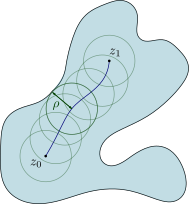
Since the successive centers are no farther apart than we have constructed a chain of overlapping circles running from to in . Since each circle has at least an entire neighborhood in common with the preceding and since in the first circle, it follows that . ◻
Thus we see that a function regular and analytic in a domain is completely determined by its behavior in any neighborhood of an interior point of , and also, if an analytic extension of the function into a larger domain is possible then the extension, too, is virtually determined. We say virtually, because in general the representation of an analytic and regular function in its original domain is not valid in the extended domain, as in the example of .
This leads to a fundamental problem: Given an analytic function defined in a domain , can be extended into a larger domain, and if so, how? We shall use the name function-element for a single-valued analytic function defined in a domain , since the possibility of extending the domain of definition makes it desirable to distinguish between the whole function defined in the largest possible domain into which the function can be extended analytically, " the function in the large ", and the part of it defined in .
Definition 4.1 (Analytic Continuation). Let be an analytic function defined in a domain and let be another domain having a part in common with . Then, a function is said to be a direct analytic continuation of into if is analytic in and coincides identically with in the common portion . Plainly, such an extension is unique.
Since the process is symmetrical in and , is also an analytic continuation of . Note that this is equivalent to the existence of an analytic function in which coincides with in and with in .
The question arises whether analytic continuation is always possible. It is obvious that we can never extend a function analytically over a singular point (excepting a removable discontinuity). We may even construct a function in the unit circle for which every point on the boundary is singular. An example of such a function is given by the power series convergent in the unit circle. Now if is any fraction then for we have whence . The function becomes unbounded in the neighborhood of every boundary point. Therefore the whole unit circle is a singular line for the function, across which no analytical extension is possible. We call such a line a natural boundary for the function.
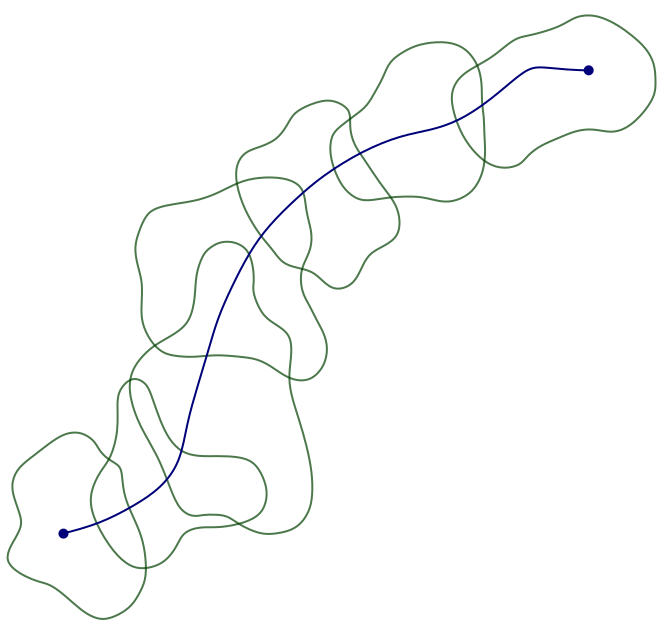
If a function-element in has been analytically extended by into , then it may be possible to extend , by means of an element , analytically into a domain by the same process. A sequence of function-elements is said to form a "chain" of function-elements if each is a direct analytic continuation of the preceding. We generalize the notion of analytic continuation by calling two function-elements analytic continuations of each other if they can be connected by a chain in the above sense. The original case, that of two directly overlapping function-elements, will be called an "immediate" analytic extension.
It is often convenient to speak of analytic continuation along an arc, or curve. If is a function-element in and an arc extending out from , then is said to be continued analytically along the arc if we can find a chain of function-elements leading out from which completely cover the arc . Evidently any chain extension is equivalent to an arc extension, and vice versa.
Analytic Continuation by Power Series
Our discussion so far offers no way of actually finding either an immediate analytic continuation of a function-element, or a chain of function-elements along a given arc. The following general method, due to Weierstrass, is based on the theory of power series:
Suppose a function-element to be defined by a power series
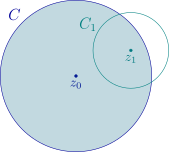
in its circle of convergence about . Then, if is any point in , we may expand about in a Taylor series
The power series method may also be used to obtain a chain of function-elements along a given are. For let be any arc extending out from a regular point and denote by the circle of convergence of the function at . We may choose a point on , expand about in a circle , then choosing a point in but not in (if this is possible), expand about , etc. We can ultimately reach any point on the arc with a finite number of these circles, provided each circle has a part outside the previous circle and the circles do not nest down to a point. If the circles do nest down to a point, this point must be a singularity of the function in the large, and no further extension is possible.
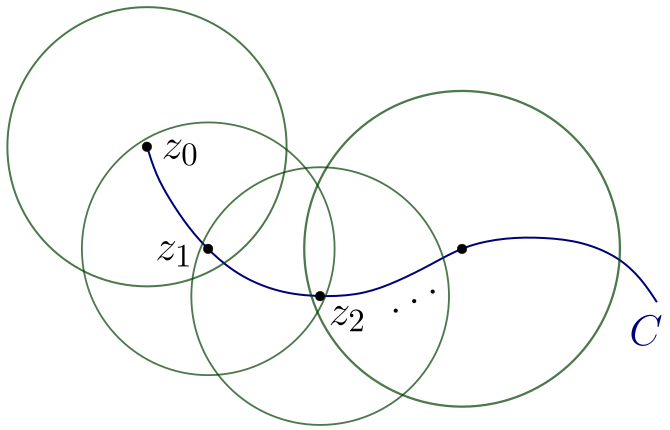
This construction shows, if we know beforehand where the singularities of the function lie, that it is always possible to continue analytically along any path avoiding them. For, if is the distance from to the nearest singularity or boundary point, we may expand in a circle of radius about any point along ; choosing points at distance apart as centers will provide the desired chain of circles.
The Monodromy Theorem
If the function-element is an analytic continuation of but not an immediate continuation then we cannot say that is uniquely determined by since can depend on the choice of the chain leading to it. As a simple example, consider defined in a small circle about . We can extend along the upper half of the unit circle by overlapping circles until a circle about , with a corresponding power series, is obtained. But, from the multiple-valuedness of the logarithm, the same continuation process performed along the lower half of the unit circle also gives a function-element about , but differing from the first by . Of course, the same function-element would be reached if we chose two chains not including the origin between them. Two chains issuing from a given function-element will be called equivalent if they have the same values wherever they overlap.
The example of leads us to suspect that every instance in which two different paths give two different continuations may be accounted for by the existence of some singularity between them. This is actually so, as we see by the Monodromy Theorem:
Theorem 4.8 (Monodromy Theorem). If a function-element defined in a domain can be continued analytically along every path in a simply connected domain containing , then is single-valued in .
Proof. Let and
Denote the smallest distance between and the boundary of by . Thus any function element defined on or in its interior must have a radius of convergence .
is a simple closed curve. It follows by a well-known theorem of topology 1 that and its interior may be mapped in a continuous one-to-one manner respectively, onto the boundary of the unit circle, , and its interior, . Suppose the transformation to be given by the mapping and inversely by . We may suppose , since we may assure this result by applying a linear transformation. By means of the mapping we may describe a continuous deformation of the curve into the curve
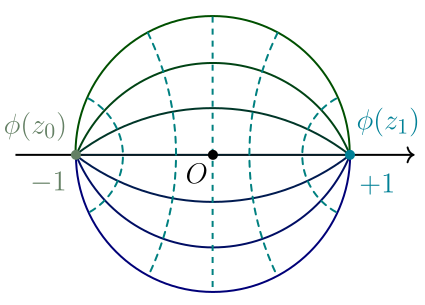
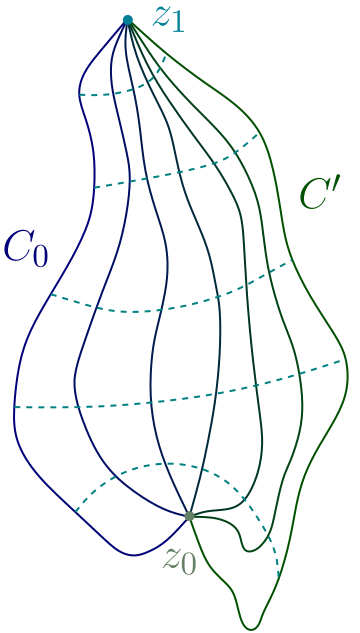
As goes from to the arcs sweep out the entire unit circle beginning at and ending at
Now, since is continuous on a closed set it is uniformly continuous. Consequently, we may find a such that insures . This will certainly occur (as the reader may easily verify) if . We choose deformation curves
Let us continue the function along the curves and observe what occurs. Denote by the point of intersection of with . We continue along by means of the successive function elements at the . Now the continuations on and must lead to the same value at , for they define the same function in the entire region enclosed between them. First of all, they are the same in the first mesh, the region bounded by , , and , since all points of the mesh are nearer to than and hence lie within the first function element at . Now the second function elements at and being of radius , must contain both the first and second mesh and these meshes are also contained in the function element at . The two continuations being direct analytic continuations, must agree wherever they have a common overlap in the function element about . They must therefore be identical on the second mesh. Now the third mesh together with the second lies inside the function elements about , , , and and therefore the two continuations must be identical on the third mesh.
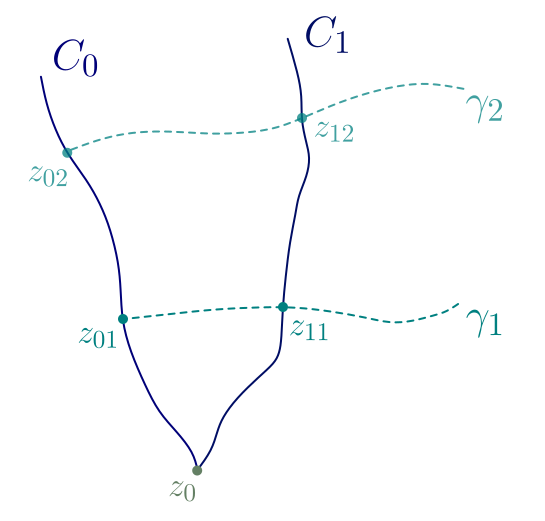
In this way we continue and in a finite number of steps we obtain two continuations which define the same function in the region bounded by and . Hence both continuations give the same value at . By the same argument it follows that
Analytic Functions in the Large
We are now in a position to define the concept of analytic function in the large.
An analytic function in the large is the totality of the function-elements which are obtained by analytic continuation from a given function element. Any of the function elements of the analytic function could be used for the definition. It can be proved that the point set at which the analytic function exists always fulfills the properties of a domain, where, in the case of multi-valuedness of the function a couple of one and the same -value and two distinct functional values are considered as two distinct points. Clearly, an appropriate notion of "neighborhood of a point" must be introduced, in order that such an abstract point set form a space. We will not go into a detailed analysis of the concept of the domain of an analytic function, but this is what we meant by a Riemann surface.
An interesting discovery in this connection was made by Poincaré and Volterra. It states that the different values that an analytic function assigns to a fixed value of can be at most denumerably infinite.
Exercises
Exercise 4.15 . The series represents a function element of in the unit circle. Applying Weierstrass’ method, obtain a chain of circles encircling and show that the opposite function element is obtained over the origin by analytical continuation around .
4.3.2 Analytic Continuation by Means Other than Power Series
The power series method of analytic continuation though useful as a theoretical means is not very useful as a practical procedure. A method that can be used in many practical cases is the reflection principle of Schwarz. It depends on the so-called Principle of continuity .
Theorem 4.9 (Principle of continuity). Let and be two function elements defined in the respective domains and which do not overlap but which share a piecewise smooth arc as a common boundary. Then, if both functions are continuous and assume the same value on the boundary each is an analytic continuation of the other.
In other words, if two analytic functions are connected continuously across an arc, they are connected analytically.
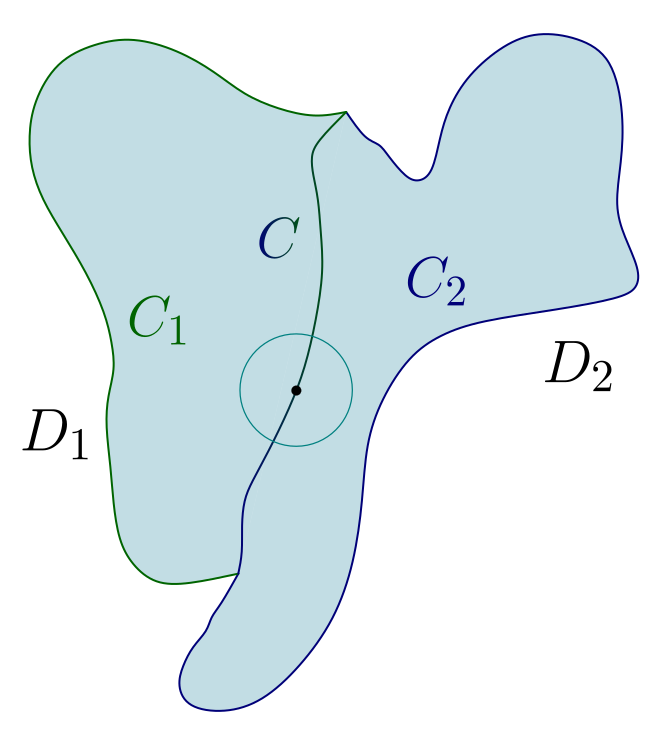
Proof. Since is smooth in the neighborhood of at least one point, it is possible to draw a circle about that point which is intersected by no more than twice.
Let be represented in the form and suppose the origin, , say, is a point contained in a smooth interval on . We may choose the interval so small that the change in the direction of is kept arbitrarily small. Setting , , we specify
Let us investigate either branch of the curve proceeding from , say, through increasing values of , . The entire are must lie in the sector .
For suppose there were a point outside the sector; . By the Mean Value Theorem there must be a point
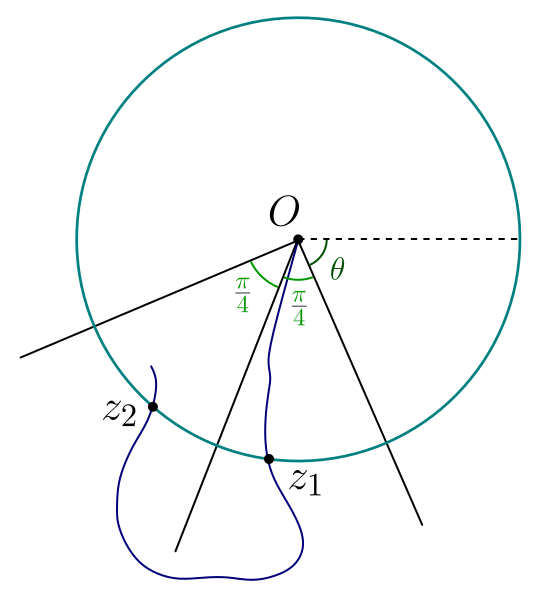
Now we may find a circle about so small that it has no points of intersection with outside the smooth interval. The arc can only have one intersection with the circle. For suppose there were two and . Since they lie on the circle without the sector we must have either
Denote by the part of the circle in , the part of the circle in . The circle is divided by into two roughly semicircular subdomains and lying in and respectively. We define a function inside the circle such that
Now, by Cauchy’s Integral Formula we may express in and in by the integrals
Theorem 4.10 (The principle of reflection). Let be an analytic function of in a domain which has a straight line segment in its boundary. Suppose further that is continuous on and maps onto a straight line segment on the boundary of the image of . Let be the domain obtained from by reflection through and the domain obtained by reflecting through . If is the reflection of in the reflection of in then the function
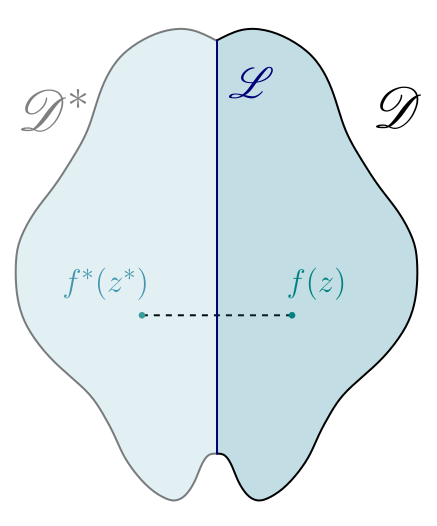
证明. 该命题容易证明。由 将 映射到 是保形的,因此由 将 映射到 也是保形的。 和 在 上连续且取相同的值。连续性原理的条件得到满足,且 是 在反射区域 中的解析延拓。 ◻
当区域的边界包含一段圆弧,且该圆弧映射到另一段圆弧时,也可以使用反射原理。在这种情况下,延拓是通过关于这些圆弧的反演得到的。
类似的反射定理也适用于调和函数。即,如果 是一个调和函数,其边界值沿一条直线 变为零,那么它可以被调和地延拓到通过关于 反射其区域 而得到的区域中,只需在点 的像
类似地,如果 是一个调和函数,其法向导数沿直线 为零,那么它可以通过关于 的反射被调和地延拓,只需在反射点
作为反射原理的一个简单应用示例,可以证明,如果 以一一对应的保形方式将单位圆内部映射到自身,那么它必须是线性函数。这留作练习。
反射原理的应用,函数
应用于基本函数 的四种初等运算及其逆运算,给出了多项式、有理函数以及重要的代数函数类型,即那些可用有理函数的有限次根式表示的函数。(例如, )。然而,这些运算不足以定义所有重要的解析函数,例如所谓的超越函数 、 等。引入微分过程不会扩展代数函数类。另一方面,积分过程则会,我们发现许多重要类型的超越函数可以通过代数函数甚至有理函数的不定积分来表示。这包括所有所谓的“初等函数”以及椭圆函数。作为简单的例子,我们有 通过取后者的逆,我们得到函数 ,并通过简单的代数组合,得到所有其他三角函数。
为了使这样的表示收敛或保持单值,通常需要对其定义域施加一些限制。这种定义域常常由直线或圆弧段围成,并且在该函数元素下的像也以类似的方式围成。然后,反射过程就成为扩展这些函数元素(要么无限扩展,要么扩展到其自然边界)以及分析和研究所得到的函数的性质的重要手段。许多重要类型的函数都可以通过这种方式来研究和构建。我们将通过详细讨论由积分定义的函数来说明:
函数 的临界点出现在 处,它们对应于 。如果我们沿实轴从 到 以及从 到 切割 平面,从而连接这些点,那么就可以在上半平面内的每条弧上解析延拓 ,因此,根据单值化定理,(3.20) 定义了一个单值解析函数 ,它将上半平面映射到 平面的某个区域上。为了找到这个区域,我们确定其边界,即实轴的像。
如果 位于实轴上,介于 和 之间,那么积分(3.20)是实的,其值位于实轴上的区间 内。我们约定 指的是正的平方根。当 沿实轴继续取值 或 时,我们可以分别写成
我们将考察函数
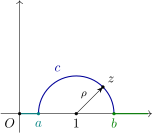
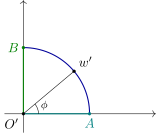
当 沿 移动时,
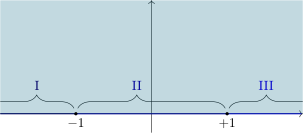
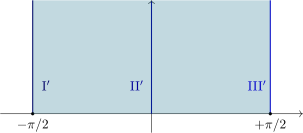
图中的线段 I、II、III 分别映射为相应的线段 I
直线边界上的对应关系允许通过反射以三种方式解析延拓 ,即穿过 I、II 或 III。穿过 II 的反射得到通过边 II 连接到 的下半 平面。这仍然在两个半平面中沿 I 和 III 留下自由边。穿过 II
该黎曼面的结构展示了逆函数的周期性。因为,在每个带形区域中具有全等位置的点 ( )对应于黎曼面上彼此重叠的一系列点,这意味着逆函数在那里取相同的值。此外,我们有 对于 ( )以及 。正如我们所见,这些性质刻画了函数 。因此,我们已确认积分(3.20)与逆函数 等同。
通过函数方程的解析延拓
设 对于 在区域 中的值以及 分别在区域 中的值,是关于每个单独变量的解析函数。现在假设在 中存在 的一个邻域,以及函数 ,它们在 处正则,且函数值在相应的区域 中,使得关系式
定理 4.11 (函数方程的恒久性)。如果解析函数 在 的某个区域上满足一个函数方程,那么(只要该方程有意义)它们在所有函数都有定义的最大区域上也满足该函数方程。
证明. 设 是 的一个函数元素,对于 中 邻域内的点,它只取 中的值。函数 是 的正则函数,并且在 的邻域内满足关系式 。该定理的证明是通过表明:如果这些元素 可以在 中解析延拓,使得函数值仍然落在相应的区域 中,那么方程(3.21) 在整个延拓过程中保持有效。
为了证明,设 是 中关于 的最大圆,使得所有 在其上收敛,并且只取属于相应 的值。现在令 是 的直接解析延拓,并令 是最大的圆,使得 在其中收敛到相应 中的元素。在 和 的公共部分,至少我们有 但是 在 中的 上是解析的,并且在 与 的公共部分上为零,因此它在整个圆 中必定恒等于零。现在,由于 的任何解析延拓都可以通过有限个直接解析延拓的链得到,这就证明了我们的定理。 ◻