曲线积分
Table of Contents
3.1.1 Geometrical Notions
A curve, or rather a continuous curve in the -plane, is any collection of points whose coordinates , are continuous functions of a single parameter in some interval . In complex notation such a curve is described in the form If the initial point of the curve coincides with the end point, the curve is said to be closed and if it does not intersect itself elsewhere, i.e. if
It will sometimes be necessary to approximate to a piecewise smooth simple curve by a sequence of paths . Namely, if is given by a function then the curves given in the parametric form must satisfy the relation uniformly in . The directions of the approximating curves need not approximate the direction of the limiting curve ; but, if that is the case, if in addition to we have uniformly in , then the sequence is said to approximate smoothly . 2 In particular, any path can be smoothly approximated by a sequence of polygonal paths consisting either of its tangents or of its chords. By means of the latter approximation it is not difficult to prove if a sequence of paths forms a smooth approximation to then the lengths of the approximating curves converge to that of the limit curve.
There is a famous theorem of Jordan which states that every continuous simple closed curve subdivides the -plane into two non-overlapping domains, an infinite domain, the exterior, and a bounded domain, the interior. It is by no means an easy theorem to prove although it has a deceptive appearance of simplicity, a complete proof having been achieved only in comparatively recent years. For theorems of this kind one should be very suspicious of the promptings of an undisciplined intuition. It might be supposed for example that the boundary of a simply-connected domain is a continuous curve. However, plausible this assertion may appear it can be easily confuted by various counter examples:
In the square , , erect vertical lines of height at the points . The region consisting of the interior of the rectangle minus the points on these lines is such a simply-connected domain. Its boundary, however, is made up of a curve plus an infinite number of branches.
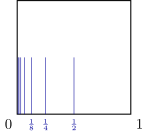
One might also suppose that every boundary point of a domain could be "reached" from the interior of the domain, i.e., by a polygon which, except for its end point on the boundary, lies entirely in the interior of the domain. This, however, need not be true, as one may verify for the points , in the above example.
The following example illustrates a domain, part of whose boundary is a simple closed curve, yet no point of this curve is accessible from the interior.
Let be the unit circle, and consider a spiral domain encircling an infinite number of times as its thickness tends to zero. Every point of the unit circle is a limit point of the spiral. The interior of is certainly a domain in our sense and the boundary contains the unit circle. However, any polygon drawn in the interior of towards encircles an indefinite number of times and cannot stop on . The unit circle is therefore completely inaccessible from the interior.
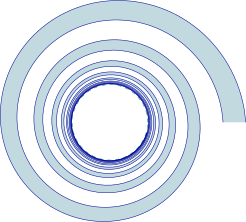
The proof of the general Jordan curve theorem is too long to have any proper place here. However, the reader may find it amusing the instructive to attempt to prove a special result. 3
A simple closed polygon divides the -plane into two disjoint domains. More exactly, if the polygon is deleted from the plane the remainder consists of two non-overlapping open connected point sets.
From the Jordan theorem for polygons we conclude that the interior and exterior of a simple closed polygon are both domains in the function theoretical sense. By means of this theorem we may now distinguish between domains which have "holes" in them and those which do not. The latter are said to be simply connected and we define a domain to be simply connected if for each simple closed polygon in , the domain contains its interior. The domains of Fig. 1 , 2 for example are simply connected. The ring domain , on the other hand, is not.
Next is the simply-connected domain from which a single point, or a simply-connected sub-domain has been cut – the so-called "ring domain". [See Fig. 3. ]
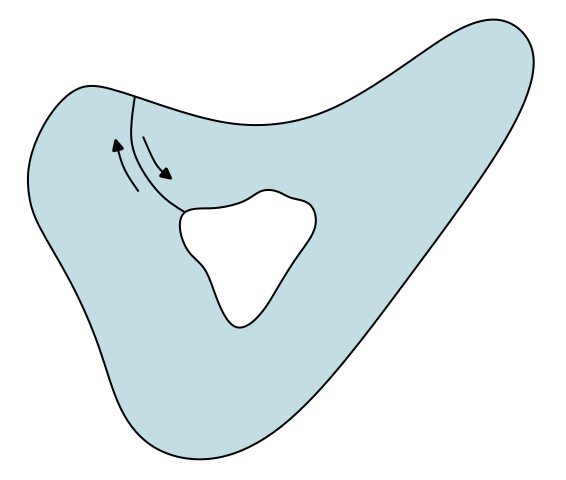
Such a domain is called doubly-connected . In general, an -tuply connected domain is one in which holes have been cut out of a simply connected domain. If the domain is bounded by piecewise-smooth arcs then an -tuply connected domain has closed boundary curves .
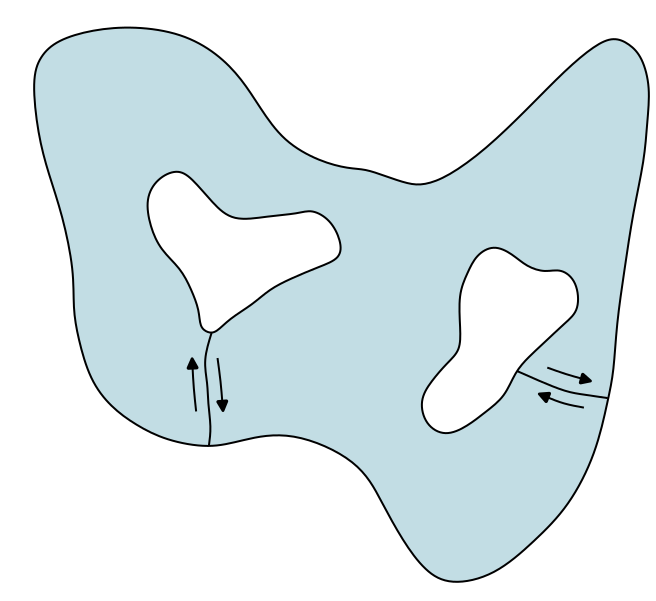
An -tuply connected domain can always be made simply connected by introducing “cross cuts”, i.e., paths which run through the domain and connect each of the interior boundary curves to the exterior. These cuts we add to the boundary of the domain, and agree not to take any path in the domain which crosses a cut. This automatically excludes any closed path which encircles one of the holes; the cut domain is therefore simply-connected.
Another theorem, needed later, is the following:
Theorem 3.1 . The interior of any simple, closed polygon can be decomposed into a finite number of triangles.
To prove this theorem, we define the property of convexity . A point-set is said to be convex if for every two points , of the set, the whole line segment between and is also contained in the set. The simplest example of a convex set is the infinite region on one side of a straight line, a half-plane .
It follows directly from the definition that the points common to a finite number of convex sets also form a convex set. For if and are two points of , the line segment lies in each one of the sets , , , and hence in . As a special case we have: The intersection of any finite number of half-planes is convex. [See Fig. 5 .]
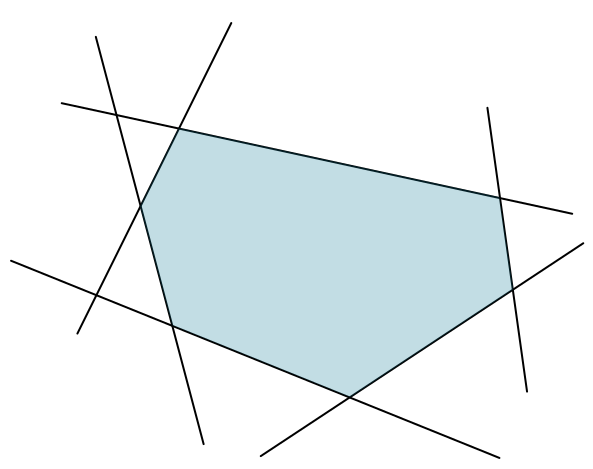
A convex polygonal region may easily be subdivided into triangles by choosing any interior point and joining it to the vertices. In general for any polygon the subdivision is accomplished as follows:
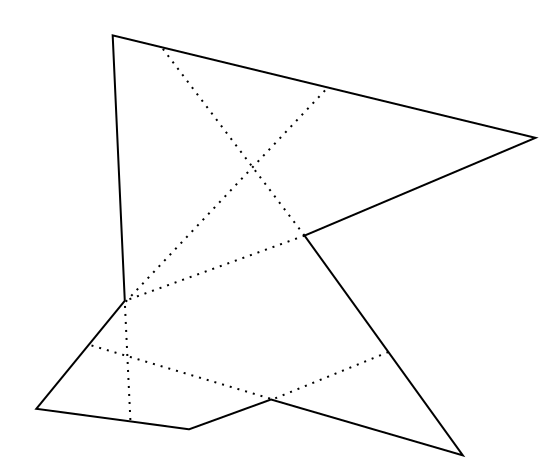
Extend each side of the polygon indefinitely in both directions. The interior of will then be split into a finite number of polygonal domains. [See Fig. 6 .] Each of these is the intersection of half planes and is therefore convex. The subdivision into triangles may then be carried out in each of the convex subdomains.
3.1.2 Line Integrals
A line integral as defined in calculus, 4 is an expression of the form where and are continuous functions of and in a domain of the -plane which contains the path . The value of the integral is defined by the ordinary Riemann integral
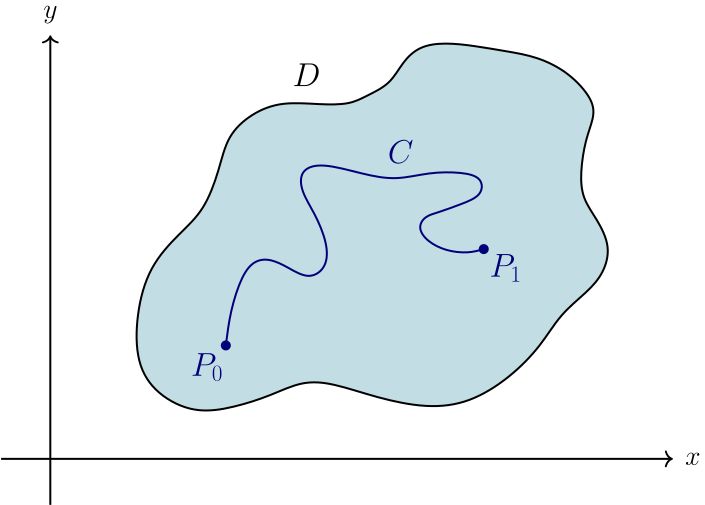
Keep the endpoints and fixed and join them by another path
Theorem 3.2 . A necessary and sufficient condition that the line integral shall be independent of the path joining to for each point pair , in is that there exist a function in such that
The expression is the differential of and is called a total or an exact differential.
In this form the theorem is not applicable to specific cases since it does not give any criterion in terms of the given functions and for the existence of . However, by introducing further assumptions concerning the domain and the functions we arrive at a more directly applicable theorem.
Theorem 3.3 . If is a simply connected domain and , are differentiable functions, then the line integral will be independent of the path if and only if
This condition is known as the integrability condition . for two variables. It is a necessary and sufficient condition that the differential be exact.
3.1.3 Complex Integrals
The definite integral of a function of a complex variable may be defined in terms of the integrals of the real and imaginary parts. Setting we define
In introducing the notion of definite integral we need not refer to the real and imaginary parts of the integrand. It is possible to define a complex integral completely in complex terms in a manner somewhat analogous to that of the ordinary Riemann integral for real functions of a single variable.
Let be a continuous single-valued function on a curve . We need not require that be a path but only that be rectifiable, say of length . Subdivide into arcs and denote the successive points of subdivision by .
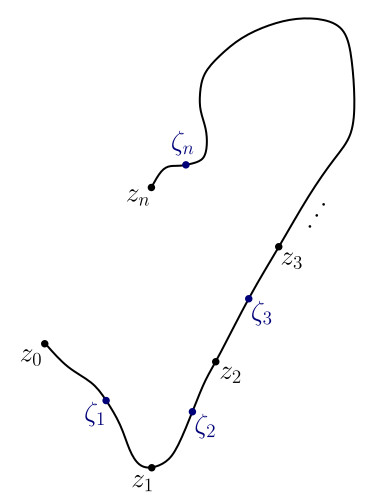
在细分的每个连续弧段上任意选取一点,并将依次选取的点记为 ,构造和式
由于 是闭集, 在 上连续,从而一致连续。由 的可求长性可知,任给 ,可以找到一个足够小的 ,使得对于曲线上由长度小于 的弧段连接的任何两点
积分的若干简单性质直接源于定义:
引理3.1 。 如果函数 有界,即 ,则
引理3.2 。 如果曲线 由两段连续的可求长弧段 和 组成,则
引理3.3 。 如果积分方向反转,积分值改变符号。因此,若将 的反向记作 ,我们有
引理3.4 。 积分是线性运算,即若 是常数,则
更一般地,我们有
引理3.5 。 一致收敛级数的积分等于各项积分之和。
证明. 假设我们有一个级数 在曲线 上一致收敛。则对于充分大的 ,有 其中 是第 部分和 。由(1.33) 可得 其中 是 的长度。因此 ◻
引理3.6 。 常数的积分与积分曲线无关。更确切地说,我们有
类似地,我们有
因为我们可以用以下两个和式中的任何一个来逼近积分
引理3.7 。 设 是区域 内的连续函数。如果存在一列有界长的曲线 逼近一条给定的可求长曲线 ,则
证明. 记 上的积分为 。通过取充分细的细分,我们可以得到 的一致逼近。将曲线 用参数形式记作 , 。我们首先证明,可以对参数区间进行细分,使得在所有 上得到一致小的细分。
由曲线的可求长性,对于有限条曲线,我们总能确定这样的细分。但该结论可以对所有曲线证明。即,任给 ,存在一个 ,使得只要 ,就有 ,且 与 无关。反之,假设对于任何 ,总存在一个 ,以及某个 、 满足 ,却有 。令 是一个趋于零的 序列。用 表示第一个使得存在 、 满足 且 的 。显然 无界。现在我们可以找到充分大的 ,使得对所有 ,一致地有 关于 一致成立。此外,由于 可求长,存在一个 ,使得当 时有 选取一个 ,使得 且 。则对所有满足 的 、 ,有
由于 在区域 内连续,从而一致连续。因此,任给 ,存在 ,使得对所有满足 的 、 (均在 内),有 选取参数区间的一个足够小的细分,使得对所有 ,有 令 ,并构造和式 由(1.37) 可得 因为在每一项中 是常数。由此我们推断
现在选取充分大的 ,使得 关于 一致成立。考虑差 :
证明. 设路径 由参数表示给出, , 。取 的任意划分,使得导数 的不连续点包含在划分点中。求和式 (1.32) 可以用实项和式替代