The peculiarities of the world of rotating systems are not exhausted by the existence of radial gravitational forces. We shall become acquainted with still another interesting effect whose theory was presented in 1835 by the Frenchman Gaspard Gustave de Coriolis (1792–1843).
Let us pose the following question: What does rectilinear motion look like from the point of view of a rotating laboratory? A design of such a laboratory is depicted in Figure 1. The rectilinear trajectory of some body is shown by means of a ray passing through the centre. We are considering the case when the path of the body passes through the centre of rotation of our laboratory. The disc on which the laboratory is standing rotates uniformly; five positions of the laboratory with respect to the rectilinear trajectory are shown in the figure. This is how the relative positions of the laboratory and the trajectory of the body look after one, two, three, etc., seconds. The laboratory, as you see, is rotating counter-clockwise if looked upon from above.
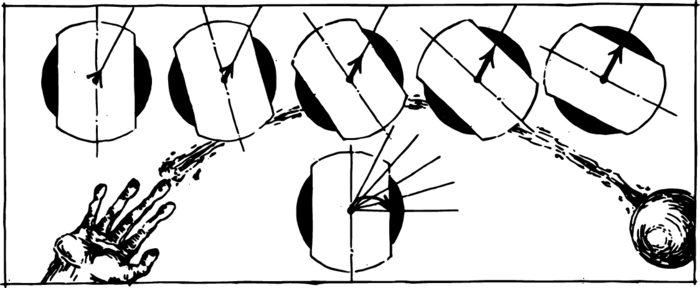
Arrows corresponding to the segments through which the body passes during one, two, three, etc., seconds have been drawn on the line of its path. The body covers the same distance during each second, since we are dealing with uniform and rectilinear motion from the point of view of a fixed observer.
Imagine that the moving body is a freshly painted ball rolling along the disc. What kind of trace will remain on the disc? Our construction yields the answer to this question. The points which mark the ends of the arrows have been transferred from our five drawings to a single diagram. It remains to connect these points by a smooth curve. The result of our construction will not surprise us: rectilinear and uniform motion looks like curvilinear motion from the point of view of a rotating observer. The following rule attracts our attention: a moving body is deflected to the right of its path during the entire course of the motion. We now assume that the disc is rotating in the clockwise direction, and leave the repetition of our construction to the reader. It will show that, in this case, a moving body is deflected to the left of its path from the point of view of a rotating observer.
We know that a centrifugal force arises in rotating systems. However, its action cannot serve as the cause of the deformation of the path, for it is directed along the radius. Hence, besides the centrifugal force another additional force arises in rotating systems. It is called the Coriolis force.
Why is it that in the previous examples we did not come across the Coriolis force and managed superbly with only centrifugal? The reason is that until now we have not regarded motion from the point of view of a rotating observer, and a Coriolis force arises only in such a case. Only a centrifugal force is exerted on bodies which are, stationary in rotating systems. A table in a rotating laboratory is screwed on to the floor—only a centrifugal force is exerted on it. But on a ball which has fallen from the table and rolled along the floor of the rotating laboratory besides a centrifugal force a Coriolis force is also exerted.
On what quantities does the magnitude of a Coriolis force depend? It can be calculated, but the computations are too complicated to be given here. We shall therefore present only the result of these computations.
Unlike a centrifugal force whose magnitude depends on the distance from the axis of rotation, a Coriolis force is independent of the position of a body. It is determined by the velocity vector (i.e. not only by its magnitude, but also by its direction with respect to the axis of rotation). If the body moves along the axis of rotation, the Coriolis force is equal to zero. The greater the angle between the velocity vector and the axis of rotation, the greater will be the Coriolis force; this force assumes its maximum value when the motion of the body is at right angles to the axis. As we know, it is always possible to decompose a velocity vector into any pair of its components and consider separately the two resulting motions in which the body is simultaneously involved.
If the velocity of a body is decomposed into components \(v_{\parallel}\) and \(v_{\perp}\)—parallel and perpendicular to the axis of rotation—then the first motion will not be subject to the action of a Coriolis force. The magnitude of the Coriolis force \(F_{C}\) is determined by the component \(v_{\perp}\) of the velocity. Computations lead to the formula \[F_{C}= 4 \pi n v_{\perp} m\] Here \(m\) is the mass of the body, and \(n\) is the number of revolutions made by the rotating system in a unit of time. As can be seen from the formula, the faster the system rotates and the faster the body moves, the greater will be the Coriolis force.
Calculations also established the direction of a Coriolis force. This force is always perpendicular to the axis of rotation and the direction of the motion. Moreover, as has already been said above, the force is directed to the right of its path in a system rotating counterclockwise.
Many interesting phenomena occurring on the Earth are explained by the action of Coriolis forces. The Earth is a sphere, and not a disc. This makes the effect of Coriolis forces more complicated. These forces will not only influence motion along the Earth’s surface but also the falling of bodies to the Earth.
Does a body fall exactly along a vertical? Not quite. Only at a pole does a body fall exactly along a vertical. Here the direction of the motion and the Earth’s axis of rotation coincide, so there is no Coriolis force. The situation is different at the equator; here the direction of the motion forms right angles with the Earth’s axis. If looked upon from the North Pole, the Earth’s rotation will appear to be counterclockwise. Hence, a freely falling body should be deflected to the right of its path, i.e. to the East. The magnitude of this eastward deflection, the greatest at the equator, decreases to zero as the poles are approached.
Let us compute the magnitude of the deflection at the equator. Since a freely falling body moves with a uniform acceleration, the Coriolis force increases as the Earth is approached. We shall therefore restrict ourselves to an approximate computation. If the body falls from a height, say, of 80 m, its fall will last about 4 s according to the formula \(t = \sqrt{2h/g}\). The average speed for the fall will be equal to 20 m/s.
This is the speed that we shall substitute in our formula for the Coriolis acceleration, \(4 \pi n v\) Let us convert the value \(n = 1\) revolution in 24 hours to the number of revolutions per second; \(24 \times 3600\) seconds are contained in 24 hours, so \(n\) is equal to 1/86,400 rps: consequently, the acceleration created by the Coriolis force is equal to \(\pi/1080~\mathrm{m/s^2}\). The distance covered during 4 s with such an acceleration is equal to \((1/2) (\pi/1080) \times 4^{2} = 2.3~\mathrm{cm}\). This is precisely the magnitude of the eastward deflection in our example. An exact computation, taking into account the non-uniformity of the fall, yields a close but somewhat different number.
While the deflection of a freely falling body is maximum at the equator and equal to zero at the poles, we shall see the opposite picture in the case of the deflection of a body moving in a horizontal plane under the action of a Coriolis force.
A horizontal site on the North or South Pole does not differ at all from the rotating disc with which we began our study of Coriolis forces. A body moving along such a site will be deflected to the right of its path by the Coriolis force at the North Pole, and to the left at the South Pole. Using the same formula for the Coriolis acceleration, the reader can calculate without difficulty that a bullet fired from a rifle with an initial speed of 500 m/s will be deflected from the target by 3.5 cm in a horizontal plane during one second (i.e. while it travels 500 m).
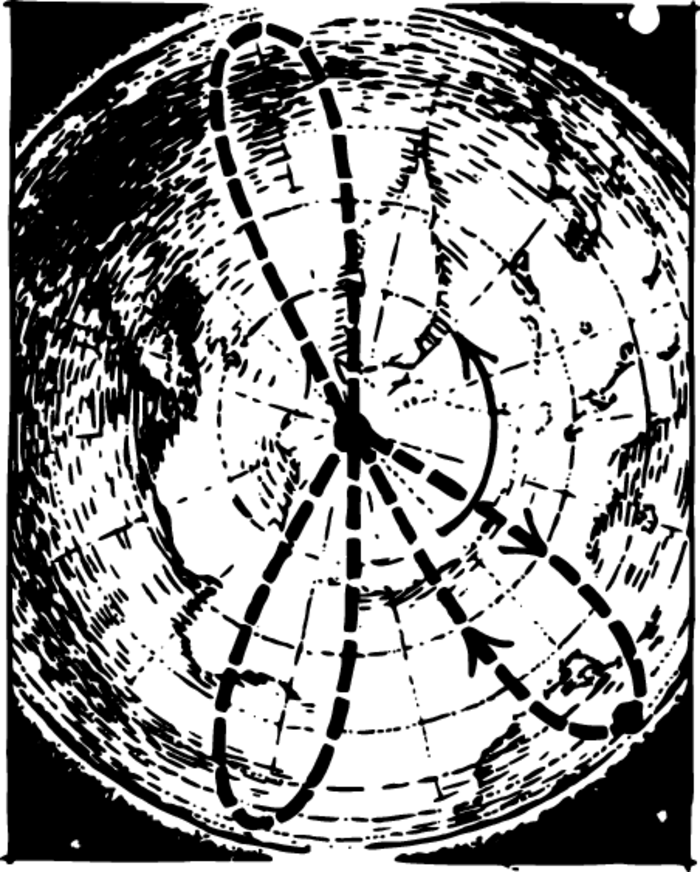
But why should the deflection in a horizontal plane at the equator be equal to zero? Without rigorous proofs, it is clear that this should be the case. At the North Pole a body is deflected to the right of its path, and at the South Pole to the left, hence, half-way between the poles, i.e. at the equator, the deflection will be equal to zero. Let us recall the experiment with the Foucault pendulum. A pendulum oscillating at a pole preserves the plane of its oscillations. The Earth in its rotation moves away from under the pendulum. This is how the stellar observer explains the Foucault experiment. But the observer rotating together with the Earth explains this experiment by means of a Coriolis force. As a matter of fact, a Coriolis force is directed perpendicularly to the Earth’s axis and perpendicularly to the direction of the motion of the pendulum; in other words, the force is perpendicular to the plane of the oscillation of the pendulum and will continually turn this plane. It can be arranged so that the end of the pendulum traces the trajectory of the motion. This trajectory is represented by the “rosette” shown in Figure 2. It can be seen from this figure that the “Earth” completes one quarter of a rotation during one and a half periods of the oscillation of the pendulum. The Foucault pendulum turns much more slowly. At a pole, the plane of oscillation of the pendulum will turn through one-fourth of a degree during one minute. At the North Pole the plane will be turned to the right of the path of the pendulum, and at the South Pole to the left.
The Coriolis effect will be somewhat less at Central European latitudes than at the equator. A bullet in the example we have just given will be deflected not by 3.5 cm but by 2.5 cm. The Foucault pendulum will be turned by about one-sixth of a degree during one minute.
Must a gunner take the Coriolis force into account? Big Bertha used by the Germans to shell Paris during World War I was situated 110 km from the target. The Coriolis deflection is as much as 1600 m in such a case. This is no longer a small quantity. If a flying projectile is sent very far without taking the Coriolis force into account, it will be deflected significantly from its course. This effect is large not because the force is great (for a ten ton projectile having a speed of 1000 km/h, the Coriolis force will be about 25 kgf but because it is exerted continually for a long period of time.
Of course, the influence of wind on a rocket projectile may be no less significant. Flight corrections made by a pilot depend on the action of the wind, the Coriolis effect and imperfections in the airplane or flying bomb.
What specialists besides aviators and gunners should be aware of the Coriolis effect? Strange as it may seem, among such specialists are railroaders. Under the action of the Coriolis force, one of the rails of a railroad wears out on the inside noticeably more than the other. We know just which one: in the Northern Hemisphere it will be the right rail (relative to the motion of a train), and in the Southern Hemisphere the left one. Only the railroaders in equatorial countries are saved from trouble in connection with this.
The washing away of right banks in the Northern Hemisphere is explained in exactly the same way as the wearing out of rails. The deviation of a river bed is to a large extent related to the action of the Coriolis force. It turns out that rivers in the Northern Hemisphere pass obstacles on the right.
It is known that streams of air flow into a low-pressure area. But why is such a wind called a cyclone? After all, the root of this word suggests a circular (cyclic) motion.
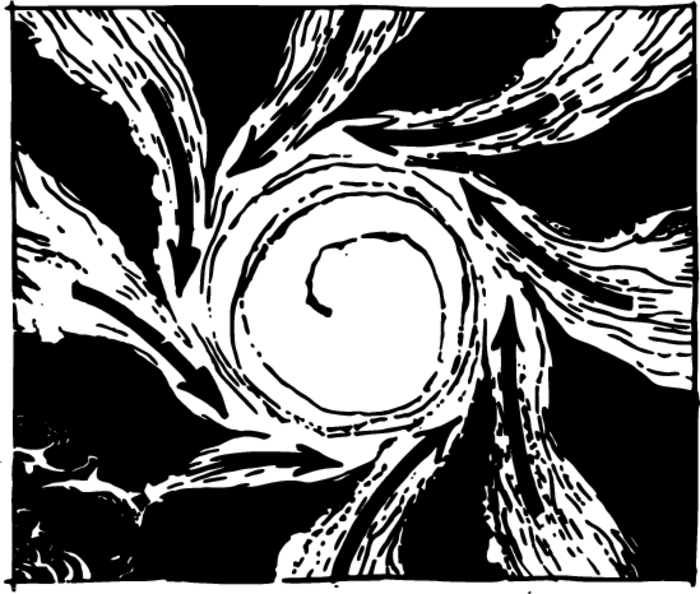
This is precisely the case—a circular motion of air masses arises in a low-pressure area (Figure 3). The cause lies in the action of the Coriolis force. In the Northern Hemisphere all air streams directed towards the low-pressure area are deflected to the right of their motion. Take a look at Figure 4—you see that this leads to a westward deflection of the winds blowing in both hemispheres from the tropics to the equator (trade-winds).
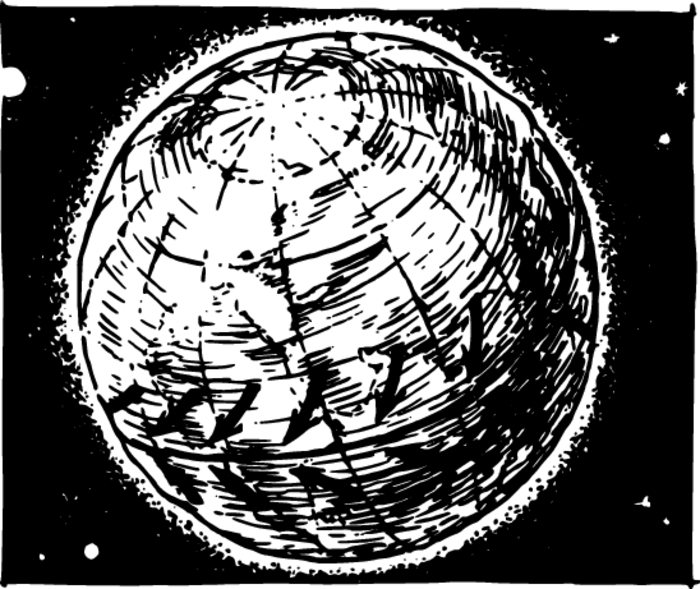
Why does such a small force play such a big role in the motion of air masses? This is explained by the insignificance of the frictional forces. Air is extremely mobile, and a small but constantly acting force can lead to important consequences.
" style="fill: %2300a1ff"/>%0A </g>%0A <g id="patch_3">%0A <path d="M 367.323255 30.020542 %0AL 391.543219 30.020542 %0AL 277.440506 212.584882 %0AL 253.220542 212.584882 %0Az%0A" clip-path="url(%23p7d9eacca36)" style="fill: %2300a1ff"/>%0A </g>%0A <g id="patch_4">%0A <path d="M 369.163993 30.020542 %0AL 389.702481 30.020542 %0AL 389.702481 212.584882 %0AL 369.163993 212.584882 %0Az%0A" clip-path="url(%23p7d9eacca36)" style="fill: %2300a1ff"/>%0A </g>%0A <g id="patch_5">%0A <path d="M 322.381881 111.033468 %0AL 436.484593 111.033468 %0AL 436.484593 131.571957 %0AL 322.381881 131.571957 %0Az%0A" clip-path="url(%23p7d9eacca36)" style="fill: %2300a1ff"/>%0A </g>%0A <g id="patch_6">%0A <path d="M 367.323255 30.020542 %0AL 391.543219 30.020542 %0AL 448.594575 121.302712 %0AL 424.374611 121.302712 %0Az%0A" clip-path="url(%23p7d9eacca36)" style="fill: %2300a1ff"/>%0A </g>%0A <g id="patch_7">%0A <path d="M 367.323255 30.020542 %0AL 391.543219 30.020542 %0AL 310.271899 121.302712 %0AL 334.491863 121.302712 %0Az%0A" clip-path="url(%23p7d9eacca36)" style="fill: %2300a1ff"/>%0A </g>%0A <g id="patch_8">%0A <path d="M 424.374611 121.302712 %0AL 448.594575 121.302712 %0AL 391.543219 212.584882 %0AL 367.323255 212.584882 %0Az%0A" clip-path="url(%23p7d9eacca36)" style="fill: %2300a1ff"/>%0A </g>%0A <g id="patch_9">%0A <path d="M 334.491863 121.302712 %0AL 310.271899 121.302712 %0AL 367.323255 212.584882 %0AL 391.543219 212.584882 %0Az%0A" clip-path="url(%23p7d9eacca36)" style="fill: %2300a1ff"/>%0A </g>%0A <g id="patch_10">%0A <path d="M 512.492094 212.584882 %0AL 533.030582 212.584882 %0AL 533.030582 30.020542 %0AL 512.492094 30.020542 %0Az%0A" clip-path="url(%23p7d9eacca36)" style="fill: %2300a1ff"/>%0A </g>%0A <g id="patch_11">%0A <path d="M 539.876745 212.584882 %0AL 539.876745 30.020542 %0AL 636.864051 30.020542 %0AQ 653.979458 30.020542 653.979458 47.135949 %0AL 653.979458 195.469476 %0AQ 653.979458 212.584882 636.864051 212.584882 %0Az%0AM 560.415233 111.033468 %0AL 624.883266 111.033468 %0AQ 633.440969 111.033468 633.440969 102.475765 %0AL 633.440969 59.116734 %0AQ 633.440969 50.559031 624.883266 50.559031 %0AL 560.415233 50.559031 %0Az%0AM 560.415233 192.046394 %0AL 624.883266 192.046394 %0AQ 633.440969 192.046394 633.440969 183.488691 %0AL 633.440969 140.12966 %0AQ 633.440969 131.571957 624.883266 131.571957 %0AL 560.415233 131.571957 %0Az%0A" clip-path="url(%23p7d9eacca36)" style="fill: %2300a1ff"/>%0A </g>%0A <g id="text_1">%0A <g style="fill: %2300a1ff" transform="translate(27.149522 312.323656) scale(0.76 -0.76)">%0A <defs>%0A <path id="Inter-Regular-41" d="M 755 0 %0AL 1223 1318 %0AL 3105 1318 %0AL 3573 0 %0AL 4164 0 %0AL 2455 4655 %0AL 1873 4655 %0AL 164 0 %0AL 755 0 %0Az%0AM 1400 1818 %0AL 2146 3918 %0AL 2182 3918 %0AL 2927 1818 %0AL 1400 1818 %0Az%0A" transform="scale(0.015625)"/>%0A </defs>%0A <use xlink:href="%23Inter-Regular-41"/>%0A </g>%0A </g>%0A <g id="text_2">%0A <g style="fill: %2300a1ff" transform="translate(87.183803 312.323656) scale(0.76 -0.76)">%0A <defs>%0A <path id="Inter-Regular-44" d="M 2000 0 %0AC 3418 0 4218 882 4218 2336 %0AC 4218 3782 3418 4655 2064 4655 %0AL 564 4655 %0AL 564 0 %0AL 2000 0 %0Az%0AM 1127 500 %0AL 1127 4155 %0AL 2027 4155 %0AC 3118 4155 3673 3464 3673 2336 %0AC 3673 1200 3118 500 1964 500 %0AL 1127 500 %0Az%0A" transform="scale(0.015625)"/>%0A </defs>%0A <use xlink:href="%23Inter-Regular-44"/>%0A </g>%0A </g>%0A <g id="text_3">%0A <g style="fill: %2300a1ff" transform="translate(150.459958 312.323656) scale(0.76 -0.76)">%0A <use xlink:href="%23Inter-Regular-41"/>%0A </g>%0A </g>%0A <g id="text_4">%0A <g style="fill: %2300a1ff" transform="translate(213.676738 312.323656) scale(0.76 -0.76)">%0A <defs>%0A <path id="Inter-Regular-50" d="M 564 0 %0AL 1127 0 %0AL 1127 1700 %0AL 2146 1700 %0AC 3230 1700 3718 2359 3718 3182 %0AC 3718 4005 3230 4655 2136 4655 %0AL 564 4655 %0AL 564 0 %0Az%0AM 1127 2200 %0AL 1127 4155 %0AL 2118 4155 %0AC 2875 4155 3164 3741 3164 3182 %0AC 3164 2623 2875 2200 2127 2200 %0AL 1127 2200 %0Az%0A" transform="scale(0.015625)"/>%0A </defs>%0A <use xlink:href="%23Inter-Regular-50"/>%0A </g>%0A </g>%0A <g id="text_5">%0A <g style="fill: %2300a1ff" transform="translate(275.064768 312.323656) scale(0.76 -0.76)">%0A <defs>%0A <path id="Inter-Regular-54" d="M 309 4155 %0AL 1773 4155 %0AL 1773 0 %0AL 2336 0 %0AL 2336 4155 %0AL 3800 4155 %0AL 3800 4655 %0AL 309 4655 %0AL 309 4155 %0Az%0A" transform="scale(0.015625)"/>%0A </defs>%0A <use xlink:href="%23Inter-Regular-54"/>%0A </g>%0A </g>%0A <g id="text_6">%0A <g style="fill: %2300a1ff" transform="translate(351.076861 312.323656) scale(0.76 -0.76)">%0A <defs>%0A <path id="Inter-Regular-49" d="M 1127 4655 %0AL 564 4655 %0AL 564 0 %0AL 1127 0 %0AL 1127 4655 %0Az%0A" transform="scale(0.015625)"/>%0A </defs>%0A <use xlink:href="%23Inter-Regular-49"/>%0A </g>%0A </g>%0A <g id="text_7">%0A <g style="fill: %2300a1ff" transform="translate(397.080829 312.323656) scale(0.76 -0.76)">%0A <defs>%0A <path id="Inter-Regular-56" d="M 755 4655 %0AL 164 4655 %0AL 1873 0 %0AL 2455 0 %0AL 4164 4655 %0AL 3573 4655 %0AL 2191 736 %0AL 2136 736 %0AL 755 4655 %0Az%0A" transform="scale(0.015625)"/>%0A </defs>%0A <use xlink:href="%23Inter-Regular-56"/>%0A </g>%0A </g>%0A <g id="text_8">%0A <g style="fill: %2300a1ff" transform="translate(461.704796 312.323656) scale(0.76 -0.76)">%0A <defs>%0A <path id="Inter-Regular-45" d="M 564 0 %0AL 3409 0 %0AL 3409 500 %0AL 1127 500 %0AL 1127 2082 %0AL 3227 2082 %0AL 3227 2582 %0AL 1127 2582 %0AL 1127 4155 %0AL 3373 4155 %0AL 3373 4655 %0AL 564 4655 %0AL 564 0 %0Az%0A" transform="scale(0.015625)"/>%0A </defs>%0A <use xlink:href="%23Inter-Regular-45"/>%0A </g>%0A </g>%0A <g id="text_9">%0A <g style="fill: %23ffffff" transform="translate(583.014294 312.323656) scale(0.76 -0.76)">%0A <defs>%0A <path id="Inter-Regular-42" d="M 564 0 %0AL 2246 0 %0AC 3346 0 3800 536 3800 1236 %0AC 3800 1973 3291 2373 2864 2400 %0AL 2864 2445 %0AC 3264 2555 3618 2818 3618 3418 %0AC 3618 4100 3164 4655 2191 4655 %0AL 564 4655 %0AL 564 0 %0Az%0AM 1127 500 %0AL 1127 2118 %0AL 2273 2118 %0AC 2882 2118 3264 1709 3264 1236 %0AC 3264 827 2982 500 2246 500 %0AL 1127 500 %0Az%0AM 1127 2609 %0AL 1127 4155 %0AL 2191 4155 %0AC 2809 4155 3082 3827 3082 3418 %0AC 3082 2927 2682 2609 2173 2609 %0AL 1127 2609 %0Az%0A" transform="scale(0.015625)"/>%0A </defs>%0A <use xlink:href="%23Inter-Regular-42"/>%0A </g>%0A </g>%0A <g id="text_10">%0A <g style="fill: %23ffffff" transform="translate(640.459824 312.323656) scale(0.76 -0.76)">%0A <defs>%0A <path id="Inter-Regular-4f" d="M 4491 2327 %0AC 4491 3800 3627 4718 2436 4718 %0AC 1246 4718 382 3800 382 2327 %0AC 382 855 1246 -64 2436 -64 %0AC 3627 -64 4491 855 4491 2327 %0Az%0AM 3946 2327 %0AC 3946 1118 3282 464 2436 464 %0AC 1591 464 927 1118 927 2327 %0AC 927 3536 1591 4191 2436 4191 %0AC 3282 4191 3946 3536 3946 2327 %0Az%0A" transform="scale(0.015625)"/>%0A </defs>%0A <use xlink:href="%23Inter-Regular-4f"/>%0A </g>%0A </g>%0A <g id="text_11">%0A <g style="fill: %23ffffff" transform="translate(702.115042 312.323656) scale(0.76 -0.76)">%0A <use xlink:href="%23Inter-Regular-4f"/>%0A </g>%0A </g>%0A <g id="text_12">%0A <g style="fill: %23ffffff" transform="translate(767.92651 312.323656) scale(0.76 -0.76)">%0A <defs>%0A <path id="Inter-Regular-4b" d="M 564 0 %0AL 1127 0 %0AL 1127 1509 %0AL 1709 2164 %0AL 3327 0 %0AL 4009 0 %0AL 2055 2555 %0AL 4009 4655 %0AL 3273 4655 %0AL 1182 2345 %0AL 1127 2345 %0AL 1127 4655 %0AL 564 4655 %0AL 564 0 %0Az%0A" transform="scale(0.015625)"/>%0A </defs>%0A <use xlink:href="%23Inter-Regular-4b"/>%0A </g>%0A </g>%0A <g id="text_13">%0A <g style="fill: %23ffffff" transform="translate(830.12204 312.323656) scale(0.76 -0.76)">%0A <defs>%0A <path id="Inter-Regular-53" d="M 3109 3491 %0AL 3655 3491 %0AC 3630 4193 2982 4718 2082 4718 %0AC 1191 4718 491 4200 491 3418 %0AC 491 2791 946 2418 1673 2209 %0AL 2246 2045 %0AC 2736 1909 3173 1736 3173 1273 %0AC 3173 764 2682 427 2036 427 %0AC 1482 427 991 673 946 1200 %0AL 364 1200 %0AC 418 436 1036 -82 2036 -82 %0AC 3109 -82 3718 509 3718 1264 %0AC 3718 2136 2891 2418 2409 2545 %0AL 1936 2673 %0AC 1591 2764 1036 2945 1036 3445 %0AC 1036 3891 1446 4218 2064 4218 %0AC 2627 4218 3055 3950 3109 3491 %0Az%0A" transform="scale(0.015625)"/>%0A </defs>%0A <use xlink:href="%23Inter-Regular-53"/>%0A </g>%0A </g>%0A </g>%0A </g>%0A <defs>%0A <clipPath id="p7d9eacca36">%0A <rect x="7.2" y="7.2" width="892.8" height="371.974843"/>%0A </clipPath>%0A </defs>%0A</svg>%0A)