Dérivées des fonctions trigonométriques

Les lettres grecques étant couramment utilisées pour désigner des angles, nous prendrons comme lettre habituelle pour tout angle variable la lettre \(\theta\) (“thêta”). Dans ce chapitre, \(\theta\) est mesuré en radians.1

Dérivée du Sinus

Considérons la fonction \[y= \sin \theta.\]

Ce que nous devons étudier, c'est la valeur de \(\dfrac{d(\sin \theta)}{d \theta}\); ou, en d'autres termes, si l'angle \(\theta\) varie, nous devons trouver la relation entre l'augmentation du sinus et l'augmentation de l'angle, les deux augmentations étant indéfiniment petites en elles-mêmes. Examinez la figure suivante, où, si le rayon du cercle est unité, la hauteur de \(y\) est le sinus, et \(\theta\) est l'angle. Maintenant, si \(\theta\) est supposé augmenter par l'ajout de l'angle petit \(d \theta\)—un élément d'angle—la hauteur de \(y\), le sinus, sera augmentée par un petit élément \(dy\). La nouvelle hauteur \(y + dy\) sera le sinus du nouvel angle \(\theta + d \theta\), ou, énonçant cela comme une équation, \[y+dy = \sin(\theta + d \theta);\] et en soustrayant cela de la première équation, nous obtenons \[dy = \sin(\theta + d \theta)- \sin \theta.\]
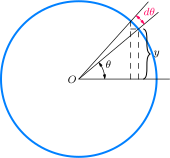
Fig. 15.1

La quantité du côté droit est la différence entre deux sinus, et les livres sur la trigonométrie nous indiquent comment la résoudre. Car ils nous disent que si \(M\) et \(N\) sont deux angles différents, \[\sin M - \sin N = 2 \cos\frac{M+N}{2}\cdot\sin\frac{M-N}{2}.\]

Si, alors, nous posons \(M= \theta + d \theta\) pour un angle, et \(N= \theta\) pour l'autre, nous pouvons écrire \[\begin{align} dy &= 2 \cos\frac{\theta + d\theta + \theta}{2} \cdot \sin\frac{\theta + d\theta - \theta}{2}, \end{align}\] ou, \[\begin{align} dy &= 2\cos\left(\theta + \frac{1}{2}d\theta\right)\cdot \sin\frac{d\theta}{2}. \end{align}\]

Mais si nous considérons \(d \theta\) comme indéfiniment petit, alors dans la limite nous pouvons négliger \(\frac{1}{2} d \theta\) par rapport à \(\theta\), et nous pouvons également considérer \(\sin\frac{d\theta}{2}\) comme étant le même que \(\frac{1}{2} d \theta\). L'équation devient alors: \[\begin{align} dy &= 2 \cos \theta \times \frac{1}{2} d \theta; \\ dy &= \cos \theta \cdot d \theta, \end{align}\] et, finalement, \[\begin{align} \dfrac{dy}{d \theta} &= \cos \theta. \end{align}\] [Remarquez que l'approximation \(\sin \frac{d\theta}{2}\approx \frac{d\theta}{2}\) est vraie seulement lorsque \(d\theta\) est mesuré en radians.]

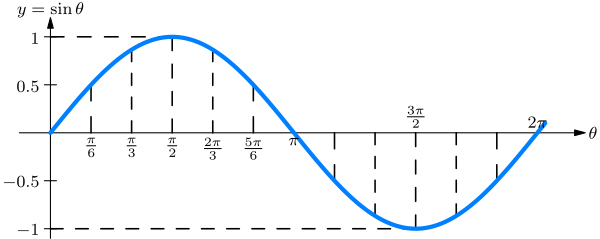
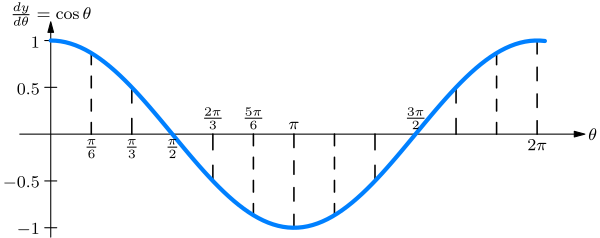
Les courbes accompagnantes dans les deux figures suivantes montrent, tracées à l'échelle, les valeurs de \(y=\sin \theta\), et \(\dfrac{dy}{d\theta}=\cos\theta\), pour les valeurs correspondantes de \(\theta\).

Fig. 15.2


Fig. 15.3

Dérivée du Cosinus

Prendre ensuite le cosinus.

Soit \(y=\cos \theta\).

Maintenant \(\cos \theta=\sin\left(\dfrac{\pi}{2}-\theta\right)\).

Par conséquent \[\begin{align} dy = d\left(\sin\left(\frac{\pi}{2} - \theta\right)\right) &= \cos\left(\frac{\pi}{2} - \theta\right) \times d(-\theta), \\ &= \cos\left(\frac{\pi}{2} - \theta\right) \times (-d\theta), \end{align}\] \[\frac{dy}{d\theta} = -\cos\left(\frac{\pi}{2} - \theta\right).\] Et il s'ensuit que \[\frac{dy}{d\theta} = -\sin \theta.\]

Dérivée de la Tangente

Enfin, prenons la tangente.

Comme \(\tan\theta=\dfrac{\sin\theta}{\cos\theta}\), nous pouvons appliquer la Règle du Quotient pour trouver \(\dfrac{d(\tan\theta)}{d\theta}\):2

\[\begin{align} \frac{d(\tan\theta)}{d\theta}&=\frac{\cos\theta \dfrac{d(\sin\theta)}{d\theta}-\sin\theta \dfrac{d(\cos\theta)}{d\theta}}{\cos^2\theta}\\ &=\frac{\cos\theta \cdot \cos\theta -\sin\theta (-\sin\theta)}{\cos^2\theta}\\ &=\frac{\cos^2\theta+\sin^2\theta}{\cos^2\theta} \end{align}\] Puisque \[\frac{\cos^2\theta+\sin^2\theta}{\cos^2\theta}=1+\left(\frac{\sin \theta}{\cos \theta}\right)^2\] nous obtenons \[\frac{d(\tan\theta)}{d\theta}=1+\tan^2 \theta.\] De plus, puisque \(\sin^2\theta+\cos^2\theta=1\), nous obtenons \[\frac{d(\tan\theta)}{d\theta}=\frac{1}{\cos^2\theta}=\sec^2\theta.\] Par conséquent, \[\frac{d(\tan\theta)}{d\theta}=\sec^2\theta=1+\tan^2\theta.\]

Résumé des Résultats

En recueillant ces résultats, nous avons: \[\begin{array}{|c|c|} \hline y & \dfrac{dy}{d\theta} \\[9pt] \hline \sin\theta & \cos\theta \\[9pt] \cos\theta & -\sin\theta\\[9pt] \tan\theta & \sec^2\theta=1+\tan^2 \theta\\[9pt] \hline \end{array}\]

Pour déduire les résultats ci-dessus, nous avons remplacé \(\sin(d\theta/2)\) par \(d\theta/2\). En général, \(\sin x\) est approximativement égal à \(x\) lorsque (1) \(x\) est petit (2) \(x\) est mesuré en radians \[\sin x\approx x \qquad (x \text{ est petit et mesuré en radians}).\] Par exemple, \(1^\circ\) est la même chose que \(\frac{\pi}{180}\) radians, et nous ne pouvons pas approximer \(\sin 1^\circ\) par 1 \[\sin 1^\circ\neq 1\] mais \[\sin 1^\circ=\sin\frac{\pi}{180}\approx \frac{\pi}{180}=0.017.\] Par conséquent, les résultats tabulés ci-dessus ne sont vrais que lorsque \(\theta\) est mesuré en radians.


Parfois, dans les questions mécaniques et physiques, comme par exemple dans le mouvement harmonique simple et dans les mouvements d'onde, nous devons traiter des angles qui augmentent en proportion du temps. Ainsi, si \(T\) est le temps d'une période complète, ou d'un mouvement autour du cercle, alors, puisque l'angle tout autour du cercle est \(2\pi\) radians, (équivalent à \(360^\circ\)), la quantité d'angle parcourue pendant le temps \(t\), sera \[\begin{align} \theta &= 2\pi\frac{t}{T},\quad \text{en radians.} \end{align}\] Si la fréquence, ou le nombre de périodes par seconde, est désigné par \(n\), alors \(n = \dfrac{1}{T}\), et nous pouvons alors écrire: \[\theta=2\pi nt.\] Nous aurons alors \[y = \sin (2\pi nt).\]

Si, maintenant, nous souhaitons savoir comment le sinus varie par rapport au temps, nous devons différencier par rapport non à \(\theta\), mais à \(t\). Pour cela, nous devons recourir à la règle de la chaîne expliquée dans le chapitre sur la Règle de la Chaîne, et mettre \[\frac{dy}{dt} = \frac{dy}{d\theta} \cdot \frac{d\theta}{dt}.\]

Maintenant \(\dfrac{d\theta}{dt}\) sera évidemment \(2\pi n\); de sorte que \[\begin{align} \frac{dy}{dt} &= \cos \theta \times 2\pi n \\ &= 2\pi n \cdot \cos (2\pi nt). \end{align}\] De même, il s'ensuit que \[\begin{align} \frac{d\left(\cos (2\pi nt)\right)}{dt} &= -2\pi n \cdot \sin (2\pi nt). \end{align}\]

Secondes Dérivées du Sinus et du Cosinus

Nous avons vu que lorsque \(\sin \theta\) est différencié par rapport à \(\theta\), il devient \(\cos \theta\); et que lorsque \(\cos \theta\) est différencié par rapport à \(\theta\), il devient \(-\sin \theta\); ou, en symboles, \[\frac{d^2({\sin \theta})}{d\theta^2} = -\sin \theta.\]

Nous avons donc ce résultat curieux que nous avons trouvé une fonction telle que si nous la différencions deux fois, nous obtenons la même chose que celle avec laquelle nous avons commencé, mais avec le signe changé de \(+\) à \(-\).

La même chose est vraie pour le cosinus; car le différenciant \(\cos\theta\) nous donne \(-\sin\theta\), et le différenciant \(-\sin\theta\) nous donne \(-\cos\theta\); ou donc: \[\frac{d^2(\cos\theta)}{d\theta^2} = -\cos\theta.\]

Les sinus et cosinus sont les seules fonctions dont la seconde dérivée est égale (et de signe opposé) à la fonction originale.

Exemples

Avec ce que nous avons appris jusqu'à présent, nous pouvons maintenant différencier des expressions d'une nature plus complexe.

Exemple 15.1. Si \(y=\arcsin x\), trouvez \(\dfrac{dy}{dx}\).

[Dans de nombreux manuels modernes de calcul, le sinus inverse est noté par \(\sin^{-1}\); c'est-à-dire, \(\arcsin x=\sin^{-1} x\). Notez que \(\sin^{-1} x\) n'est PAS la même chose que \(\frac{1}{\sin x}\). Pour éviter la confusion, la notation \(\arcsin x\) peut être préférée à \(\sin^{-1} x\) dans certains textes, y compris celui-ci.]

Solution. Si \(y\) est l'arc dont le sinus est \(x\), alors \(x = \sin y\). \[\frac{dx}{dy}=\cos y.\]

En passant maintenant de la fonction inverse à la fonction originale, nous obtenons \[\begin{align} \frac{dy}{dx} &= \frac{1}{\;\dfrac{dx}{dy}\;} = \frac{1}{\cos y}. \end{align}\] maintenant puisque \(\cos^2 y+\sin^2 y=1\), \[\cos y= \pm \sqrt{1-\sin^2 y}=\pm \sqrt{1-x^2};\] d'où \[\begin{align} \frac{dy}{dx} &=\frac{1}{\cos y}= \pm \frac{1}{\sqrt{1-x^2}}. \end{align}\] Mais lequel est correct? plus ou moins? Si nous regardons le graphe de \(y=\arcsin x\) (la figure suivante), nous réalisons que la pente de la courbe est toujours positive, indiquant que nous devons prendre la racine carrée positive. Ainsi, \[\frac{dy}{dx}=\frac{1}{\sqrt{1-x^2}}.\]
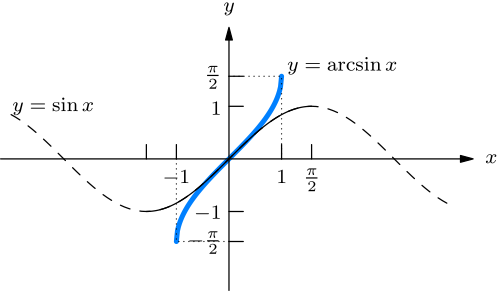
\[\begin{align} \boxed{\dfrac{d(\arcsin x)}{dx}=\dfrac{1}{\sqrt{1-x^2}}} \end{align}\]

Exemple 15.2. Si \(y=\cos^3 \theta\), trouvez \(\dfrac{dy}{d\theta}\).

Solution. Ceci est la même chose que \(y=(\cos \theta)^3\).

Soit \(\cos\theta=v\); alors \(y=v^3\);\(\dfrac{dy}{dv}=3v^2\). \[\begin{align} \frac{dv}{d\theta} &= -\sin\theta.\\ \frac{dy}{d\theta} &= \frac{dy}{dv} \times \frac{dv}{d\theta} = -3 \cos^2 \theta \sin\theta. \end{align}\]

Exemple 15.3. Si \(y=\sin(x+a)\), trouvez \(\dfrac{dy}{dx}\).

Solution. Soit \(x+a=v\); alors \(y=\sin v\). \[\frac{dy}{dv}=\cos v;\qquad \frac{dv}{dx}=1 \quad\text{et}\quad \frac{dy}{dx}=\cos(x+a).\]

Exemple 15.4. Si \(y=\ln \sin \theta\), trouvez \(\dfrac{dy}{d\theta}\).

Solution. Soit \(\sin\theta=v\);\(y=\ln v\). \[\begin{align} \frac{dy}{dv} &= \frac{1}{v};\quad \frac{dv}{d\theta}=\cos\theta;\\ \frac{dy}{d\theta} &= \frac{1}{\sin\theta} \times \cos\theta = \cot\theta. \end{align}\]

Exemple 15.5. Si \(y=\cot\theta=\dfrac{\cos\theta}{\sin\theta}\), trouvez \(\dfrac{dy}{d\theta}\).

Solution. \[\begin{align} \frac{dy}{d\theta} &= \frac{-\sin^2\theta - \cos^2 \theta}{\sin^2 \theta}\\ &= -(1+\cot^2 \theta) = -\text{csc}^2 \theta. \end{align}\]

Exemple 15.6. Si \(y=\tan 3\theta\), trouvez \(\dfrac{dy}{d\theta}\).

Solution. Soit \(3\theta=v\);\(y=\tan v\);\(\dfrac{dy}{dv}=\sec^2 v\). \[\frac{dv}{d\theta}=3;\quad \frac{dy}{d\theta}=3 \sec^2 3\theta.\]

Exemple 15.7. Si \(y = \sqrt{1+3\tan^2\theta}\), trouvez \(\dfrac{dy}{d\theta}\).

Solution. \(y=(1+3 \tan^2 \theta)^{\frac{1}{2}}\).

Soit \(3\tan^2\theta=v\). \[y = (1+v)^{\frac{1}{2}};\quad \frac{dy}{dv} = \frac{1}{2\sqrt{1+v}} \]   \[\frac{dv}{d\theta} = 6\tan\theta \sec^2 \theta \] (car, si \(\tan \theta = u\), \[\begin{align} v &= 3u^2;\quad \frac{dv}{du} = 6u;\quad \frac{du}{d\theta} = \sec^2 \theta; \end{align}\] d'où \(\displaystyle \frac{dv}{d\theta}= 6 \tan \theta \sec^2 \theta\);)
donc \[\begin{align} \frac{dy}{d\theta} &= \frac{6\tan\theta \sec^2\theta}{2\sqrt{1 + 3\tan^2\theta}}. \end{align}\]

Exemple 15.8. Si \(y=\sin x \cos x\), trouvez \(\dfrac{dy}{dx}\).

Solution. \[\begin{align} \frac{dy}{dx} &= \sin x(-\sin x) + \cos x \times \cos x = \cos^2 x - \sin^2 x. \end{align}\]

Exercices

Exercice 15.1. Différenciez les suivants: \[\begin{align} \text{(i)}\quad y &= A \sin\left(\theta - \frac{\pi}{2}\right).\\ \text{(ii)}\quad y &= \sin^2 \theta;\quad \text{et }\quad y = \sin 2\theta.\\ \text{(iii)}\quad y &= \sin^3 \theta;\quad \text{et }\quad y = \sin 3\theta. \end{align}\]


Réponse

(i) \(\dfrac{dy}{d\theta} = A \cos \left( \theta - \dfrac{\pi}{2} \right)\);


(ii) \(\dfrac{dy}{d\theta} = 2\sin\theta \cos\theta = \sin2\theta\) et \(\dfrac{dy}{d\theta} = 2\cos2\theta\);

(iii) \(\dfrac{dy}{d\theta} = 3\sin^2 \theta \cos\theta\) et \(\dfrac{dy}{d\theta} = 3\cos3\theta\).


Solution

(i) \(\displaystyle y=A \sin \left(\theta-\frac{\pi}{2}\right)\)


Nous écrivons \[y=A \sin u \quad \text { où }\quad u=\theta-\frac{\pi}{2}\] En utilisant la règle de la chaîne: \[\begin{align} \frac{d y}{d \theta}&= \frac{d y}{d u} \cdot \frac{d u}{d \theta} \\ & =(A \cos u)(1) \\ & =A \cos \left(\theta-\frac{\pi}{2}\right) \end{align}\]

(ii) Si \(y =\sin ^{2} \theta=(\sin \theta)^{2}\)

Soit \[y =u^{2} \quad \text { où }\quad u=\sin \theta\] En utilisant la règle de la chaîne: \[\begin{align} \frac{d y}{d \theta} & =\frac{d y}{d u} \cdot \frac{d u}{d \theta} \\ & =2 u \cdot \cos \theta \\ & =2 \sin \theta \cos \theta \end{align}\] Le résultat peut aussi être écrit comme \(\sin 2 \theta\) puisque \(\sin 2 \theta=2 \sin \theta \cos \theta.\)

Si \(y=\sin 2 \theta\), alors soit \[y=\sin u\quad \text { où }\quad u=2 \theta.\] En utilisant la règle de la chaîne: \[\begin{align} \frac{d y}{d \theta}&=\frac{d y}{d u} \cdot \frac{d u}{d \theta} \\ &=(\cos u)(2) \\ &=2 \cos (2 \theta) \end{align}\] Si \(y=\sin ^{3} \theta=(\sin \theta)^{3}\), nous écrivons \[y=u^{3}\quad \text{où}\quad u=\sin \theta\] Alors en utilisant la règle de la chaîne \[\begin{align} \frac{d y}{d \theta}&=\frac{d y}{d u} \cdot \frac{d u}{d \theta} \\ &=3 u^{2} \cdot \cos \theta \\ &=3(\sin \theta)^{2} \cdot \cos \theta \\ &=3 \cos \theta \sin ^{2} \theta \\ &=(\cos u) \cdot(3) \\ &=3 \cos 3 \theta \cdot \sin 3 \theta \end{align}\] Si \(y=\sin 3\theta\), nous écrivons \[y=\sin u\quad\text{où}\quad u=3\theta\] Alors \[\begin{align} \frac{dy}{d \theta}&=\frac{d y}{d u} \cdot \frac{d u}{d \theta} \\ &=(\cos u)(3)\\ &=3\cos {3\theta} \end{align}\]


Exercice 15.2. Trouvez la valeur de \(\theta\) pour laquelle \(\sin\theta \times \cos\theta\) est un maximum.


Réponse

\(\theta = 45^\circ\) ou \(\dfrac{\pi}{4}\) radians.


Solution


\[y=\sin \theta \cos \theta\]

Méthode 1) En utilisant la règle du produit:

\[\begin{align} \frac{d y}{d \theta}&=\cos \theta \cdot \cos \theta-\sin \theta \sin \theta \\ &=\cos ^{2} \theta-\sin ^{2} \theta \\ &=\cos 2 \theta \end{align}\] \[\frac{d y}{d \theta}=\cos 2 \theta=0\ \Leftrightarrow\ 2 \theta=\frac{\pi}{2}\ \text { ou }\ 2 \theta=\frac{3 \pi}{2}\] \[\frac{d y}{d \theta}=0\quad \Leftrightarrow \quad \theta=\frac{\pi}{4} \quad \text { ou } \quad \theta=\frac{3 \pi}{4}\] \[\begin{align} \frac{d^{2} y}{d \theta^{2}}&= \frac{d(\cos 2 \theta)}{d(2 \theta)} \cdot \frac{d(2 \theta)}{d \theta} \\ &=(-\sin 2 \theta)(2) \\ &=-2 \sin 2 \theta \end{align}\] Quand \(\theta=\dfrac{\pi}{4}\) \[\frac{d^{2} y}{d \theta^{2}}=-2<0\] Donc, la courbe est concave vers le bas, et ainsi quand \(\theta=\dfrac{\pi}{4}\), \(y\) a un maximum de \[\sin \left(\frac{\pi}{4}\right) \cos \left(\frac{\pi}{4}\right)=\frac{1}{\sqrt{2}} \cdot \frac{1}{\sqrt{2}}=\frac{1}{2}.\]

Quand \(\theta=\dfrac{3 \pi}{4}\) \[\frac{d^{2} y}{d \theta^{2}}=-2 \sin \left(\frac{3 \pi}{2}\right)=2>0\] donc, la courbe est concave vers le haut et ainsi quand \(\theta=\dfrac{3 \pi}{4}\), \(y\) a un minimum de \[\begin{align} \sin \left(\frac{3 \pi}{4}\right) \cos \left(\frac{3 \pi}{4}\right) & =\sin \left(\frac{\pi}{2}+\frac{\pi}{4}\right) \cos \left(\frac{\pi}{2}+\frac{\pi}{4}\right) \\ & =\cos \left(\frac{\pi}{4}\right) \times\left(-\sin \left(\frac{\pi}{4}\right)\right) \\ & =\frac{1}{\sqrt{2}} \times \frac{-1}{\sqrt{2}} \\ & =-\frac{1}{2}. \end{align}\]

Méthode 2)

\[y=\sin \theta \cdot \cos \theta=\frac{1}{2} \sin 2 \theta\] \(y\) est un maximum où que \(\sin 2 \theta\) soit un maximum et cela se produit quand \[2 \theta=\frac{\pi}{2} \text { ou } \quad \theta=\frac{\pi}{4}\] Le maximum de \(y\) est alors \(\frac{1}{2} \cdot \sin \left(\frac{\pi}{2}\right)=\frac{1}{2}\).


Exercice 15.3. Différenciez \(y=\dfrac{1}{2\pi} \cos (2\pi nt)\).


Réponse

\(\dfrac{dy}{dt} = -n \sin 2\pi nt\).


Solution

\[y=\frac{1}{2 \pi} \cos (2 \pi n t)\] Nous écrivons \[y=\frac{1}{2 \pi} \cos u \quad \text { où }\quad u=2 \pi n t\] \[\begin{align} \frac{d y}{d t} &= \frac{d y}{d u} \cdot \frac{d u}{d t} \\ &=-\frac{1}{2 \pi} \sin u \cdot 2 \pi n \\ &=-n \sin u \\ &= n \sin (2 \pi n t) \end{align}\]


Exercice 15.4. Si \(y = \sin a^x\), trouvez \(\dfrac{dy}{dx}\).


Réponse

\(a^x \ln a \cos a^x\).


Solution


\[y=\sin \left(a^{x}\right)\] Soit \(y=\sin u\)\(u=a^{x}\). Alors \[\begin{align} \frac{d y}{d x} & =\frac{d y}{d u} \cdot \frac{d u}{d x} \\ & =\cos u \cdot a^{x} \cdot \ln a \\ & =\cos \left(a^{x}\right) \cdot a^{x} \cdot \ln a \end{align}\]


Exercice 15.5. Différenciez \(y=\ln \cos x\).


Réponse


\(\dfrac{\cos x}{\sin x} = \cot x\)


Solution


\[y=\ln \cos x\]

Nous écrivons \(y=\ln u\)\(u=\cos x\). Alors

\[\begin{align} \frac{d y}{d x} & =\frac{d y}{d u} \cdot \frac{d u}{d x} \\ & =\frac{1}{u} \cdot(-\sin x) \\ & =\frac{1}{\cos x}(-\sin x) \\ & =-\tan x \end{align}\]


Exercice 15.6. Différenciez \(y=18.2 \sin(x+26)\).


Réponse

\(18.2 \cos \left(x + 26 \right)\).


Solution


\[y=18.2 \sin (x+26)\]

Nous écrivons \(y=18.2 \sin u\)\(u=x+26\). Alors

\[\begin{align} \frac{d y}{d x} & =\frac{d y}{d u} \cdot \frac{d u}{d x} \\ & =(18.2 \cos u)(1) \\ & =18.2 \cos (x+26) \end{align}\]


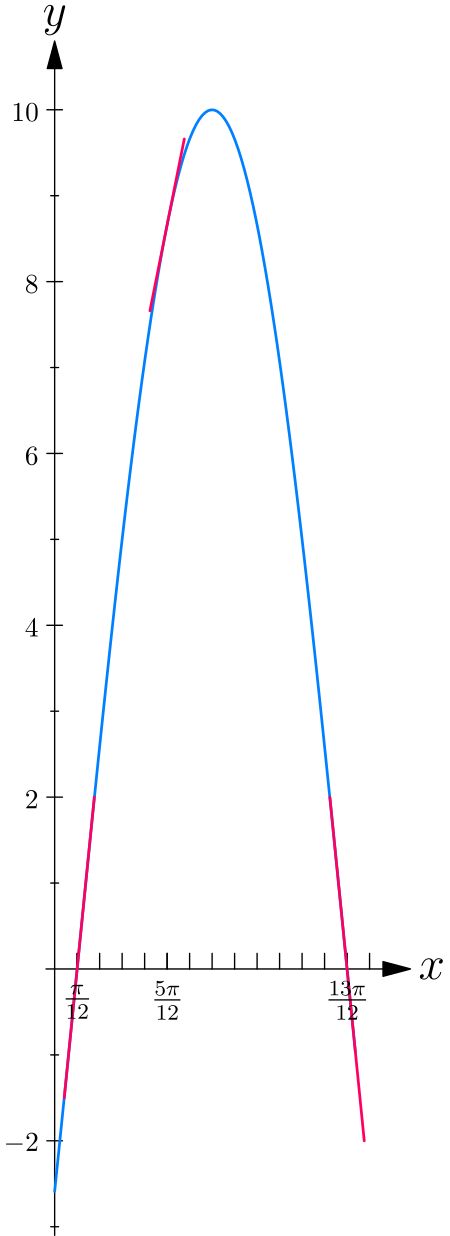
Exercice 15.7. Tracez la courbe \(y=10 \sin\left(\theta-\dfrac{\pi}{12}\right)\); et montrez que la pente de la courbe à \(\theta = \dfrac{5\pi}{12}\) est la moitié de la pente maximale.


Réponse

La pente est \(\dfrac{dy}{d\theta} = 100\cos\left(\theta -\frac{\pi}{12} \right)\), qui est un maximum quand \((\theta -\frac{\pi}{12}) = 0\), ou \(\theta = \frac{\pi}{12}\); la valeur de la pente étant alors \({}= 100\). Quand \(\theta = \frac{5\pi}{12}\) la pente est \(100\cos\left(\frac{5\pi}{12} - \frac{\pi}{12}\right) = 100\cos \frac{\pi}{3} = 100 \times \frac{1}{2} = 50\).


Solution


\[\begin{align} & y=10 \sin \left(\theta-\frac{\pi}{12}\right) \\ & \frac{d y}{d \theta}=10 \cos \left(\theta-\frac{\pi}{12}\right) \end{align}\]

Pour trouver la pente maximale, nous devons différencier \(\dfrac{d y}{d \theta}\) par rapport à \(\theta\) et égaler le résultat à zéro

\[\frac{d\left(\dfrac{d y}{d \theta}\right)}{d \theta}=\frac{d^{2} y}{d \theta^{2}}=-10 \sin \left(\theta-\frac{\pi}{12}\right)=0\]

\[\begin{align} \frac{d^{2} y}{d \theta^{2}}=0\quad\Leftrightarrow &\quad \theta-\frac{\pi}{12}=0 \quad \text { ou } \quad \theta-\frac{\pi}{12}=\pi \\ \frac{d^{2} y}{d \theta^{2}}=0\quad \Leftrightarrow &\quad \theta=\frac{\pi}{12} \quad \text { ou } \quad \theta=\frac{13 \pi}{12} \end{align}\]

Quand \(\theta=\dfrac{\pi}{12}\) \[\frac{d y}{d \theta}=10 \cos 0=10\quad (\text {pente max})\]

Quand \(\theta=\dfrac{13 \pi}{12}\) \[\frac{d y}{d \theta}=10 \cos (\pi)=-10 \quad (\text {pente min})\]

Pente quand \(\theta=\dfrac{5 \pi}{12}\): \[\begin{align} \frac{d y}{d \theta} & =10 \cos \left(\frac{5 \pi}{12}-\frac{\pi}{12}\right)=10 \cos \left(\frac{\pi}{3}\right) \\ & =10 \times \frac{1}{2}=5 . \end{align}\] Comme nous pouvons le voir, la pente de la courbe à \(\theta=\frac{5 \pi}{12}\), qui est 5, est la moitié de la pente maximale, qui est 10 et se produit quand \(\theta=\frac{\pi}{12}.\)


Exercice 15.8. Si \(y=\sin \theta\cdot\sin 2\theta\), trouvez \(\dfrac{dy}{d\theta}\).


Réponse

\[\begin{align} \cos\theta \sin2\theta + 2\cos2\theta \sin\theta &= 2\sin\theta\left(\cos^2 \theta + \cos2\theta\right) \\ &= 2\sin\theta\left(3\cos^2 \theta - 1\right). \end{align}\]


Solution


\[y=\sin \theta \cdot \sin 2 \theta\]

En utilisant la règle du produit:

\[\frac{d y}{d \theta}=\frac{d(\sin \theta)}{d \theta} \cdot \sin 2 \theta+\sin \theta \frac{d(\sin 2 \theta)}{d \theta}\]

Nous avons montré dans l'exercice 1 (ii) \(\dfrac{d(\sin 2 \theta)}{d \theta}=2 \cos 2 \theta\).

Par conséquent

\[\frac{d y}{d \theta}=\cos \theta \cdot \sin 2 \theta+2 \sin \theta \cos 2 \theta\]

Nous pouvons simplifier cela davantage en utilisant

\[\sin 2 \theta=2 \sin \theta \cos \theta\] et \[\cos 2 \theta=2 \cos ^{2} \theta-1.\]

\[\begin{align} \frac{d y}{d \theta} & =2 \sin \theta \cos ^{2} \theta+2 \sin \theta\left(2 \cos ^{2} \theta-1\right) \\ & =2 \sin \theta\left(\cos ^{2} \theta+2 \cos ^{2} \theta-1\right) \\ & =2 \sin \theta\left(3 \cos ^{2} \theta-1\right) . \end{align}\]


Exercice 15.9. Si \(y=a\cdot\tan^m(\theta^n)\), trouvez la dérivée de \(y\) par rapport à \(\theta\).


Réponse

\(amn\theta^{n-1} \tan^{m-1}\left(\theta^n\right)\sec^2 \theta^n\).


Solution

\[y=a \tan ^{m}\left(\theta^{n}\right)=a\left[\tan \left(\theta^{n}\right)\right]^{m}\] Nous écrivons \[y=a u^{m}\quad\text{ où }\quad u=\tan v\ \text{ et }\ v=\theta^{n}.\] Alors


\[\begin{align} & \frac{d y}{d \theta}=\frac{d y}{d u} \cdot \frac{d u}{d v} \cdot \frac{d v}{d \theta} \\ &=a m u^{m-1} \cdot \sec ^{2} v \cdot n \cdot \theta^{n-1} \\ &=a m (\tan v)^{m-1} \cdot \sec ^{2} v \cdot n \cdot \theta^{n-1} \\ &=a \cdot m \cdot n \cdot\left[\tan \left(\theta^{n}\right)\right]^{m-1} \cdot \sec ^{2}\left(\theta^{n}\right) \cdot \theta^{n-1} \end{align}\] Notez que \(\sec ^{2}\left(\theta^{n}\right)\) signifie \(\left[\sec \left(\theta^{n}\right)\right]^{2}\) et \(\left[\tan \left(\theta^{n}\right)\right]^{m-1}\) peut être écrite comme \(\tan ^{m-1}\left(\theta^{n}\right)\). Donc \[\frac{d y}{d \theta}=a m n \theta^{n-1} \tan ^{m-1}\left(\theta^{n}\right) \sec ^{2}\left(\theta^{n}\right)\]


Exercice 15.10. Si \(y=e^x \sin^2 x\), trouvez \(\dfrac{dy}{dx}\) et \(\dfrac{d^2y}{dx^2}\).


Réponse

\(e ^x \left(\sin^2 x + \sin2x\right)\); \(e ^x \left(\sin^2 x + 2\sin2x + 2\cos2x\right)\).


Solution

\[y=e^{x} \sin ^{2} x=e^{x}(\sin x)^{2}\]


\[\frac{d y}{d x}=\frac{d\left(e^{x}\right)}{d x} \sin ^{2} x+e^{x} \frac{d\left(\sin ^{2} x\right)}{d x}\]

Pour trouver \(\dfrac{d\left(\sin ^{2} x\right)}{d x}\), nous remarquons que

\[\sin ^{2} x=(\sin x)^{2}\]

et

\[\begin{align} \frac{d\left(u^{2}\right)}{d x} & =\frac{d\left(u^{2}\right)}{d u} \cdot \frac{d u}{d x} \qquad(u=\sin x) \\ & =2 u \cdot \cos x \\ & =2 \sin x \cos x \\ & =\sin 2 x \end{align}\] Par conséquent \[\begin{align} \frac{d y}{d x} & =\frac{d\left(e^{x}\right)}{d x} \sin ^{2} x+e^{x} \frac{d\left(\sin ^{2} x\right)}{d x} \\ & =e^{x} \sin ^{2} x+e^{x} \sin 2 x \\ & =e^{x}\left(\sin ^{2} x+\sin 2 x\right) \end{align}\]

La seconde dérivée : \[\begin{align} \frac{d y}{d x}&= \frac{d\left(e^{x}\left(\sin ^{2} x+\sin 2 x\right)\right)}{dx}\\ &=\frac{d(e^x)}{dx}\left(\sin ^{2} x+\sin 2 x\right)+e^x\left(\frac{d(\sin^2 x)}{dx}+\frac{d(\sin 2x)}{dx}\right)\\ &=e^x\left(\sin ^{2} x+\sin 2 x\right)+e^x\left(\underbrace{2\cos x \sin x}_{\sin 2x}+2\cos 2x\right)\\ &=e^x\left(\sin^2 x+2\sin 2x+2\cos 2x\right). \end{align}\]


Exercice 15.11. Différenciez les trois équations des Exercices 14.II (voir ici), No. 4, et comparez leurs dérivées, quant à savoir si elles sont égales, ou presque égales, pour des valeurs très petites de \(x\), ou pour des valeurs très grandes de \(x\), ou pour des valeurs de \(x\) dans le voisinage de \(x=b\).


Réponse

\(\left(i\right) \dfrac{dy}{dx} = \dfrac{ab}{\left(x + b\right)^2}\); (ii) \(\dfrac{a}{b} e ^{-\frac{x}{b}}\); (iii) \(\dfrac{2ab}{\pi}\cdot\dfrac{1}{\left(b^2 + x^2\right)}\).


Solution


(i) En utilisant la règle du quotient: \[\frac{d y}{d x}=\frac{a(x+b)-a x}{(x+b)^{2}}=\frac{a b}{(x+b)^{2}}\]

(ii) \(\dfrac{d y}{d x}=-a \times\left(-\frac{1}{b}\right) e^{-\frac{x}{b}}=\frac{a}{b} e^{-\frac{x}{b}}\)

(iii) Pour différencier \(y=\dfrac{2 a}{\pi} \arctan \left(\frac{x}{b}\right)\), nous écrivons \[y =\frac{2 a}{\pi} \arctan u \quad\text{où}\quad u=\frac{x}{b}.\] Puis \[\begin{align} \frac{d y}{d x} & =\frac{d y}{d u} \cdot \frac{d u}{d x} \\ & =\frac{2 a}{\pi} \frac{1}{1+u^{2}} \cdot \frac{1}{b} \\ & =\frac{2 a}{\pi b} \frac{1}{1+\left(\frac{x}{b}\right)^{2}} \\ & =\frac{2 a b}{\pi} \frac{1}{x^{2}+b^{2}} \end{align}\]

Quand \(x\) est très grand

\[\begin{align} & \frac{a b}{(x+b)^{2}} \approx \frac{a b}{x^{2}} \approx 0 \\ & \frac{a}{b} e^{-\frac{x}{b}} \approx \frac{a}{b} \times 0=0 \\ & \frac{2 a b}{x^{2}+b^{2}} \approx \frac{2 a b}{x^{2}} \approx 0 \end{align}\]

Par conséquent, leurs pentes sont presque nulles pour de grandes valeurs de \(x\).

Quand \(x \approx 0\) \[\begin{align} & \frac{a b}{(x+b)^{2}} \approx \frac{a b}{b^{2}}=\frac{a}{b} \\ & e^{-\frac{x}{b}} \approx 1 \Rightarrow \frac{a}{b} e^{-\frac{x}{b}} \approx \frac{a}{b} \\ & \frac{2 a b}{x^{2}+b^{2}} \approx \frac{2 a b}{b^{2}}=\frac{2 a}{b} \end{align}\] Quand \(x\) est petit (\(x\approx 0\)), les pentes de \(y=\frac{a x}{x+b}\) et \(y=a\left(1-e^{-\frac{x}{b}}\right)\) sont presque identiques, mais la pente de \(\frac{2 a}{\pi} \arctan \left(\frac{x}{b}\right)\) est deux fois plus grande qu'elles.

Quand \(x \approx b\) \[\begin{align} & \frac{a b}{(x+b)^{2}} \approx \frac{a b}{(2 b)^{2}}=\frac{a}{4 b} \\ & \frac{a}{b} e^{-\frac{x}{b}} \approx \frac{a}{b} \cdot e^{-1}=\frac{a}{2.78 b} \\ & \frac{2 a b}{x^{2}+b^{2}} \approx \frac{2 a b}{2 b^{2}}=\frac{a}{b} . \end{align}\]


Exercice 15.12. Différenciez les suivants: \[\begin{align} \text{(i)}\quad y &= \sec x. & \text{(ii)}\quad y &= \arccos x. \\ \text{(iii)}\quad y &= \arctan x. & \text{(iv)}\quad y &= \text{arcsec} x. \\ \text{(v)}\quad y &= \tan x \times \sqrt{3 \sec x}. && \end{align}\]


Réponse

(i) \(\dfrac{dy}{dx} = \sec x \tan x\);


(ii) \(\dfrac{dy}{dx} = - \dfrac{1}{\sqrt{ 1 - x^2}}\);

(iii) \(\dfrac{dy}{dx} = \dfrac{1}{ 1 + x^2}\);

(iv) \(\dfrac{dy}{dx} = \dfrac{1}{|x| \sqrt{ x^2 - 1}}\);

(v) \(\dfrac{dy}{dx} = \dfrac{\sqrt{ 3\sec x} \left(3\sec^2 x - 1\right)}{2}\).


Solution


(i) \(y=\sec x=\dfrac{1}{\cos x}\)
En utilisant la règle du quotient \[\begin{align} \frac{d y}{d x} & =\frac{-(-\sin x)}{\cos ^{2} x}=\frac{\sin x}{\cos x} \cdot \frac{1}{\cos x} \\ & =\tan x \cdot \sec x . \end{align}\]

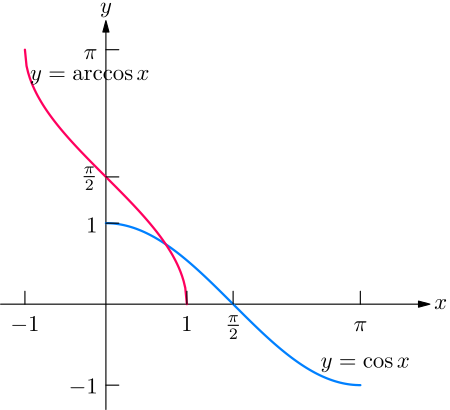
(ii) \(y=\arccos x\) (ou \(y=\cos ^{-1} x\) )

Si \(y=\arccos x\), alors \(x=\cos y\) et \[\frac{d x}{d y}=-\sin y\]

\[\begin{align} \frac{d y}{d x} & =\frac{1}{\frac{d x}{d y}} \\ & =\frac{1}{-\sin y} \end{align}\] Puisque \(\sin y= \pm \sqrt{1-\cos ^{2} y}\) \[\frac{d y}{d x}=\frac{1}{-\sqrt{1-\cos ^{2} y}}\] Puisque \(x=\cos y\) \[\frac{d y}{d x}=\frac{1}{\mp \sqrt{1-x^{2}}}\] Mais lequel est correct? Le signe \(-\) ou le signe \(+\)? Si nous regardons le graphe de \(y=\arccos x\), la pente est négative partout.

Donc \[\frac{d(\arccos x)}{d x}=\frac{-1}{\sqrt{1-x^{2}}}\]

(iii) Si \(y=\arctan x\), alors \(x=\tan y\) et

\[\frac{d x}{d y}=1+\tan ^{2} y \quad\left(\text { ou } \sec ^{2} y\right)\] Par conséquent,

\[\begin{align} \frac{d y}{d x} & =\frac{1}{\dfrac{d x}{d y}} \\ & =\frac{1}{1+\tan ^{2} y} \\ & =\frac{1}{1+x^{2}} \end{align}\]

(iv) Si \(y=\operatorname{arcsec} x\) alors \(x=\sec y\). Dans la partie (i), nous avons montré que

\[\frac{d x}{d y}=\tan y \cdot \sec y \text {. }\] Donc \[\begin{align} \frac{d y}{d x} & =\frac{1}{\dfrac{d x}{d y}} \\ & =\frac{1}{\tan y \cdot \sec y} \end{align}\] Puisque \(1+\tan ^{2} y=\sec ^{2} y \Rightarrow \tan y= \pm \sqrt{\sec ^{2} y-1}\), nous avons \[\begin{align} \frac{d y}{d x} & =\frac{1}{ \pm \sqrt{\sec ^{2} y-1} \cdot \sec y} \\ & =\frac{1}{ \pm x \sqrt{x^{2}-1}} . \end{align}\]

Maintenant, nous devons décider du signe.
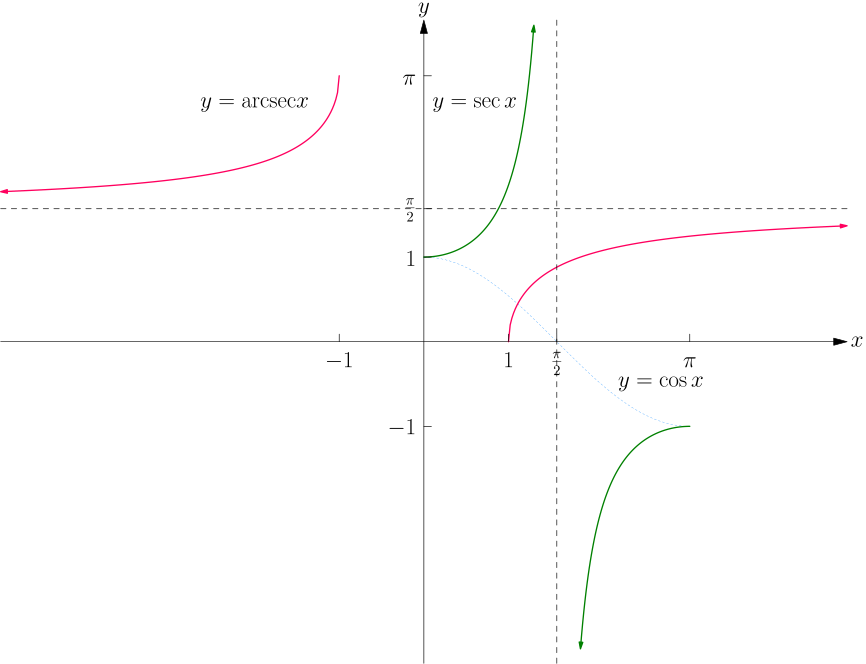
Comme nous pouvons le voir sur le graphe \(y=\operatorname{arcsec} x\), la pente est toujours positive. Donc nous devons avoir

\[\begin{align} & \frac{d y}{d x}=\frac{1}{x \sqrt{x^{2}-1}} &&\text { si } x \geq 1 \\ & \frac{d y}{d x}=\frac{1}{-x \sqrt{x^{2}-1}} &&\text { si } x \leq-1 \end{align}\] Nous pouvons combiner ces deux et écrire \[\frac{d y}{d x}=\frac{1}{|x| \sqrt{x^{2}-1}}\]

(v) \(y=\tan x\times \sqrt{3 \sec x}=\sqrt{3}\, \tan x \cdot \sqrt{\sec x}\).

En utilisant la règle du produit: \[\frac{d y}{d x}=\sqrt{3}\left[\frac{d(\tan x)}{d x} \cdot \sqrt{\sec x}+\tan x \frac{d(\sqrt{\sec x})}{d x}\right]\]

Pour trouver \(\dfrac{d\left(\sqrt{\sec x}\right)}{d x}\), soit