Often, in addition to the differential equation, the unknown function is required to satisfy certain conditions at one or more points within the interval of interest.
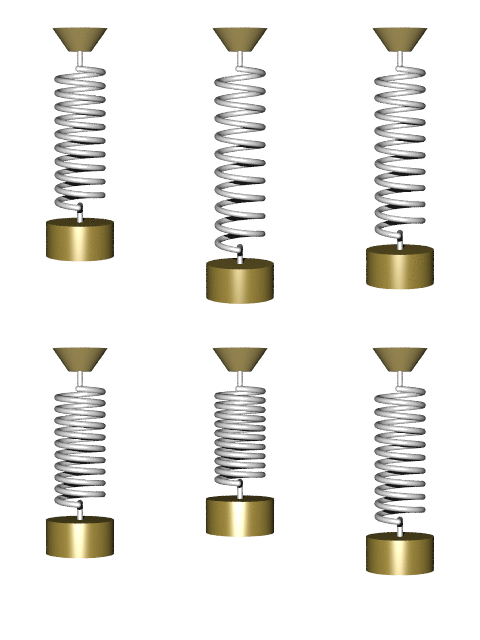
For example, considering an oscillator connected to a spring (see the following figure), in addition to the governing differential equation
where m is the mass of the body, k is the spring constant, and F(t) is the applied force, we are required to know its initial position and initial velocity
in order to determine its position (
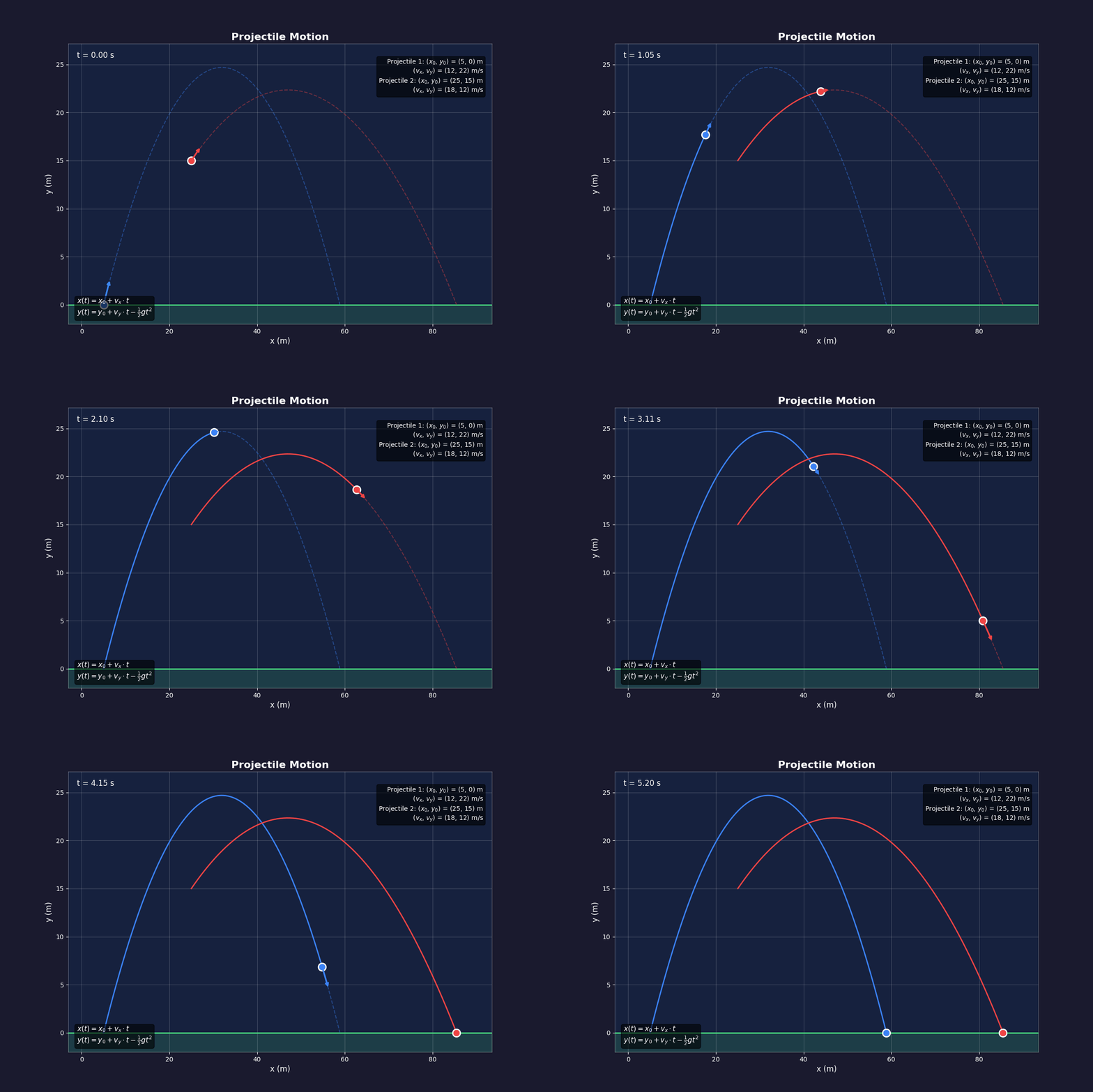
Similarly, we need to know the initial position (x(0), y(0)) and initial velocity components (
Another example would be the deformation of a beam. In addition to the governing equation

What is the difference between the first two examples and the last one? In the first two examples, the additional conditions are specified at the same value of the independent variable, say
In the last example, the additional conditions are specified at the endpoints (or boundaries) of the interval of interest (
When these conditions are specified at the same value of
BVPs (Boundary Value Problems) and IVPs (Initial Value Problems) are two fundamental types of differential equation problems that specify different kinds of conditions for the solutions of the differential equations.
Initial Value Problem (IVP)
An Initial Value Problem involves a differential equation along with some additional conditions specified at a single point. For example, given a differential equation like
for example constitute an initial value problem because both conditions are specified at
The key characteristic of an IVP is that the initial conditions are given at one specific point, and the solution is typically sought within an interval starting from this point.
IVPs are common in problems where the state at a starting time is known, and the objective is to predict the future behavior, such as the motion of a projectile at the moment it is launched.
Boundary Value Problem (BVP)
A Boundary Value Problem involves a differential equation along with conditions specified at two or more points. For instance, for the equation
BVPs are characterized by the requirement to satisfy the conditions at multiple boundaries, which can make them more complex to solve than IVPs.
Such problems are typical in steady-state phenomena where conditions are known at spatial boundaries, like the temperature distribution along a rod that is heated at both ends.
The numerical methods for solving IVPs and BVPs can differ significantly, primarily due to the nature of the conditions that need to be satisfied. Numerical methods for IVPs often proceed forward from the known initial condition, while BVPs might require iterative techniques that adjust the solution until it satisfies conditions at all specified boundaries.
Mixed Problems
In some partial differential equations, both initial conditions and boundary conditions are required. Consider the vibration of a string or a heat distribution problem. In such a problem, not only do we need to know the conditions of the string (position of the string points) or the temperature of every point, but we also need the conditions at both ends, say the temperature on the boundary or the fact that the string is fixed at both ends.
Neither IVP nor BVP
Not every differential equation problem comes with initial conditions and/or boundary conditions. But these two types of conditions are the most common ones.