Some Important
Formulas
Binomial theorem \begin{align} (a+b)^n=a^n+n a^{n-1}b+\frac{n(n-1)}{2!}a^{n-2}b^2+\frac{n(n-1)(n-2)}{3!}a^{n-3}b^3+\cdots \end{align}
\displaystyle \log_c (AB)=\log_c A+\log_c B
\displaystyle \log_c \left(A^n\right)=n \log_c A
\displaystyle \log_c \sqrt[n]{A}=\log_c \left(A^{\frac{1}{n}}\right)=\frac{1}{n}\log_c A
\displaystyle \log_c\frac{A}{B}=\log_cA-\log_c B
\displaystyle \log_c A=\dfrac{\log_b A}{\log_b c}
\displaystyle \tan x=\frac{\sin x}{\cos x}
\cot x=\dfrac{1}{\tan x}=\dfrac{\cos x}{\sin x}.
\sec x=\dfrac{1}{\cos x}
\csc x=\dfrac{1}{\sin x}
\sin(-x)=-\sin x
\cos(-x)=\cos x
\tan(-x)=-\tan x
\sin^2 x+\cos^2 x=1
\sin(A\pm B)=\sin A \cos B\pm \cos A\sin B
\cos(A\pm B)=\cos A\cos B\mp\sin A\sin B
\tan(A+B)=\dfrac{\tan A+\tan B}{1-\tan A\tan B}
\tan(A-B)=\dfrac{\tan A-\tan B}{1+\tan A\tan B}
\sin 2x=2\sin x\cos x
\cos 2x=\cos^2 x-\sin^2 x or
\cos 2x=1-2\sin^2 x or
\cos 2x=2\cos^2 x-1\tan 2x=\dfrac{2\tan x}{1-\tan^2x}
\sin^2 x=\dfrac{1-\cos 2x}{2}
\cos^2 x=\dfrac{1+\cos 2x}{2}
\cos\left(\dfrac{\pi}{2}-x\right)=\sin x
\sin\left(\dfrac{\pi}{2}-x\right)=\cos x
\cot\left(\dfrac{\pi}{2}-x\right)=\tan x
\tan\left(\dfrac{\pi}{2}-x\right)=\cot x
\sin(\pi -x)=\sin x
\cos(\pi -x)=-\cos x
\tan(\pi-x)=-\tan x
\sin A+\sin B=2\sin\dfrac{A+B}{2}\cos\dfrac{A-B}{2}
\cos A+\cos B=2\cos\dfrac{A+B}{2}\cos\dfrac{A-B}{2}
\sin M \cos N=\dfrac{1}{2}\left[\sin(M-N)+\sin(M+N)\right]
\sin M \sin N=\dfrac{1}{2}\left[\cos(M-N)-\cos(M+N)\right]
\cos M \cos N=\dfrac{1}{2}\left[\cos(M-N)+\cos(M+N)\right]
If \theta is the angle between two lines whose slopes are m_1 and m_2, then \tan\theta=\frac{m_1-m_2}{1+m_1m_2}
Two lines whose slopes are m_1 and m_2 are parallel if m_1=m_2 and are perpendicular if m_1=-\dfrac{1}{m_2}.
Transforming from polar coordinates to rectangular coordinates x=r\cos\theta,\qquad\text{and}\qquad y=r\sin\theta
The area of a triangle with length sides a, b, and c is A=\sqrt{s(s-a)(s-b)(s-c)} where s is half the perimeter or s=\dfrac{a+b+c}{2}.
Volume of a sphere of radius r: V=\dfrac{4}{3}\pi r^3
Surface area of a sphere of radius r: A=4\pi r^2
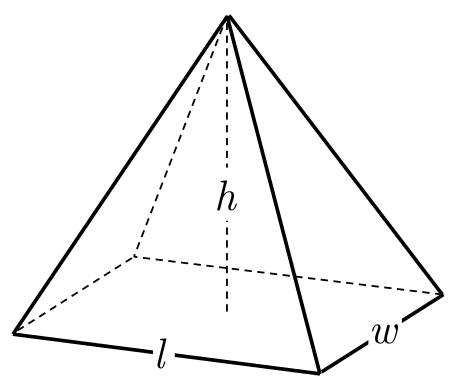
Volume of a rectangular pyramid V=lwh/3
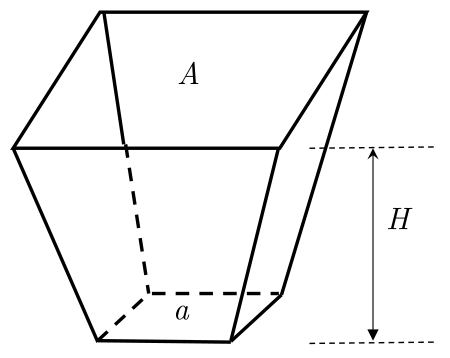
Volume of a frustum of pyramid of height h and of base areas A and a: V=\frac{h}{3}(A+a+\sqrt{Aa})
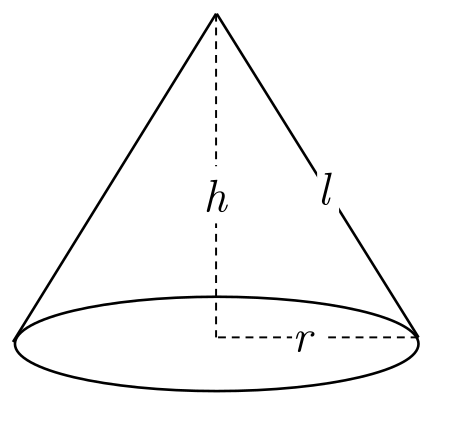
Volume of a cone of radius r and height h V=\frac{1}{3}h\pi r^2
Lateral area of a cone of radius r and height h: A_L=\pi r\sqrt{h^2+r^2}. This can also be written as A_L=\pi r l, where l is its slant height.