Chapter Summary (Express)
Why does anybody want to differentiate twice over?
In the context of space and time, performing a second differentiation provides the acceleration of a moving body.
In the geometrical interpretation, as applied to curves, means the slope of the curve. However, denotes the rate at which the slope changes per unit of length , offering insight into the variation of the curve’s slope and indicating whether it curves upward or downward as increases.
Returning to the process of successive differentiation, it may be asked: Why does anybody want to differentiate twice over? We know that when the variable quantities are space and time, by differentiating twice over we get the acceleration of a moving body, and that in the geometrical interpretation, as applied to curves, means the slope of the curve. But what can mean in this case? Clearly it means the rate (per unit of length ) at which the slope is changing—in brief, it is an indication of the manner in which the slope of the portion of curve considered varies, that is, whether the slope of the curve increases or decreases when increases, or, in other words, whether the curve curves up or down towards the right.
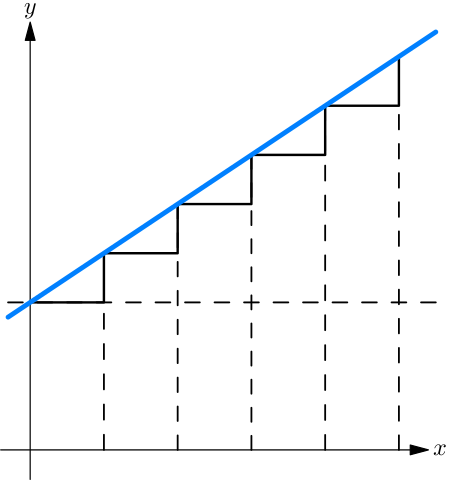
Suppose a slope constant, as in the following figure.
Here, is of constant value.
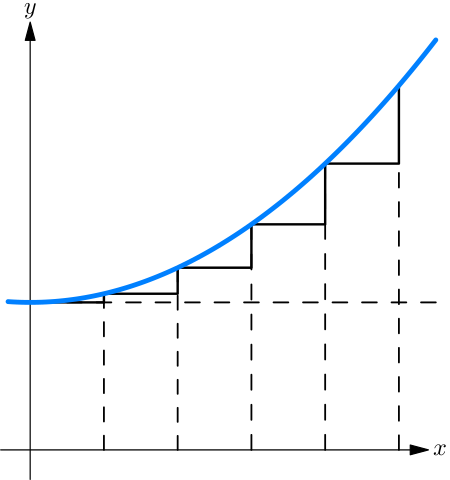
Suppose, however, a case in which, like the next figure, the slope itself is getting greater upwards, then , that is, , will be positive.
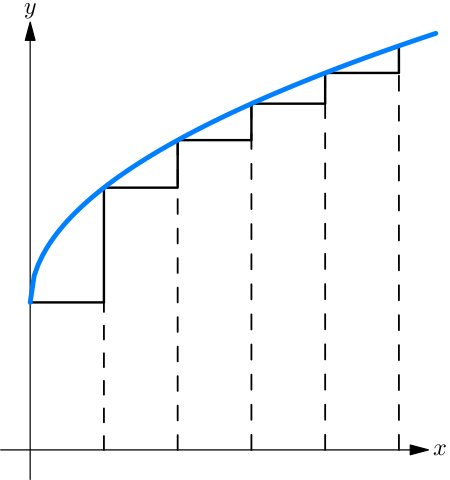
If the slope is becoming less as you go to the right as in the following figure, then, even though the curve may be going upward, since the change is such as to diminish its slope, its will be negative.
To determine whether the result obtained by equating to zero corresponds to a maximum or a minimum, you can apply the second derivative test:
After differentiating once, differentiate the expression again and observe the sign of the second derivative, .
If is positive, the value of obtained represents a minimum, while a negative indicates a maximum.
It is now time to initiate you into another secret—how to tell whether the result that you get by “equating to zero” is a maximum or a minimum. The trick is this: After you have differentiated (so as to get the expression which you equate to zero), you then differentiate a second time, and look whether the result of the second differentiation is positive or negative. If comes out positive, then you know that the value of which you got was a minimum; but if comes out negative, then the value of which you got must be a maximum. That’s the rule.
Why the Second Derivative Test works
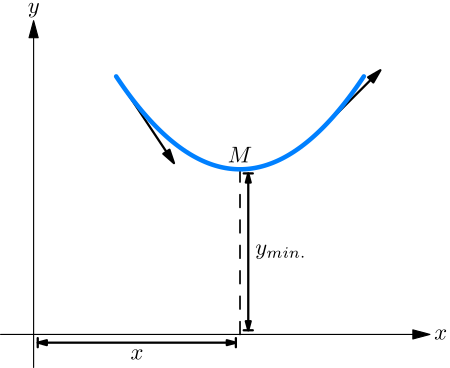
The reason of it ought to be quite evident. Think of any curve that has a minimum point in it (like the next figure) where the point of minimum is marked , and the curve is concave upward.1 To the left of the slope is downward, that is, negative, and is getting less negative. To the right of the slope has become upward, and is getting more and more upward. Clearly the change of slope as the curve passes through is such that is positive, for its operation, as increases toward the right, is to convert a downward slope into an upward one.
Similarly, consider any curve that has a maximum point in it (like the next figure) where the curve is concave downward,2 and the maximum point is marked . In this case, as the curve passes through from left to right, its upward slope is converted into a downward or negative slope, so that in this case the “slope of the slope” is negative.
This is called the second derivative test for maxima and minima.
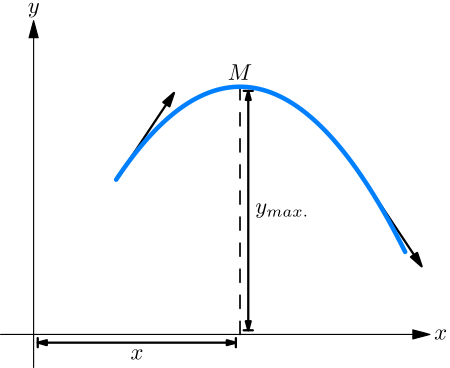
In summary:
If , the curve is concave upward (or convex).
If , the curve is concave downward (or concave).
and
The Second Derivative Test
Suppose for some particular value of :
If for this particular value of , the value of for this is a minimum.
If for this particular value of , the value of for this is a maximum.
Go back now to the examples of the last chapter and verify in this way the conclusions arrived at as to whether in any particular case there is a maximum or a minimum. You will find below a few worked out examples.
Example 12.1. Find the maximum or minimum of and ascertain if it be a maximum or a minimum in each case.
Solution
(a) \begin{align} \dfrac{dy}{dx}= 8x-9=0\quad \Rightarrow\quad x=1\frac{1}{8}. \end{align} The value of for (or at) is . (b)
The value of for is
The graphs of and are shown below.
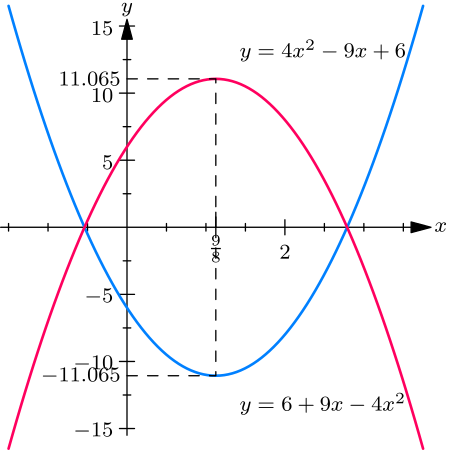
Example 12.2. Find the maxima and minima of the function .
Solution
hence corresponds to a minimum . For , is ; hence corresponds to a maximum .
The graph of is shown below.
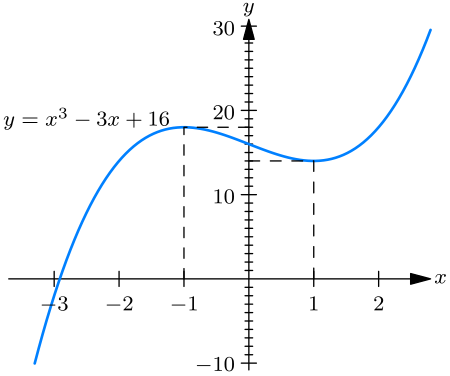
Example 12.3. Find the maxima and minima of .
Solution
or , whose solutions are and . \begin{align} \dfrac{d^2y}{dx^2} &= - \frac{(x^2 + 2)^2 \times (2x-2) - (x^2 - 2x - 2)(4x^3 + 8x)}{(x^2 + 2)^4} \\ &= - \frac{2x^5 - 6x^4 - 8x^3 - 8x^2 - 24x + 8}{(x^2 + 2)^4}. \end{align}
The denominator is always positive, so it is sufficient to ascertain the sign of the numerator.
If we put , the numerator is negative; the maximum, .
If we put , the numerator is positive; the minimum, .
The graph of is shown below.
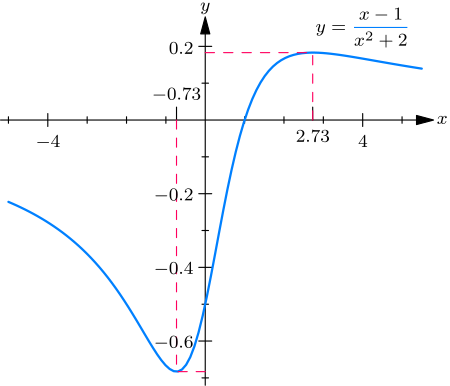
Example 12.4. The expense of handling the products of a certain factory varies with the weekly output according to the relation , where , , , are positive constants. For what output will the expense be least?
Solution
hence and .
As the output cannot be negative, .
Now which is positive for all the values of ; hence corresponds to a minimum.
Example 12.5. The total cost per hour of lighting a building with lamps of a certain kind is where is the commercial efficiency (watts per candle), \begin{align} &\text{$P$ is the candle power of each lamp,} \\ &\text{$t$ is the average life of each lamp in hours,} \\ &\text{$C_l =$ cost of renewal in cents per hour of use,} \\ &\text{$C_e =$ cost of energy per $1000$~watts per~hour.} \end{align}
Moreover, the relation connecting the average life of a lamp with the commercial efficiency at which it is run is approximately , where and are constants depending on the kind of lamp.
Find the commercial efficiency for which the total cost of lighting will be least.
Solution
We have \begin{align} C &= N\left(\frac{C_l}{m} E^{-n} + \frac{PC_e}{1000} E\right), \\ \dfrac{dC}{dE} &= \frac{PC_e}{1000} - \frac{nC_l}{m} E^{-(n+1)} = 0 \end{align} for maximum or minimum. and
This is clearly for minimum, since which is positive for a positive value of .
For a particular type of candle-power lamps, cents, cents; and it was found that and .
Exercises
Exercise 12.1. Find the maxima and minima of
Answer
Max.: , ; min.:, , .
Solution
To distinguish between a maximum and minimum, we find the second derivative:
When Therefore, the curve is concave downward close to and corresponds to a maximum
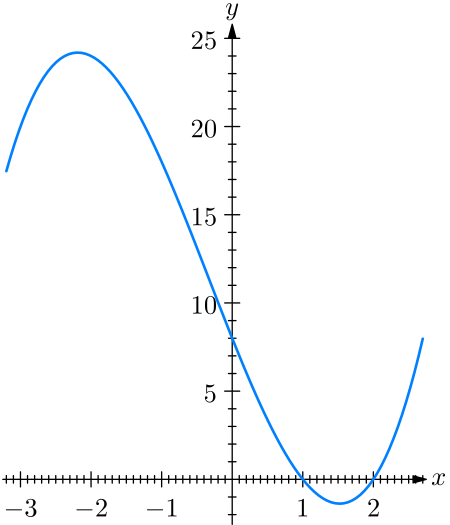
When \begin{align} & y \approx-1.38 \\ & \frac{d^{2} y}{d x^{2}}=6 \times 1.52+2>0 \end{align} Therefore, the curve is concave upward near and corresponds to a minimum .
This curve is shown below:
Exercise 12.2. Given , find expressions for , and for , also find the value of which makes a maximum or a minimum, and show whether it is maximum or minimum (assume ).
Answer
; ; (a maximum).
Solution
\begin{align} y & =\frac{b}{a} x-c x^{2} \\ \frac{d y}{d x} & =\frac{b}{a}-2 c x=0 \Rightarrow x=\frac{b}{2 a c} \\ \frac{d^{2} y}{d x^{2}} & =-2 c \end{align}
When
This is a maximum value since .
Exercise 12.3. Find how many maxima and how many minima there are in the curve, the equation to which is and how many in that of which the equation is
Answer
(a) One maximum and two minima.
(b) One maximum. (; other points unreal.)
Solution
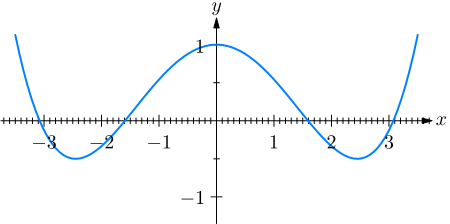
\begin{align} & y=1-\frac{x^{2}}{2}+\frac{x^{4}}{24} \\ & \frac{d y}{d x}=-x+\frac{1}{6} x^{3}=x\left(\frac{x^{2}}{6}-1\right) \\ & \frac{d y}{d x}=0 \quad \Leftrightarrow \quad x=0 \quad \text { or } \quad x= \pm \sqrt{6} \\ & \frac{d^{2} y}{d x^{2}}=-1+\frac{1}{2} x^{2} \end{align}
When , Therefore, makes a maximum value. When , .
When or Therefore, or corresponds to a minimum .
The graph of is shown below:
Now let’s consider the second function \begin{align} \frac{d y}{d x} & =-x+\frac{x^{3}}{6}-\frac{x^{5}}{120}=\frac{1}{120} x\left(-120+20 x^{2}-x^{4}\right) \\ \frac{d y}{d x}=0 & \Leftrightarrow x=0 \text { or } x^{4}-20 x^{2}+120=0 \end{align}
The expression is quadratic in terms of
Since the discriminant of this equation, , is negative, the above equation has no roots.
Therefore,
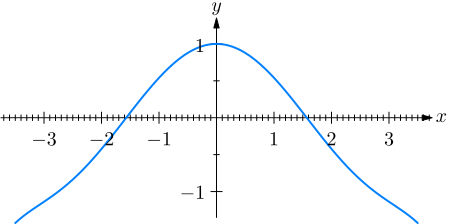
The value of for is 1 . Since
is negative when , is a maximum.
The graph of is shown below:
Exercise 12.4. Find the maxima and minima of
Answer
Min.: , .
Solution
We can rewrite it as Then The second derivative is:
To find where is a maximum or minimum we set equal to zero:
Since , corresponds to a minimum
Exercise 12.5. Find the maxima and minima of
Answer
Max: , .
Solution
Using the Quotient Rule
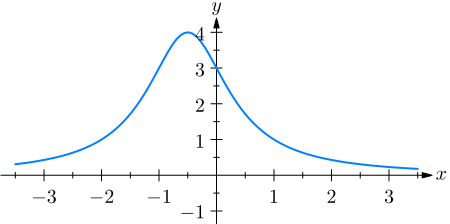
\begin{align} & \frac{d y}{d x}=-\frac{3(2 x+1)}{\left(x^{2}+x+1\right)^{2}} \\ & \frac{d y}{d x}=0 \quad \Leftrightarrow \quad x=-\frac{1}{2} \end{align}
To determine if has a maximum or a minimum when , we can use the Second Derivative Test:
When
Therefore, the curve is concave downward and corresponds to a maximum .
Alternatively, we can use the First Derivative Test.
When , , the curve ascends
When , , the curve descends.
Thus is a maximum that occurs when .
The graph of is shown below.
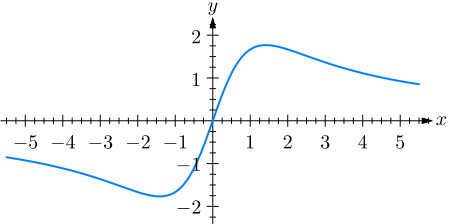
Exercise 12.6. Find the maxima and minima of
Answer
Max.: , .
Min.: , .
Solution
Using the Quotient Rule:
or
\begin{align} & \frac{d y}{d x}=0 \Leftrightarrow 10-5 x^2=0 \\ & \frac{d y}{d x}=0 \Leftrightarrow \quad x= \pm \sqrt{2} \end{align}
Using the Second Derivative Test:
When It follows from the Second Derivative Test that corresponds to a maximum .
When This means that corresponds to a minimum .
The graph of is shown below.
Exercise 12.7. Find the maxima and minima of
Answer
Max.: , .
Min.: , .
Solution
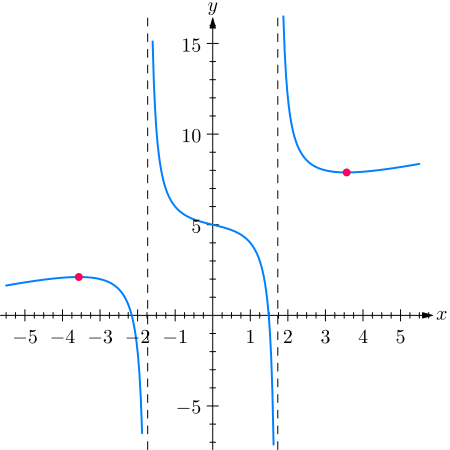
\begin{align} & y=\frac{3 x}{x^{2}-3}+\frac{x}{2}+5 \\ \frac{d y}{d x} & =\frac{3\left(x^{2}-3\right)-6 x^{2}}{\left(x^{2}-3\right)^{2}}+\frac{1}{2} \\ & =\frac{-9-3 x^{2}}{\left(x^{2}-3\right)^{2}}+\frac{1}{2} \\ & =\frac{2\left(-9-3 x^{2}\right)+\left(x^{2}-3\right)^{2}}{2\left(x^{2}-3\right)^{2}} \\ & =\frac{-18-6 x^{2}+x^{4}-6 x^{2}+9}{2\left(x^{2}-3\right)^{2}} \\ & =\frac{x^{4}-12 x^{2}-9}{2\left(x^{2}-3\right)^{2}} \end{align} The equation is quadratic in terms of . Thus The negative is unacceptable because . Therefore
Using the Second Derivative Test
When
\begin{align} \frac{d^{2} y}{d x^{2}} & =\frac{3\left(3 \times 3.565^{2}-24 \times 3.565\right)(+)-8(+)(-)(0)}{(+)} \\ & =\frac{3(-)(+)-0}{(+)} \\ & =(-) \end{align} Therefore, corresponds to a maximum .
When
Therefore, corresponds to a minimum .
The graph of is shown below.
Exercise 12.8. Divide a number into two parts in such a way that three times the square of one part plus twice the square of the other part shall be a minimum.
Answer
, .
Solution
Let
part one
part two
We know and we want to minimize
Since , we want to minimize
Let then \begin{align} \frac{d y}{d x} & =6 x+2 \times 2 \times(-1)(N-x) \\ & =10 x-4 N \end{align}
Does correspond to a minimum or a maximum ? To answer this, we can use the Second Derivative Test
It follows from the Second Derivative Test that corresponds to a minimum value.
When , and
\begin{align} & y=3(0.4 N)^{2}+2(0.6 N)^{2} \\ & y=1.2 N^{2} \end{align}
Exercise 12.9. The efficiency of an electric generator at different values of output is expressed by the general equation: where is a constant depending chiefly on the energy losses in the iron and a constant depending chiefly on the resistance of the copper parts. Find an expression for that value of the output at which the efficiency will be a maximum.
Answer
.
Solution
Using Quotient Rule:
\begin{align} \frac{d u}{d x} & =\frac{\left(a+b x+c x^{2}\right)-x(b+2 c x)}{\left(a+b x+c x^{2}\right)} \\ & =\frac{a-c x^{2}}{\left(a+b x+c x^{2}\right)^{2}} \end{align}
When , [Note that is zero when ]
Therefore, makes a maximum.
cannot be negative (What is the meaning of negative output of an electric generator?), but even if were acceptable, when , we have
Therefore is a minimum when .
Exercise 12.10. Suppose it to be known that consumption of coal by a certain steamer may be represented by the formula ; where is the number of tons of coal burned per hour and is the speed expressed in nautical miles per hour. The cost of wages, interest on capital, and depreciation of that ship are together equal, per hour, to the cost of ton of coal. What speed will make the total cost of a voyage of nautical miles a minimum? And, if coal costs per ton, what will that minimum cost of the voyage amount to?
Answer
Speed nautical miles per hour. Time taken hours.
Minimum cost .
Solution
Since the cost of other expenses is equivalent to , if the voyage takes hours, then the total cost of the voyage is where is the cost of coal per ton.
If the speed of the steamer is , since the voyage is nautical miles, the time of the voyage is Therefore, we can write that the cost of the voyage is \begin{align} \text{cost } &=a\left(1.3+0.001v^3\right)\frac{1000}{v}\\ &=a\left(\frac{1300}{v}+v^2\right). \end{align}
To minimize the cost, we differentiate cost with respect to velocity and set the result equal to zero:
8.662 nautical miles per hour is the speed that will make the total cost a minimum.
If the steamer moves by the speed , the voyage takes hours.
To find the minimum cost, we have to calculate for and :
Exercise 12.11. Find the maxima and minima of
Answer
Max. and min. for , .
Solution
First consider Then
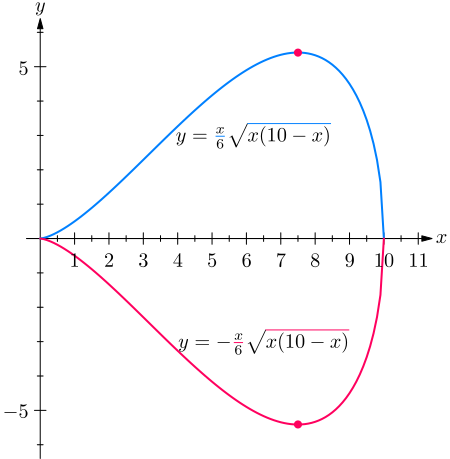
To differentiate , let and \begin{align} \frac{d \left(\sqrt{u}\right)}{d x} & =\frac{d \left(\sqrt{u}\right)}{d u} \cdot \frac{d u}{d x} \\ & =\frac{1}{2 \sqrt{u}} \cdot(10-2 x) \\ & =\frac{1}{\sqrt{x(10-x)}} \cdot(5-x) \end{align} Therefore,
\begin{align} \frac{d y}{d x}&=\frac{1}{6} \sqrt{x(10-x)}+\frac{x}{6} \frac{5-x}{\sqrt{x(10-x)}} \\ &=\frac{x(10-x)+x(5-x)}{6 \sqrt{x(10-x)}} \\ &=\frac{15 x-2 x^{2}}{6 \sqrt{x(10-x)}} \end{align} \begin{align} \frac{d y}{d x}=0 \quad &\Leftrightarrow\quad x(15-2 x)=0 \\ &\Leftrightarrow \quad x=0 \text { or } x=7.5 \end{align}
To distinguish between a maximum or a minimum, we need the sign of the second derivative for and for .
Note that, to find the sign of , we do not need to write the expression for because the result will be multiplied by which is zero for both and .
When Therefore, corresponds to a minimum .
When Hence corresponds to a maximum
If we are careless, we might say that correspom to a minimum , but we notice that is if (it is not defined for ). However, this curve has another branch which is when . Therefore, the curve has neither a minimum nor a maximum if .
If we consider , its derivative is also zero when or . The second derivative has the opposite sign of the second derivative of the other branch . Therefore, when . Hence has a minimum value of when .
The curve is shown below.
Exercise 12.12. Find the maxima and minima of
Answer
Min.: , ; max.: , .
Solution
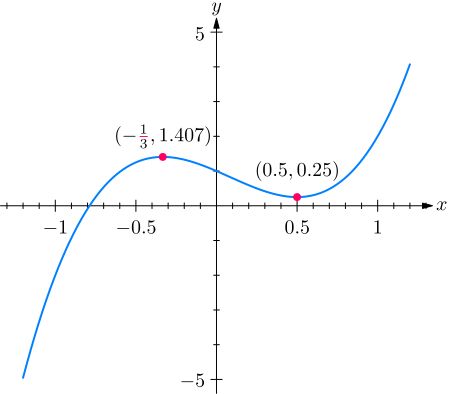
\begin{align} y & =4 x^{3}-x^{2}-2 x+1 \\ \frac{d y}{d x} & =12 x^{2}-2 x-2=2\left(6 x^{2}-x-1\right) \\ \frac{d y}{d x}=0 &\quad \Leftrightarrow \quad x=\frac{1 \pm \sqrt{1+24}}{12}=\frac{1 \pm 5}{12} \\ \frac{d y}{d x} =0 & \quad \Leftrightarrow \quad x=\frac{1}{2} \quad \text { or } \quad x=-\frac{1}{3} \\ \frac{d^{2} y}{d x^{2}} & =2(12 x-1) \end{align}
When , , the curve is concave upward and has a minimum value of when .
When , , the curve is concave downward and has a maximum value of when .
The graph of is shown below.
Full Chapter
Returning to the process of successive differentiation, it may be asked: Why does anybody want to differentiate twice over? We know that when the variable quantities are space and time, by differentiating twice over we get the acceleration of a moving body, and that in the geometrical interpretation, as applied to curves, means the slope of the curve. But what can mean in this case? Clearly it means the rate (per unit of length ) at which the slope is changing—in brief, it is an indication of the manner in which the slope of the portion of curve considered varies, that is, whether the slope of the curve increases or decreases when increases, or, in other words, whether the curve curves up or down towards the right.
Suppose a slope constant, as in the following figure.
Here, is of constant value.
Suppose, however, a case in which, like the next figure, the slope itself is getting greater upwards, then , that is, , will be positive.
If the slope is becoming less as you go to the right as in the following figure, then, even though the curve may be going upward, since the change is such as to diminish its slope, its will be negative.
It is now time to initiate you into another secret—how to tell whether the result that you get by “equating to zero” is a maximum or a minimum. The trick is this: After you have differentiated (so as to get the expression which you equate to zero), you then differentiate a second time, and look whether the result of the second differentiation is positive or negative. If comes out positive, then you know that the value of which you got was a minimum; but if comes out negative, then the value of which you got must be a maximum. That’s the rule.
The reason of it ought to be quite evident. Think of any curve that has a minimum point in it like the next figure, where the point of minimum is marked , and the curve is concave upward.1 To the left of the slope is downward, that is, negative, and is getting less negative. To the right of the slope has become upward, and is getting more and more upward. Clearly the change of slope as the curve passes through is such that is positive, for its operation, as increases toward the right, is to convert a downward slope into an upward one.
Similarly, consider any curve that has a maximum point in it (like Fig. 10.11 in this chapter), or like the next figure, where the curve is concave downward,2 and the maximum point is marked . In this case, as the curve passes through from left to right, its upward slope is converted into a downward or negative slope, so that in this case the “slope of the slope” is negative.
This is called the second derivative test for maxima and minima.
In summary:
If , the curve is concave upward (or convex).
If , the curve is concave downward (or concave).
and
The Second Derivative Test
Suppose for some particular value of
If for this particular value of , the value of for this is a minimum.
If for this particular value of , the value of for this is a maximum.
Go back now to the examples of the last chapter and verify in this way the conclusions arrived at as to whether in any particular case there is a maximum or a minimum. You will find below a few worked out examples.
Example 12.1. Find the maximum or minimum of and ascertain if it be a maximum or a minimum in each case.
Solution. (a) \begin{align} \dfrac{dy}{dx}= 8x-9=0\quad \Rightarrow\quad x=1\frac{1}{8}. \end{align} The value of for (or at) is . (b)
The value of for is
The graphs of and are shown below.
Example 12.2. Find the maxima and minima of the function .
Solution. hence corresponds to a minimum . For , is ; hence corresponds to a maximum .
The graph of is shown below.
Example 12.3. Find the maxima and minima of .
Solution. or , whose solutions are and . \begin{align} \dfrac{d^2y}{dx^2} &= - \frac{(x^2 + 2)^2 \times (2x-2) - (x^2 - 2x - 2)(4x^3 + 8x)}{(x^2 + 2)^4} \\ &= - \frac{2x^5 - 6x^4 - 8x^3 - 8x^2 - 24x + 8}{(x^2 + 2)^4}. \end{align}
The denominator is always positive, so it is sufficient to ascertain the sign of the numerator.
If we put , the numerator is negative; the maximum, .
If we put , the numerator is positive; the minimum, .
The graph of is shown below.
Example 12.4. The expense of handling the products of a certain factory varies with the weekly output according to the relation , where , , , are positive constants. For what output will the expense be least?
Solution. hence and .
As the output cannot be negative, .
Now which is positive for all the values of ; hence corresponds to a minimum.
Example 12.5. The total cost per hour of lighting a building with lamps of a certain kind is where is the commercial efficiency (watts per candle), \begin{align} &\text{$P$ is the candle power of each lamp,} \\ &\text{$t$ is the average life of each lamp in hours,} \\ &\text{$C_l =$ cost of renewal in cents per hour of use,} \\ &\text{$C_e =$ cost of energy per $1000$~watts per~hour.} \end{align}
Moreover, the relation connecting the average life of a lamp with the commercial efficiency at which it is run is approximately , where and are constants depending on the kind of lamp.
Find the commercial efficiency for which the total cost of lighting will be least.
Solution. We have \begin{align} C &= N\left(\frac{C_l}{m} E^{-n} + \frac{PC_e}{1000} E\right), \\ \dfrac{dC}{dE} &= \frac{PC_e}{1000} - \frac{nC_l}{m} E^{-(n+1)} = 0 \end{align} for maximum or minimum. and
This is clearly for minimum, since which is positive for a positive value of .
For a particular type of candle-power lamps, cents, cents; and it was found that and .
Exercises
Exercise 12.1. Find the maxima and minima of
Answer
Max.: , ; min.:, , .
Solution
To distinguish between a maximum and minimum, we find the second derivative:
When Therefore, the curve is concave downward close to and corresponds to a maximum
When \begin{align} & y \approx-1.38 \\ & \frac{d^{2} y}{d x^{2}}=6 \times 1.52+2>0 \end{align} Therefore, the curve is concave upward near and corresponds to a minimum .
This curve is shown below:
Exercise 12.2. Given , find expressions for , and for , also find the value of which makes a maximum or a minimum, and show whether it is maximum or minimum (assume ).
Answer
; ; (a maximum).
Solution
\begin{align} y & =\frac{b}{a} x-c x^{2} \\ \frac{d y}{d x} & =\frac{b}{a}-2 c x=0 \Rightarrow x=\frac{b}{2 a c} \\ \frac{d^{2} y}{d x^{2}} & =-2 c \end{align}
When
This is a maximum value since .
Exercise 12.3. Find how many maxima and how many minima there are in the curve, the equation to which is and how many in that of which the equation is
Answer
(a) One maximum and two minima.
(b) One maximum. (; other points unreal.)
Solution
\begin{align} & y=1-\frac{x^{2}}{2}+\frac{x^{4}}{24} \\ & \frac{d y}{d x}=-x+\frac{1}{6} x^{3}=x\left(\frac{x^{2}}{6}-1\right) \\ & \frac{d y}{d x}=0 \quad \Leftrightarrow \quad x=0 \quad \text { or } \quad x= \pm \sqrt{6} \\ & \frac{d^{2} y}{d x^{2}}=-1+\frac{1}{2} x^{2} \end{align}
When , Therefore, makes a maximum value. When , .
When or Therefore, or corresponds to a minimum .
The graph of is shown below:
Now let’s consider the second function \begin{align} \frac{d y}{d x} & =-x+\frac{x^{3}}{6}-\frac{x^{5}}{120}=\frac{1}{120} x\left(-120+20 x^{2}-x^{4}\right) \\ \frac{d y}{d x}=0 & \Leftrightarrow x=0 \text { or } x^{4}-20 x^{2}+120=0 \end{align}
The expression is quadratic in terms of
Since discriminant of this equation, , is negative, the above equation has no roots.
Therefore,
The value of for is 1 . Since
is negative when , is a maximum.
The graph of is shown below:
Exercise 12.4. Find the maxima and minima of
Answer
Min.: , .
Solution
We can rewrite it as Then The second derivative is:
To find where is a maximum or minimum we set equal to zero:
Since , corresponds to a minimum
Exercise 12.5. Find the maxima and minima of
Answer
Max: , .
Solution
Using the Quotient Rule
\begin{align} & \frac{d y}{d x}=-\frac{3(2 x+1)}{\left(x^{2}+x+1\right)^{2}} \\ & \frac{d y}{d x}=0 \quad \Leftrightarrow \quad x=-\frac{1}{2} \end{align}
To determine if has a maximum or a minimum when , we can use the Second Derivative Test:
When
Therefore, the curve is concave downward and corresponds to a maximum .
Alternatively, we can use the First Derivative Test.
When , , the curve ascends
When , , the curve descends.
Thus is a maximum that occurs when .
The graph of is shown below.
Exercise 12.6. Find the maxima and minima of
Answer
Max.: , .
Min.: , .
Solution
Using the Quotient Rule:
or
\begin{align} & \frac{d y}{d x}=0 \Leftrightarrow 10-5 x^2=0 \\ & \frac{d y}{d x}=0 \Leftrightarrow \quad x= \pm \sqrt{2} \end{align}
Using the Second Derivative Test:
When It follows from the Second Derivative Test that corresponds to a maximum .
When This means that corresponds to a minimum .
The graph of is shown below.
Exercise 12.7. Find the maxima and minima of
Answer
Max.: , .
Min.: , .
Solution
\begin{align} & y=\frac{3 x}{x^{2}-3}+\frac{x}{2}+5 \\ \frac{d y}{d x} & =\frac{3\left(x^{2}-3\right)-6 x^{2}}{\left(x^{2}-3\right)^{2}}+\frac{1}{2} \\ & =\frac{-9-3 x^{2}}{\left(x^{2}-3\right)^{2}}+\frac{1}{2} \\ & =\frac{2\left(-9-3 x^{2}\right)+\left(x^{2}-3\right)^{2}}{2\left(x^{2}-3\right)^{2}} \\ & =\frac{-18-6 x^{2}+x^{4}-6 x^{2}+9}{2\left(x^{2}-3\right)^{2}} \\ & =\frac{x^{4}-12 x^{2}-9}{2\left(x^{2}-3\right)^{2}} \end{align} The equation is quadratic in terms of . Thus The negative is unacceptable because . Therefore
Using the Second Derivative Test
When
\begin{align} \frac{d^{2} y}{d x^{2}} & =\frac{3\left(3 \times 3.565^{2}-24 \times 3.565\right)(+)-8(+)(-)(0)}{(+)} \\ & =\frac{3(-)(+)-0}{(+)} \\ & =(-) \end{align} Therefore, corresponds to a maximum .
When
Therefore, corresponds to a minimum .
The graph of is shown below.
Exercise 12.8. Divide a number into two parts in such a way that three times the square of one part plus twice the square of the other part shall be a minimum.
Answer
, .
Solution
Let
part one
part two
We know and we want to minimize
Since , we want to minimize
Let then \begin{align} \frac{d y}{d x} & =6 x+2 \times 2 \times(-1)(N-x) \\ & =10 x-4 N \end{align}
Does correspond to a minimum or a maximum ? To answer this, we can use the Second Derivative Test
It follows from the Second Derivative Test that corresponds to a minimum value.
When , and
\begin{align} & y=3(0.4 N)^{2}+2(0.6 N)^{2} \\ & y=1.2 N^{2} \end{align}
Exercise 12.9. The efficiency of an electric generator at different values of output is expressed by the general equation: where is a constant depending chiefly on the energy losses in the iron and a constant depending chiefly on the resistance of the copper parts. Find an expression for that value of the output at which the efficiency will be a maximum.
Answer
.
Solution
Using Quotient Rule:
\begin{align} \frac{d u}{d x} & =\frac{\left(a+b x+c x^{2}\right)-x(b+2 c x)}{\left(a+b x+c x^{2}\right)} \\ & =\frac{a-c x^{2}}{\left(a+b x+c x^{2}\right)^{2}} \end{align}
When , [Note that is zero when ]
Therefore, makes a maximum.
cannot be negative (What is the meaning of negative output of an electric generator?), but even if were acceptable, when , we have
Therefore is a minimum when .
Exercise 12.10. Suppose it to be known that consumption of coal by a certain steamer may be represented by the formula ; where is the number of tons of coal burned per hour and is the speed expressed in nautical miles per hour. The cost of wages, interest on capital, and depreciation of that ship are together equal, per hour, to the cost of ton of coal. What speed will make the total cost of a voyage of nautical miles a minimum? And, if coal costs per ton, what will that minimum cost of the voyage amount to?
Answer
Speed nautical miles per hour. Time taken hours.
Minimum cost .
Solution
Since the cost of other expenses is equivalent to , if the voyage takes hours, then the total cost of the voyage is where is the cost of coal per ton.
If the speed of the steamer is , since the voyage is nautical miles, the time of the voyage is Therefore, we can write that the cost of the voyage is \begin{align} \text{cost } &=a\left(1.3+0.001v^3\right)\frac{1000}{v}\\ &=a\left(\frac{1300}{v}+v^2\right). \end{align}
To minimize the cost, we differentiate cost with respect to velocity and set the result equal to zero:
8.662 nautical miles per hour is the speed that will make the total cost a minimum.
If the steamer moves by the speed , the voyage takes hours.
To find the minimum cost, we have to calculate for and :
Exercise 12.11. Find the maxima and minima of
Answer
Max. and min. for , .
Solution
First consider Then
To differentiate , let and \begin{align} \frac{d \left(\sqrt{u}\right)}{d x} & =\frac{d \left(\sqrt{u}\right)}{d u} \cdot \frac{d u}{d x} \\ & =\frac{1}{2 \sqrt{u}} \cdot(10-2 x) \\ & =\frac{1}{\sqrt{x(10-x)}} \cdot(5-x) \end{align} Therefore,
\begin{align} \frac{d y}{d x}&=\frac{1}{6} \sqrt{x(10-x)}+\frac{x}{6} \frac{5-x}{\sqrt{x(10-x)}} \\ &=\frac{x(10-x)+x(5-x)}{6 \sqrt{x(10-x)}} \\ &=\frac{15 x-2 x^{2}}{6 \sqrt{x(10-x)}} \end{align} \begin{align} \frac{d y}{d x}=0 \quad &\Leftrightarrow\quad x(15-2 x)=0 \\ &\Leftrightarrow \quad x=0 \text { or } x=7.5 \end{align}
To distinguish between a maximum or a minimum, we need the sign of the second derivative for and for .
Note that, to find the sign of , we do not need to write the expression for because the result will be multiplied by which is zero for both and .
When Therefore, corresponds to a minimum .
When Hence corresponds to a maximum
If we are careless, we might say that correspom to a minimum , but we notice that is if (it is not defined for ). However, this curve has another branch which is when . Therefore, the curve has neither a minimum nor a maximum if .
If we consider , its derivative is also zero when or . The second derivative has the opposite sign of the second derivative of the other branch . Therefore, when . Hence has a minimum value of when .
The curve is shown below.
Exercise 12.12. Find the maxima and minima of
Answer
Min.: , ; max.: , .
Solution
\begin{align} y & =4 x^{3}-x^{2}-2 x+1 \\ \frac{d y}{d x} & =12 x^{2}-2 x-2=2\left(6 x^{2}-x-1\right) \\ \frac{d y}{d x}=0 &\quad \Leftrightarrow \quad x=\frac{1 \pm \sqrt{1+24}}{12}=\frac{1 \pm 5}{12} \\ \frac{d y}{d x} =0 & \quad \Leftrightarrow \quad x=\frac{1}{2} \quad \text { or } \quad x=-\frac{1}{3} \\ \frac{d^{2} y}{d x^{2}} & =2(12 x-1) \end{align}
When , , the curve is concave upward and has a minimum value of when .
When , , the curve is concave downward and has a maximum value of when .
The graph of is shown below.