Work is force times distance, but only when the force is constant and acts along the direction of motion. When the force varies, we slice the motion into pieces so small that the force is effectively constant on each piece, add up the tiny contributions , and pass to the integral . The same slicing idea, applied to a tank of liquid instead of a moving object, solves every pumping problem.
| Item | Statement |
|---|---|
| Constant force along a line | |
| Element of work | |
| Variable force along a line | |
| Unit of work | , and |
| Hooke's law | , where is the spring constant |
| Stretching a spring from to | |
| Newton's gravitation | , |
| Work against gravity, | |
| Gravitational potential energy | |
| Pumping a liquid | , lift distance |
| Weight density of water | (SI); (US) |
| Cylindrical tank, depth , pumped to the rim | |
| Cone (vertex down), depth , pumped to the rim | |
| Hoisting a rope of linear density | |
| Compressing a gas, |
Work Done by a Constant Force Along a Line
Suppose is a constant force. If acts on an object that moves in a straight line in the direction of the force, as in the figure below, the work done by this force is the product of the force and the distance through which the force acts; that is,
\bbox[8px, #E6F0FA, border: 3px solid #0066CC]{W=Fd.}
If is measured in newtons () and displacement in meters, then the unit of is a newton-meter (), called a joule (J).
Work Done by a Variable Force Along a Line
Suppose is a variable force, and it acts in a given direction on an object moving in this direction, which we take to be the -axis. The work done by as its point of application moves from to can be computed by integration.
If the object moves a little bit , then we can assume that is a constant force on this tiny interval, and the small work done by the force is
This is the element of work. Geometrically it is the area of a thin strip of width and height under the graph of the force, as in the figure below. The total work is the sum of all such strips:
\bbox[8px, #E6F0FA, border: 3px solid #0066CC]{W=\int_{a}^{b}dW=\int_{a}^{b}F(x)\,dx.}
Newton's law of gravitation states that every two particles of masses and attract each other with a force that is directly proportional to the product of their masses and inversely proportional to the square of the distance between their centers,
where is a universal constant called the gravitational constant (). How much work is required to move from to if is fixed?
Solution
The element of work is
\begin{aligned} dW &= F\,dr\\ &= G\frac{m_{1}m_{2}}{r^{2}}\,dr. \end{aligned}Therefore, the total work is
\begin{aligned} W=\int_{R_{0}}^{R_{1}}dW &= \int_{R_{0}}^{R_{1}}G\frac{m_{1}m_{2}}{r^{2}}\,dr\\ &= Gm_{1}m_{2}\left[-\frac{1}{r}\right]_{R_{0}}^{R_{1}}\\ &= Gm_{1}m_{2}\left(\frac{1}{R_{0}}-\frac{1}{R_{1}}\right). \end{aligned}- Gravitational potential energy. The work required to completely separate two particles is the opposite of the gravitational potential energy . So if in the above example we let , then and
- Hooke's law. The force required to stretch a spring units beyond its natural length is proportional to , as in the figure below. That is,
where is a constant called the spring constant. This is called Hooke's law, and it holds as long as is not too large.
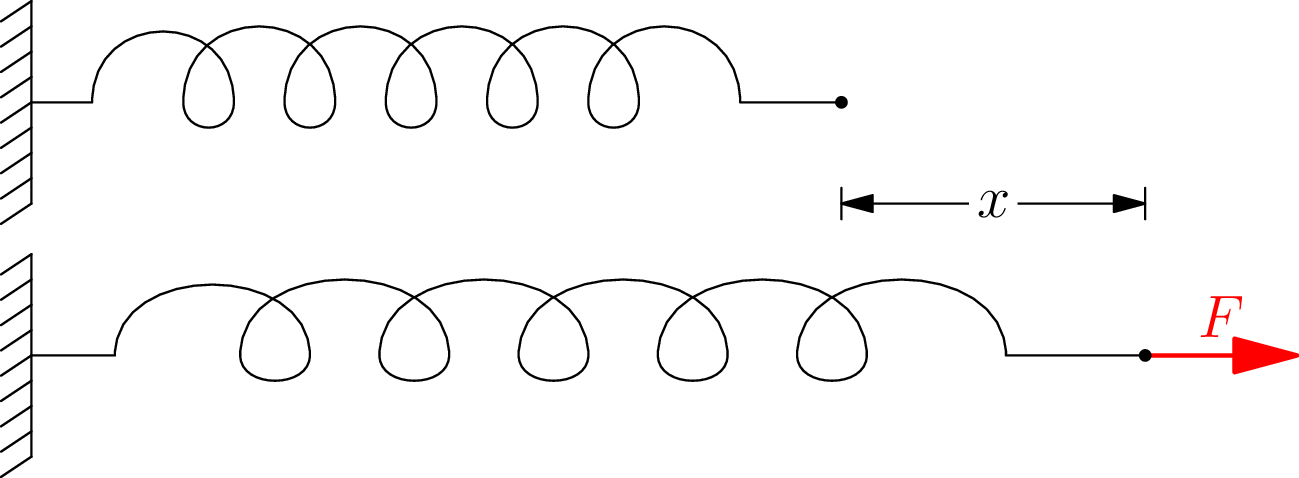
Hooke's law: the force needed to hold a spring stretched units beyond its natural length is .

The natural length of a spring is 10 cm. If we apply a force of 5 N, the length of the spring increases to 12 cm. How much work is done in stretching the spring from 12 cm to 18 cm?
Solution
First we need to find the spring constant. Hooke's law states , where is measured from the natural length. Here N and m. Therefore,
so . A length of 12 cm means m and a length of 18 cm means m, so the work done in stretching from m to m is
\begin{aligned} W &= \int_{0.02}^{0.08}250x\,dx\\ &= \left.125x^{2}\right|_{0.02}^{0.08}\\ &= 125\left(0.08^{2}-0.02^{2}\right)\\ &= 125(0.0064-0.0004)\\ &= 125(0.006)=0.75\ \text{J}. \end{aligned}Note that must be measured from the natural length, not from the floor or from the end of the stretched spring.
Pumping a Liquid Out of a Tank
Every pumping problem in this section is the same problem. The liquid at the bottom of the tank has to travel farther than the liquid at the top, so the lift distance is not a single number, and we cannot simply write . Instead we slice the liquid into thin horizontal layers, each of which moves essentially the same distance, and integrate.
The recipe.
- Draw a vertical -axis. Unless the problem suggests otherwise, put at the bottom of the tank with increasing upward.
- Slice the liquid into horizontal layers of thickness at height .
- Find the cross-sectional area of the tank at height . The volume of the layer is .
- Multiply by the weight density to get the weight of the layer, which is exactly the force needed to lift it: .
- Find the lift distance , the vertical distance from the layer at height to the outlet. If the liquid leaves at height , then .
- Multiply force by distance to get the element of work, , and integrate over the liquid that is actually present, not over the whole tank:
- The weight density is weight per unit volume, not mass per unit volume. In SI units, water has mass density , so its weight density is
In US customary units the weight density of water is already a weight, , and no factor of is inserted.
- Two traps to avoid. First, the limits of integration describe the liquid, while the outlet height in describes the tank (or the spout above it); these are different numbers whenever the tank is not full. Second, is the area of the horizontal cross section, so for a cone or a sphere it changes with and must be found by similar triangles or by the Pythagorean theorem.
A cylindrical tank of radius and height is filled with water to a height . How much work is done in pumping all of the water to the rim of the tank? Denote the weight density of water by .

Solution
Consider a layer of thickness at the height above the bottom of the tank, as shown in the figure. The cross section of a cylinder is the same disk at every height, so the volume of this layer is , and its weight is . The force required to lift this layer is equal to its weight. The distance through which this force must act is , which is the distance from the layer to the rim of the tank. Therefore, the work required to pump this layer out is

As varies between and , the total work done in pumping out all of the water is
\begin{aligned} W &= \int_{0}^{D}dW\\ &= \int_{0}^{D}\gamma\pi R^{2}(H-x)\,dx\\ &= \gamma\pi R^{2}\left[Hx-\frac{x^{2}}{2}\right]_{0}^{D}\\ &= \gamma\pi R^{2}\left(HD-\frac{D^{2}}{2}\right). \end{aligned}As a check, if the tank is full then and . That is the total weight times , which says that the whole body of water behaves as though it were concentrated at its midpoint, exactly as expected.
An inverted circular cone-shaped tank with height and base radius is filled with water to a height of . Find the work required to pump all of the water to the rim of the tank. Denote the weight density of water by .

Solution
Consider a layer of thickness at a height above the bottom (that is, above the vertex) of the tank, as shown in the figure below.

This thin layer has the shape of a circular cylinder with radius . From similar triangles (see the figure below),

The volume of this layer is , so its weight is . The force required to lift this layer is equal to its weight. The distance through which this force must act is , which is the distance from this layer to the rim of the tank. The work done in lifting this thin layer to the rim is thus
As increases from to , the total work is
\begin{aligned} W &= \int_{0}^{D}dW\\ &= \gamma\pi\frac{R^{2}}{H^{2}}\int_{0}^{D}x^{2}(H-x)\,dx\\ &= \gamma\pi\frac{R^{2}}{H^{2}}\left[\frac{H}{3}x^{3}-\frac{1}{4}x^{4}\right]_{0}^{D}\\ &= \gamma\pi\frac{R^{2}D^{3}}{H^{2}}\left(\frac{H}{3}-\frac{D}{4}\right). \end{aligned}Notice that the only thing that changed from the cylinder is the cross-sectional area: became . Everything else in the recipe is identical.
Exercises
Throughout, take and the weight density of water to be .
(a) A crate is pushed m across a level floor by a constant horizontal force of N. Find the work done.
(b) A particle moves along the -axis from to m under a force newtons directed along the axis. Find the work done.
Solution
(a) The force is constant and acts along the direction of motion, so
(b) The force varies, so we integrate the element of work :
\begin{aligned} W &= \int_{0}^{4}\left(3x^{2}+2x\right)dx\\ &= \left[x^{3}+x^{2}\right]_{0}^{4}\\ &= 64+16=80\ \text{J}. \end{aligned}A spring has natural length cm. A force of N holds it stretched to a length of cm. Find the spring constant , and then find the work done in stretching the spring from its natural length to a length of cm.
Solution
Measure from the natural length. A length of cm corresponds to m, and Hooke's law gives
A length of cm corresponds to m, so
\begin{aligned} W &= \int_{0}^{0.10}800x\,dx\\ &= \left.400x^{2}\right|_{0}^{0.10}\\ &= 400(0.01)=4\ \text{J}. \end{aligned}It takes J of work to stretch a certain spring from its natural length to m beyond its natural length. How much work is required to stretch it from m beyond its natural length to m beyond?
Solution
First recover from the given work. Stretching from to m requires
and this equals J, so . Then
\begin{aligned} W &= \int_{0.2}^{0.4}300x\,dx\\ &= \left.150x^{2}\right|_{0.2}^{0.4}\\ &= 150(0.16-0.04)\\ &= 150(0.12)=18\ \text{J}. \end{aligned}The second stretch of the same length costs three times as much work as the first, because the force is larger throughout.
A uniform rope of length m and linear mass density hangs over the edge of a tall building. How much work is required to pull the entire rope to the top?
Solution
Let be the distance measured downward from the top, so the rope occupies . A piece of rope of length located at depth has mass kg and therefore weight
That piece must be raised a distance , so the element of work is and
\begin{aligned} W &= \int_{0}^{20}4.9x\,dx\\ &= \left.2.45x^{2}\right|_{0}^{20}\\ &= 2.45(400)=980\ \text{J}. \end{aligned}Equivalently, the whole rope weighs N and its center is m below the top, giving J.
A bucket of mass kg containing kg of water is hoisted m up a well at a constant rate by a rope of negligible mass. Water leaks out at a constant rate, and exactly kg has escaped by the time the bucket reaches the top. How much work is done?
Solution
Let be the height in meters above the starting point, . The water leaks at a constant rate, losing kg over m, that is kg per meter. So at height the total mass being lifted is
and the force required is newtons. Therefore
\begin{aligned} W &= \int_{0}^{15}9.8\left(22-\frac{x}{3}\right)dx\\ &= 9.8\left[22x-\frac{x^{2}}{6}\right]_{0}^{15}\\ &= 9.8\left(330-\frac{225}{6}\right)\\ &= 9.8(330-37.5)\\ &= 9.8(292.5)=2866.5\ \text{J}. \end{aligned}Note that the leaked water is not lifted the full m, which is why the answer is less than J.
A rectangular trough is m long, m wide, and m deep. It is full of water. Find the work required to pump all the water over the top edge.
Solution
Measure upward from the bottom of the trough. Every horizontal cross section is the same rectangle, so
and a layer of thickness weighs newtons. The top edge is at height , so the lift distance is . The water occupies , so
\begin{aligned} W &= \int_{0}^{1.5}78400(1.5-x)\,dx\\ &= 78400\left[1.5x-\frac{x^{2}}{2}\right]_{0}^{1.5}\\ &= 78400(2.25-1.125)\\ &= 78400(1.125)=88200\ \text{J}. \end{aligned}A vertical cylindrical tank of radius m and height m is full of water. Find the work required to pump all the water to the rim.
Solution
Take upward from the bottom. The cross section is a disk of radius , so at every height, and a layer of thickness weighs . The rim is at height , so the lift distance is , and the water fills :
\begin{aligned} W &= \int_{0}^{6}9800(4\pi)(6-x)\,dx\\ &= 39200\pi\left[6x-\frac{x^{2}}{2}\right]_{0}^{6}\\ &= 39200\pi(36-18)\\ &= 705600\pi\approx2.22\times10^{6}\ \text{J}. \end{aligned}This agrees with the general formula derived in the text, with and .
A tank in the shape of an inverted right circular cone (vertex at the bottom) has height m and top radius m. It contains water to a depth of m. Find the work required to pump all the water to the rim.
Solution
Measure upward from the vertex. By similar triangles the radius of the cross section at height satisfies
so . The rim is at height , so the lift distance is , and the water occupies :
\begin{aligned} W &= \int_{0}^{3}9800\cdot\frac{4\pi x^{2}}{25}(5-x)\,dx\\ &= 1568\pi\int_{0}^{3}\left(5x^{2}-x^{3}\right)dx\\ &= 1568\pi\left[\frac{5x^{3}}{3}-\frac{x^{4}}{4}\right]_{0}^{3}\\ &= 1568\pi\left(45-20.25\right)\\ &= 1568\pi(24.75)=38808\pi\approx1.22\times10^{5}\ \text{J}. \end{aligned}Here . The answer also follows from the general formula with , , .
A tank has the shape of a right circular cone standing on its base, with base radius m at the bottom, apex at the top, and height m. The tank is full of water. Find the work required to pump all the water out through an opening at the apex.
Solution
Measure upward from the base. Now the cross sections shrink as increases: the radius at height is at and at , so by similar triangles
and . The outlet is at the apex, height , so the lift distance is , and
\begin{aligned} W &= \int_{0}^{4}9800\cdot\frac{9\pi(4-x)^{2}}{16}(4-x)\,dx\\ &= \frac{88200\pi}{16}\int_{0}^{4}(4-x)^{3}\,dx\\ &= 5512.5\pi\left[-\frac{(4-x)^{4}}{4}\right]_{0}^{4}\\ &= 5512.5\pi\left(0+\frac{256}{4}\right)\\ &= 5512.5\pi(64)=352800\pi\approx1.11\times10^{6}\ \text{J}. \end{aligned}Compare with the previous exercise: the geometry factor and the lift distance now involve the same quantity , which is what makes the integrand a perfect cube.
A tank has the shape of a hemispherical bowl of radius m with its flat circular face on top. It is full of water. Find the work required to pump all the water to the level of the top of the tank.
Solution
Measure upward from the lowest point of the bowl, so the water occupies and the rim is at . The center of the sphere is at height , so a horizontal cross section at height is a circle whose radius satisfies, by the Pythagorean theorem,
Hence and the lift distance is , so
\begin{aligned} W &= \int_{0}^{3}9800\pi\left(6x-x^{2}\right)(3-x)\,dx\\ &= 9800\pi\int_{0}^{3}\left(18x-6x^{2}-3x^{2}+x^{3}\right)dx\\ &= 9800\pi\int_{0}^{3}\left(18x-9x^{2}+x^{3}\right)dx\\ &= 9800\pi\left[9x^{2}-3x^{3}+\frac{x^{4}}{4}\right]_{0}^{3}\\ &= 9800\pi\left(81-81+\frac{81}{4}\right)\\ &= 9800\pi(20.25)=198450\pi\approx6.23\times10^{5}\ \text{J}. \end{aligned}A vertical cylindrical tank of radius m and height m contains water to a depth of m. The water must be pumped out through a spout whose opening is m above the top of the tank. Find the work required.
Solution
Measure upward from the bottom of the tank. The spout opening is at height , so the lift distance for the layer at height is
The cross section is a disk of radius , so . The water is only m deep, so the limits are to , not to :
\begin{aligned} W &= \int_{0}^{3}9800\pi(5.5-x)\,dx\\ &= 9800\pi\left[5.5x-\frac{x^{2}}{2}\right]_{0}^{3}\\ &= 9800\pi(16.5-4.5)\\ &= 9800\pi(12)=117600\pi\approx3.69\times10^{5}\ \text{J}. \end{aligned}The two numbers that are easy to confuse here are the outlet height, , which enters , and the water depth, , which sets the upper limit of integration.
A gas is confined in a cylinder by a movable piston. When the piston moves, the work done by the gas is , where is the pressure and the volume. Suppose the gas is compressed at constant temperature, so that for a constant . If the gas starts at a pressure of kPa occupying and is compressed to , how much work is done on the gas?
Solution
First find the constant. With and ,
Since , we have , and the work done by the gas as the volume changes from to is
\begin{aligned} W_{\text{by}} &= \int_{V_{1}}^{V_{2}}\frac{C}{V}\,dV\\ &= C\left[\ln V\right]_{V_{1}}^{V_{2}}\\ &= C\ln\frac{V_{2}}{V_{1}}. \end{aligned}With and ,
The sign is negative because the gas is compressed rather than allowed to expand. The work done on the gas is the opposite,
Notice that the element of work here is rather than ; if is the piston area, then and , so . It is the same formula written in the variable that is convenient.