AI Won't Wipe Out Jobs. It Will Multiply Them.
Everyone says AI is coming for your job. But what if they have it completely backwards? The same technology that threatens to automate work might be creating more opportunities than it destroys.
 ··3 min read
There's a lot of talk about AI destroying jobs. But I think the opposite is happening. AI isn't eliminating opportunities. It's creating entirely new markets.
Let me explain with two examples.
Software
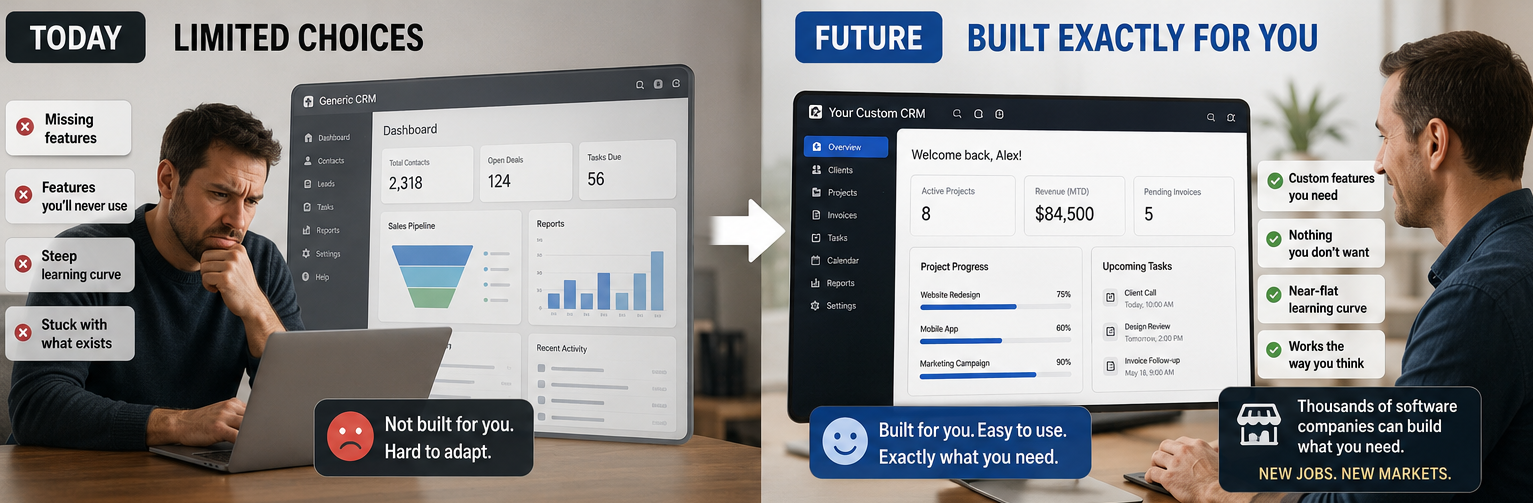
Today, if you need software for your business, you have limited choices. You search the market. You find something close to what you want. But it's missing features you need. It has features you'll never use. There's a steep learning curve because it wasn't built for you. You're stuck with what exists.
But imagine the future. You tell a software company exactly what you need. Custom features. Nothing you don't want. A learning curve that's nearly flat because the software works the way you think. By paying a few thousand or even a few hundred dollars, you get what you really want.
Right now, only massive companies can build software. But with AI, thousands of smaller software companies can emerge to serve this demand. They build what you need, exactly how you need it. Those are jobs that don't exist today.
Video and Entertainment
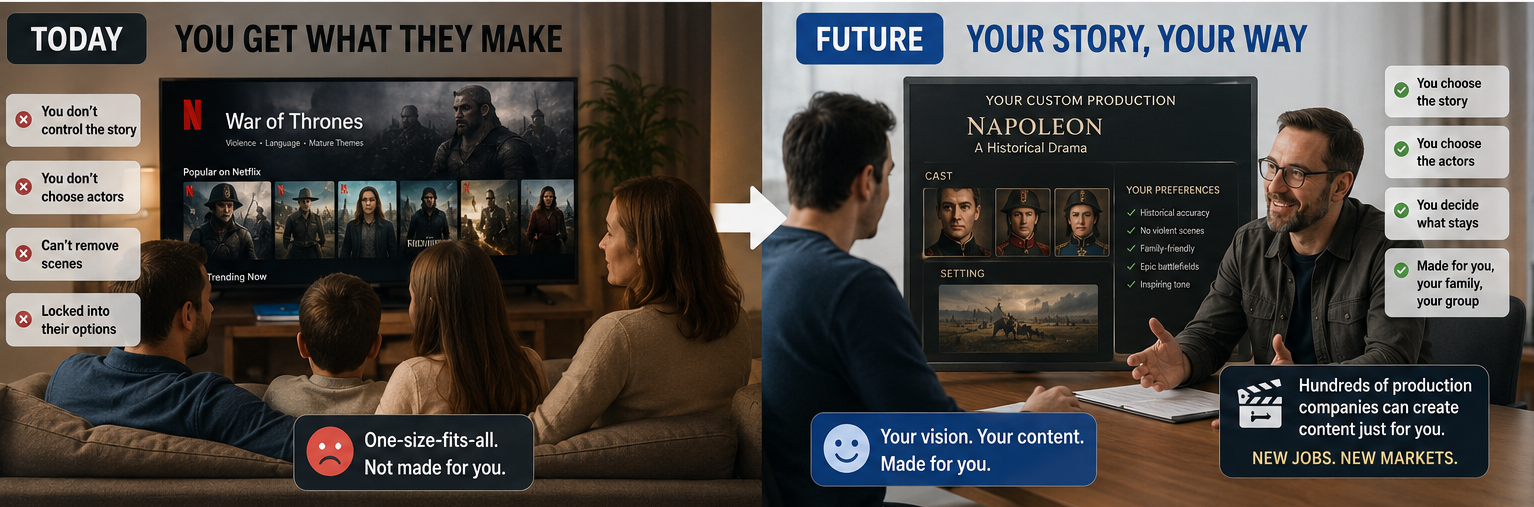
The same thing happens with movies and TV series. Today, you go to Netflix or Hollywood studios. These are your options. You don't control the story. You don't choose the actors. You can't remove scenes you don't want to watch with your kids. You're locked into what a few massive companies decide to produce.
But imagine the future. Instead of browsing a catalog and settling for something close enough, you go to a production company and tell them exactly what you want. The story you've always wanted to see. The actors you actually like. The historical setting you find fascinating. The content restrictions that matter to you because you're watching with your children. They build it. You pay a very tiny fraction of what Hollywood spends on a single episode.
Right now, only Hollywood has the resources to make movies. But with AI, hundreds of smaller production companies can emerge. They create content tailored to you, your family, your friends, your colleagues. Those are jobs in directing, editing, production design that don't exist today.
The Real Point
AI doesn't shrink opportunity. It shatters the gatekeepers. Instead of a handful of giants controlling what gets made, thousands of smaller companies compete to build exactly what you want. The market doesn't contract. It multiplies.
But What If One App Does It All?
Someone might say: what if AI becomes so seamless that you don't need a smaller company at all? You open one app, describe what you want, and it builds everything instantly. No expert. No middleman. Just you and one giant platform.
It's a fair point. But here's why it's unlikely.
First, there is no single winning AI. Different AI companies excel at different tasks. The best model for writing a screenplay is not the best for generating video. The best for composing music is not the best for character design. No single company dominates all of it. You still need someone who knows which tool to use for which job and can combine them into something that actually works.
Second, the economics matter. Right now, big AI companies are heavily discounting their services to grab market share. That won't last. When prices normalize, managing AI costs becomes a real skill. Knowing which open source model to use instead of a premium one, how to avoid burning unnecessary tokens, how to stay within budget while delivering quality. That's expertise. That's a job.
The technology is too fragmented for one winner. And the economics will eventually force everyone to think carefully about cost. That's exactly where the smaller companies and the experts step in.